Holding back third graders feels like punishment in Rhode Island. It’s a kindness in Mississippi.
Aug 26, 2026 | 5:00 am ET
Description
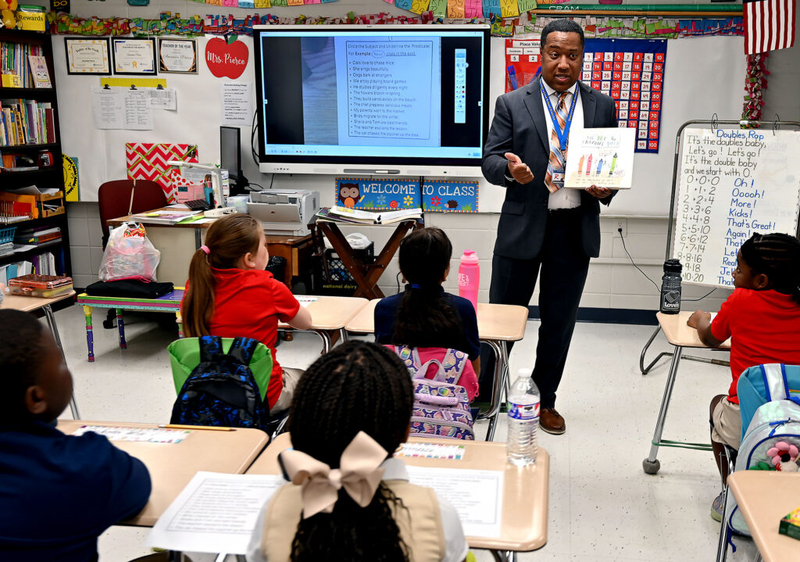
Western Line School District Assistant Superintendent James Johnson chats with second graders about books the class is reading at Riverside Elementary School in Avon, Miss., on Aug. 12, 2026. (Photo by Vickie D. King/Mississippi Today)
The state of Mississippi has long been sick of being the nation’s educational runt. For decades, they’ve scored last among states on the National Assessment of Educational Progress (NAEP) a.k.a., the Nation’s Report Card. Educators in other lagging states consoled themselves with: “At least we’re not Mississippi.”
Until 2019 when the state wowed the nation’s edusphere with improved fourth-grade reading scores while every other state tanked or stalled. However, most NAEP scores proved disappointing that pre-pandemic year so the success could have been a one-off.
Mississippi was and still is the poorest state in the nation. In Rhode Island, the 17th richest state, some educators blame the lackluster performance of our schools on poverty and bad parenting. Poverty is a massive challenge for any state, but after Mississippi’s fourth grade reading scores stayed steady or improved over time, that excuse dissolved.
By the 2010s, Mississippi’s districts had already developed pockets of strong reading results by shifting to science-backed curricula. So in 2013, Commissioner Carey Wright and her team at their Department of Education convinced their legislators to pass America’s first “science of reading” law, the Literacy-based Promotion Act.
The name of the law captures the core of their strategy, which is that any third grader who fails the state’s reading assessment would be retained in grade. But gosh that seemed harsh to me, even believing that the nation’s decade-long retreat from accountability is at the root of the nation’s declining performance. But should we punish 9-year-olds for the system’s failure?
The 2001 No Child Left Behind Act’s version of data-driven accountability initially boosted academic results, but scores soon plateaued while the law’s relentlessly punitive approach poisoned educator culture, leading to cheating scandals and hostility towards any accountability.
Accountability is not synonymous with punishment. It’s information that only might lead to consequences. Disappointing data might hurt, as failing scores do, but facts are just facts to use for good or ill.
As I studied “Mississippi Miracle,” the third grade gatekeeper test started to look like the first time a reform strategy took seriously the educational cliche: From kindergarten to third grade, kids learn to read. After that, they read to learn.
Failing 9-year-olds is upsetting, but secondary-age kids who fail tests command far less compassion, even though educators know most of them never learned to read well enough to absorb grade-level content. Bad science or history instruction won’t cripple a kid’s chances to accumulate knowledge independently the way illiteracy will.
In that light, socially promoting non-readers to the fourth grade began to look like an academic death sentence.
So Mississippi’s law laser-focused on equipping third grade readers fully.
The state provided teachers with professional development and vetted curricula free of the debunked guessing and non-phonics techniques that had been the kudzu of reading instruction for 50 years, leaving kids unable to sound out words for themselves.
Developmentally appropriate screenings are administered three times each year, K-3, to keep a close eye on each child’s progress.
The legislature allocated money for curricula, testing and most importantly, for coaches who could interpret the metrics, troubleshoot and offer solutions. Coaches work directly with teachers, not students, to help them identify struggling kids early, to determine the reasons why, and to shore up teachers’ weak instructional skills when necessary.
Interestingly, Alabama’s early use of a similar strategy put them way ahead of Mississippi until losing funding for their coaches. Coaches are critical. The real Mississippi miracle was that for 15 years, even as leaders themselves changed, the strategy and budget priorities did not.
Towards the end of third grade, kids take the gatekeeper test, but can try again two more times with intensive interventions at each failure. The law delayed the “retention gate” for two years so the changes could take hold.
As early as 2015, 85% of the third-graders passed the test on the first try. Over time, the retention rate started hovering around 6%. Mississippi now has one of the highest retention rates in the country.
“Good cause” exemptions are available for students with certain special needs. But mostly, the kids held back really do need more time and reading instruction.
Here’s a huge kicker: When the Urban Institute disaggregated the 2024 fourth grade NAEP scores by poverty, Mississippi was best in the nation. Ever the leader in high scores, Massachusetts was merely fourth. So, the strategy works well for all kids, but especially for low-income children.
Rhode Island’s per pupil funding is $22,110, 9th highest. Massachusetts is 7th highest at $22,947. Mississippi’s is $12,093, the 5th lowest.
Money does not stand in the way of Rhode Island replicating this strategy so much as the lack of anyone in particular being responsible for academic results. As a right-to-work state, Mississippi’s Department of Education has far more control over their educational landscape than our mishmash of decision-making forces that include a tradition of local control, teachers unions, and powerful politicians. The state does not share a “students first” approach, however much the adults who benefit from the system profess one.
To end on a bright note, in 2019 Rhode Island also passed a good reading law that lit a fire under enough schools to propel the state’s low income children to 15th in the nation, below both Massachusetts and Mississippi, but better than our usual meh performance.
Research contends that fully 95% of all kids can become proficient readers. Permitting illiteracy with social promotion is a choice we make out of misguided compassion when actually, sending a non-reader into a reading-dependent environment is no kindness at all.
Providence, RI