Lawmakers study Indiana’s sexual assault response
Aug 26, 2026 | 5:00 am ET
Description
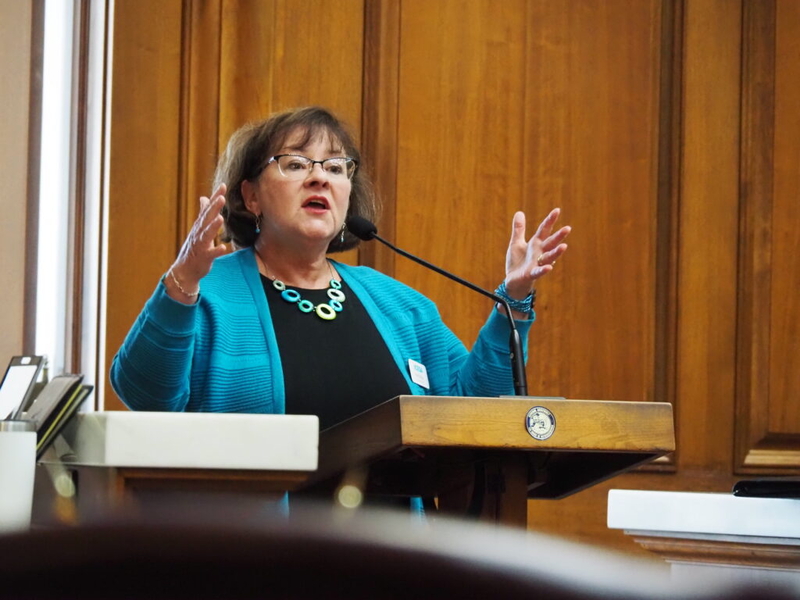
Beth White, president and CEO of the Indiana Coalition to End Sexual Assault, speaks to the Interim Study Committee on Public Health, Behavioral Health and Human Services on Aug. 25, 2026. (Photo by Mackenzi Klemann/Indiana Capital Chronicle)
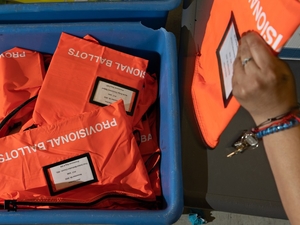
Crime victim advocates say a backlog of untested rape kits, shortage of trauma-informed investigators and forensic nurses and forthcoming cuts to federal funding is hampering Indiana’s sexual assault response.
The Interim Study Committee on Public Health, Behavioral Health and Human Services met in House chambers Tuesday to hear testimony on the topic — the first hearing of the summer as lawmakers prepare for next year’s budget session.
“Survivors deserve a response that is compassionate, coordinated and consistent,” state Rep. Becky Cash, R-Zionsville, said in a statement.
Gaps in response
Cash requested a study of the state’s sexual assault response workforce after her bill to require Indiana State Police to eliminate its backlog of untested rape kits did not advance earlier this year.
There are zero forensic nurses to examine sexual assault victims in 40 of Indiana’s 92 counties — 16 counties have no hospital at all — forcing victims to travel far from home.
Turnaround for the 815 rape kits submitted to Indiana State Police last year averaged 217 days.
“Those are 217 days when a victim is waiting, when a perpetrator is allowed to reoffend, when we have no criminal case moving forward,” Beth White, president of the Indiana Coalition to End Sexual Assault, testified on Tuesday. “That is unacceptable.”
White said Indiana’s network of rape crisis centers and sexual assault service providers does not cover the entire state, a trend likely to be exacerbated by forthcoming cuts to federal Victims of Crime Act grants.
Meanwhile, few investigators outside major cities are trained in trauma-informed interviewing techniques.
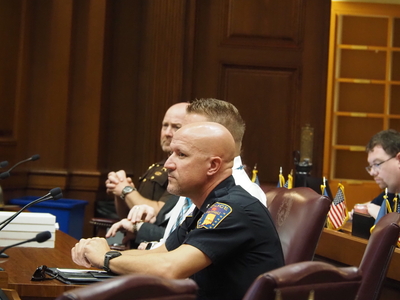
Indiana law requires investigators who regularly investigate sexual assaults to be trained in the neurobiology of trauma, available through the Indiana Law Enforcement Academy and elsewhere.
Still, Plainfield Police Chief Kyle Prewitt said 337 of Indiana’s 664 law enforcement agencies employ 10 or fewer officers, leaving patrol officers to conduct sensitive investigations for which they have little to no training.
“A patrol officer is used to showing up, asking very blunt questions of victims, and not taking a trauma-informed approach with them,” he said.
Rape survivor Samantha McCoy recounted a “confusing” and “dehumanizing” experience — describing her assault to a rotation of officers, submitting to an invasive rape examination in which photographs were taken without explanation, followed by a 30-minute drive to the crime scene and more questioning.
McCoy told the committee she did not receive mental health services nor a victim advocate.
“After months of doing everything that I was asked, it became clear that I was never going to receive criminal justice for what happened to me,” she said.
Still, McCoy said her case likely would have resulted in an arrest had officers been properly trained beforehand — calling on lawmakers to impose consequences for agencies that do not comply with state-mandated training standards.
“At the very least, I would have been treated with dignity throughout the process,” she said.
Calls for funding
Advocates asked for increased state funding to offset the 40% cut in federal VOCA grants to Indiana expected in October.
The cuts will be particularly detrimental to child advocacy centers, which conduct child abuse investigations. The centers traditionally rely on VOCA grants and private fundraising, but are asking for state funding for the first time this year.
White, from the Indiana Coalition to End Sexual Assault, asked the committee to increase Indiana’s Sexual Assault Victim Assistance Fund from $8 million to $12 million over the biennium to improve access to rape crisis centers.
White called for the creation of a state fund to reimburse hospitals for sexual assault nurse examiner training expenses.
And she is pushing for increased capacity at Indiana State Police labs to alleviate the rape kit backlog.
“We spend millions of dollars in this state for police and prosecutors,” White said. “… What I’m asking you today is to think about how much are we spending to help victims put their lives back together after something so terrible.”
Indianapolis, IN