Some states raise pay for home caregivers as shortage looms
Aug 26, 2026 | 5:00 am ET
Description
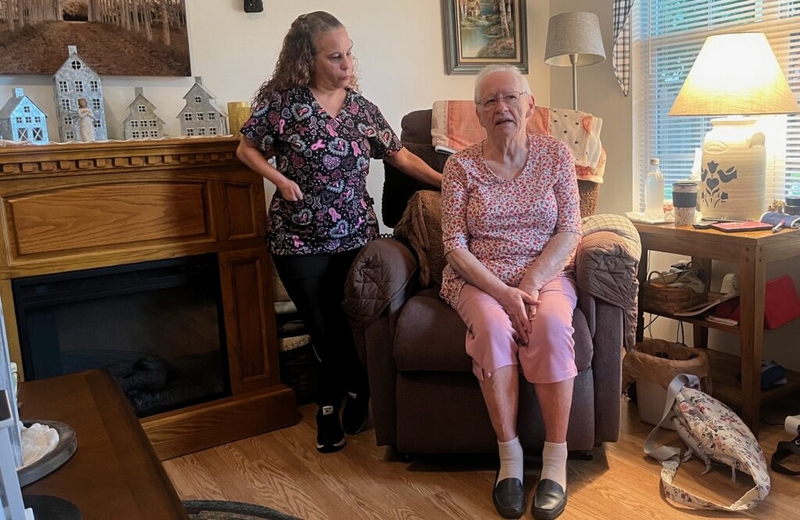
Helen Aponte, left, is a home care aide for Donna Logan, 81, of Wilmington, Ohio. Aponte spends Monday mornings helping Logan with daily household chores or a trip to the doctor’s office. Ohio and other states have lifted caregiver pay to address a shortage of workers. (Photo by Anne Saker for Stateline)
WILMINGTON, Ohio — From her recliner in her tidy townhouse, Donna Logan offers advice to the first baby boomers to hit the big ‘8-0’ this year: Life can be good, especially with someone like Helen Aponte helping with laundry and housekeeping and the drive to the doctor’s office.
“I do most things on my own,” said Logan, 81, a native of Wilmington, Ohio. “But having Helen come in once a week gives me confidence.”
“I drive her, whatever she needs,” said Aponte, 52. “It makes me happy to help Donna stay in her home.”
Logan and Aponte found each other about a year ago through the Council on Aging in Southwest Ohio in rural Clinton County, about 40 miles northeast of Cincinnati. For three hours on Mondays, Aponte works directly for Logan as a home care aide for $15 an hour, paid by a county property tax for senior services.
Aponte helps Logan with the tasks of daily living, not with medical care. For a senior, that support can mean the difference between aging at home or in an institution charging thousands of dollars a day.
Many seniors who are relatively healthy but need some assistance could see that relationship as an ideal arrangement. But it won’t be possible for many baby boomers, the 65 million Americans who were born between 1946 and 1964.
This year, four million Americans in that generation, including Cher, Sylvester Stallone and President Donald Trump, turned 80. Every day for at least the next decade, another 10,000 will join them. By 2030, Americans over 65 will outnumber those under 18.
For decades, experts have warned that the country was not prepared for this demographic wave.
In 2002, a National Institutes of Health forecast urged states, among other things, to revamp policies to prioritize home caregiving over nursing homes. The study warned that it was “becoming increasingly difficult for home care agencies and other providers to find and retain qualified caregivers,” and that the problem would only get worse as the U.S population aged.
A big factor then was the poor pay for home care workers. The future has arrived, and little has changed.
Despite the importance of their work, home caregivers are near the bottom of the nation’s pay scale: In 2024, the national median pay for home care aides was $16.78 an hour, or $34,900 per year, according to the U.S. Bureau of Labor Statistics.
The low pay and the difficulty of the work have created a labor shortage, worsened by the COVID-19 pandemic and the Trump administration’s immigration crackdown. There are 4.3 million home care aides today, but the federal government forecasts that by 2034, the nation will need more than 5 million of them.
As federal protections fade, disabled Americans fear a return to institutions
Some states that cover nonmedical home care through Medicaid, the joint state-federal healthcare program for people with low incomes, have marginally increased workers’ wages. But those small gains could be wiped out in 2027, when billions of dollars in Medicaid cuts go into effect as part of the broad tax and spending measure that President Donald Trump signed last year.
The spending cuts in that law will put pressure on cash-strapped states to cut home- and community-based services, since the federal Medicaid law only requires them to provide institutional care.
The challenge in Ohio
The structural challenges of a larger older population fall mostly to the states, and Ohio is a bellwether. The population has been aging faster since the 1990s collapse of the state’s industrial base, “so I understood the challenge when I came into office,” said Ursel McElroy.
In 2019, McElroy, a state government veteran on aging policy, became director of the Ohio Department of Aging under Republican Gov. Mike DeWine. In an interview, McElroy defined the challenge, then and now.
“Our health care is a triumph of human ingenuity, but while we’re living longer, we’re spending more years in less than good health,” he said. “That’s the problem we want to solve for. How do we keep pace with the realities of aging?”
One reality is that many seniors, such as Donna Logan, cannot afford to hire an aide on their own, but they are not eligible for Medicaid coverage. Instead, they turn to the nation’s more than 600 area agencies on aging, a network established in the 1965 Older Americans Act.
The Council on Aging of Southwestern Ohio manages senior-services levies in four counties including Clinton, said spokesperson Paula Smith. From that money, the county’s Elderly Services Program can pay home care aides, who can be hired through an employment service or directly.
In 2021, the Biden administration proposed putting $400 billion into Medicaid’s home-based and community programs to support home care workers and improve their pay as they kept older Americans out of nursing homes where COVID-19 was rampant and deadly. The proposal did not pass. The shortage of home care aides worsened.
In the past two years, some states have raised the pay of those workers in their Medicaid programs, often to bring them closer to the state’s minimum wage.
In California, for example, the basic wage for home care workers rose this year to $16.90 an hour, which is the statewide minimum wage. Each of the state’s 58 counties then adds a location adjustment. The Los Angeles County wage went up more than $1 to $19.64 this year.
In New York, the hourly wage for home care aides rose by 55 cents, to $19.65 in New York City, Long Island and Westchester County and to $18.65 in the rest of the state. Other states that have recently adjusted home care aide wages include Illinois, up a dollar to $18.75 and Texas, from $10.60 to $13.
Medicaid cuts could hurt older adults who rely on home care, nursing homes
Ohio, where the minimum wage is $11, also raised its pay in 2025 to an average of $16 an hour because, McElroy said, the Department of Aging and advocates across the state “have come together more so than I’ve seen in years past.”
The nonprofit Councils on Aging across Ohio held roundtable discussions for legislators on the critical shortage of home care aides, and the importance of their work. Raises for the Medicaid-paid workforce of home care aides, advocates said, would help bring up wages for everyone doing that work. A social media campaign pushed for pay raises, and ultimately, the legislature approved them.
Smith, the spokesperson for the Council on Aging of Southwestern Ohio, said more people are applying to become home care aides. While Smith said no one is quite sure why, the pay raises likely helped.
‘I am doing just fine here’
Donna Logan says baby boomers shouldn’t worry about turning 80. “They’re in a lot better shape, I think, than our parents,” she said one rainy summer morning in her Wilmington townhouse. “I know a lot of them want to stay at home, like me. I tell them, ‘Get Helen.’”
The handicapped tag on the rearview mirror of Aponte’s sedan allows her to ferry Logan to the grocery store or the doctor’s office. She helps Logan with housekeeping. Every week, Aponte shows Logan how to sign on to the computer to sign her time card for $15 an hour. “I’m getting the hang of it,” Logan said with a laugh.
She turned down her son’s offer to live with his family. With Aponte, “I am doing just fine here.”
Logan isn’t the only one. Aponte has 14 other clients, and they love her so much that in May, Aponte received a Council on Aging award as a home aide hero.
“I love doing this so much,” Aponte said. As a teenager, she took care of her grandmother and discovered a calling. She said her work now gives her flexibility to care for a disabled son.
In her years as a home care aide, Aponte has found one thing in common among seniors, no matter the generation.
“They have a lot of stories,” she said, “and they just want someone to listen to them.”