Voters reject State Question 844 affecting payments to local governments
Aug 25, 2026 | 9:31 pm ET

Description
A voter marks his ballot at a polling place in the Millwood High School Field House on June 16 in Oklahoma City. (Photo by Courtney Bell/Oklahoma Voice)
OKLAHOMA CITY — Voters struck down a state question that proposed changes to local government entities’ reimbursements for a manufacturing tax incentive.
State Question 844 resoundingly failed in a statewide vote Tuesday.
It would have given the state Legislature the authority to recalculate how much to reimburse local governments and school districts for property tax revenue that new manufacturers are exempt from paying.
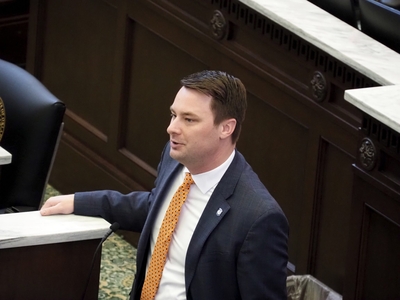
“Thanks to 844 being on the ballot, voters are immensely more educated on an expensive program in our Constitution that is also very complicated,” said House Speaker Kyle Hilbert, R-Bristow.
The tax incentive program, which voters enshrined in the state Constitution in 1985, exempts new manufacturing facilities from paying property taxes for five years. The state reimburses county governments, schools and other local entities for the lost tax revenue.
For years, a state fund dedicated to paying for these reimbursements has fallen short of their total cost. The Legislature had to add a $64.8 million supplemental appropriation in the 2025 fiscal year to cover repayments to schools alone.
State lawmakers put SQ 844 on Tuesday’s ballot, arguing the price for these reimbursements has gotten too high and disproportionately benefits a few counties.
The state question asked voters to approve a constitutional amendment to give the Legislature the flexibility to pay local entities less than 100% of the exempted property tax income.
District leaders have said these reimbursements provide transformative funding for their schools. They claimed that reducing the repayments could have negative implications not only for their districts but for public schools statewide.
Opponents of the state question, Hilbert said, urged lawmakers to “look at qualifications on the front end” of the tax incentive program, not reimbursements to counties after companies qualify.
“Certain industries, like future solar farms, should not qualify for this program but that disqualification should not come at the expense of the local school districts,” he said.
Reporter Emma Murphy contributed to this report.
Oklahoma City, OK