Wave of anti-money laundering sanctions has Strip’s attention, says Venetian’s attorney
Aug 25, 2026 | 7:00 am ET
Description
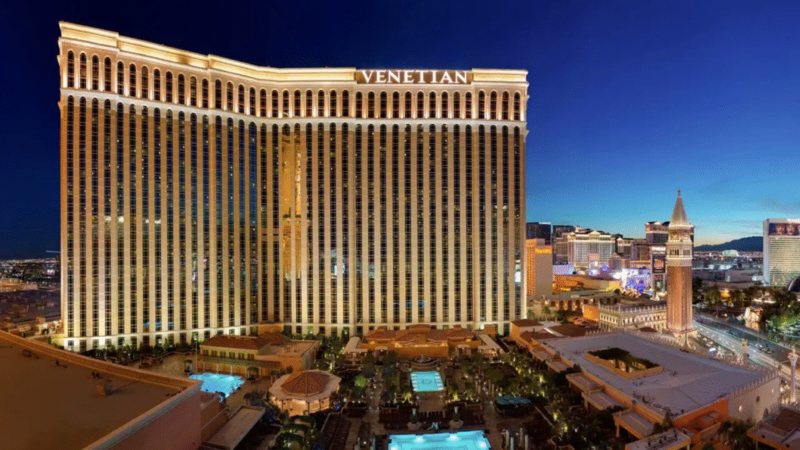
Two of the five members of the Nevada Gaming Commission recused themselves from tate's the settlement with the Venetian. (Venetian press photo)
A spate of multi-million dollar sanctions levied against Las Vegas casino companies in the last year and a half has spurred a “sea change” on the Strip, former Nevada U.S. Attorney Greg Brower, who represents the Venetian, told the Nevada Gaming Commission Thursday, as they voted to approve a $7.2 million settlement with the resort.
The Venetian is the latest Strip casino to acknowledge it allowed high-limit play by gamblers who had no verifiable source of income to support their action.
The Current was first to report in 2023 that the Criminal Division of the Internal Revenue Service in California was investigating Las Vegas casinos for anti-money laundering violations.
Since then, MGM Grand and the Cosmopolitan, Resorts World, Caesars Palace, and now, the Venetian, have paid a total of $34 million to settle complaints with the state for allowing illegal bookmakers Wayne Nix, Mathew Bowyer, Damien LeForbes, and others to gamble without ascertaining, or ignoring, the source of their income.
Deputy Attorney General Michael Somps told the commission the $7.2 million fine agreed to by the Venetian represents twice the amount Bowyer lost there from 2019 through 2023.
He asserted that Apollo Global Management, upon purchasing the Venetian in 2022, “overhauled” the compliance program “without prompting from the board,” adding it’s “proven over the course of the last several years to be quite effective.”
He also noted the fine was lower than those agreed to by other resorts because “this is limited to Mr. Bowyer. The complaint does not make any allegations that there were any other illegal bookmakers who were active at the Venetian.”
The AG’s office and the GCB declined to say after the meeting whether the regulators intend to bring a separate complaint against the Venetian for allowing LeForbes to gamble.
Venetian CEO and President Patrick Nichols, who joined the Venetian in 2022 after Apollo Global Management bought it from Las Vegas Sands, reminded the commission he “wasn’t at the Venetian when the majority of this happened.”
Bowyer, reached last week by the Current, asserted Strip executives “all blame each other, but they all knew what I did” for income.
Nichols was general manager and chief strategy officer of the Cosmopolitan when it allowed illegal bookmaker Wayne Nix to gamble. During Nichols’ tenure, the Cosmopolitan also counted LeForbes and Bowyer among its clients.
Gaming regulators made no mention that under Nichols’ watch, LeForbes lost $1.4 million at the Venetian in late 2023, as the Current reported in 2024.
LeForbes’ host at the Venetian was Jeremiah Chambers, who was fired in 2023 from the Cosmopolitan, where Chambers also catered to Nix.
The Venetian, during Nichols’ tenure, hired Chambers, where he worked until the end of 2023, according to sources who asked not to be identified in order to share information.
Nichols has not responded to inquiries dating back to 2024 about the Venetian’s hiring of Chambers.
‘Bad for Nevada’
Commissioner George Markantonis, who served as president and CEO of the Venetian and Palazzo from 2015 until shortly after Apollo’s purchase – while Bowyer was a customer – recused himself from the proceedings.
Commissioner Richard Schonfeld also recused, noting he “represented an individual in a related investigation that has some overlap with the investigation that forms the basis for this discipline item.”
Schonfeld’s law partner, David Chesnoff, represents LeForbes in at least one case involving an unpaid marker at Resorts World that was turned over to the district attorney.
Of the three commissioners who approved the settlement – Chair and former Clark County Judge Jennifer Togliatti, former Nevada Supreme Court Justice Abbi Silver, and former Lt. Gov. Brian Krolicki – Krolicki voiced the bulk of the board’s frustration at the seemingly endless procession of licensees paraded in front of the commission for failing to abide by the Bank Secrecy Act, the federal law that requires casinos to know the source of their customers’ gambling funds.
“This just infuriates me. It embarrasses me. It’s bad for Nevada. It’s certainly not a good thing for our gaming industry,” Krolicki said, adding “I never, ever, ever want to see this again because you know, if there’s a phase two of these conversations, I think you’ll get a very different reaction from me as a commissioner.”
Brower, who served as Nevada’s U.S. Attorney from 2008 to 2009, stated that “whatever message has been intended by the regulators on this issue, I think it’s been received loud and clear.” He added he’d be surprised to see a repeat episode in Nevada.
“The rash of complaints against Strip properties should be humiliating,” says former California Gambling Control Commissioner Richard Schuetz, who contends “the feds and the press had more to do with uncovering these complaints than the properties or the Nevada Gaming Control Board. That is an unequivocal failure.”
Schuetz suggests the involvement of casino compliance personnel “with the casino floor is usually limited to walking across it to get to a restaurant. Maybe they should hire some people who understand how a casino really works.”
Brower’s assertion that the message from regulators has been received is “ludicrous,” says high-stakes gambler R.J. Cipriani, a law enforcement source who provided a roadmap directing federal authorities to a trove of misdeeds on the Las Vegas Strip in 2023. “It hasn’t changed and never will, because the idea is to get people with disposable cash to the tables, and unfortunately, it’s usually people with illegal businesses.”
Casinos, Cipriani adds, “are just going to be more careful so they don’t get caught.”
Las Vegas, NV