1 month after Lindsey Graham’s death, voters go to the polls to choose his replacement
Aug 11, 2026 | 8:30 am ET
Description
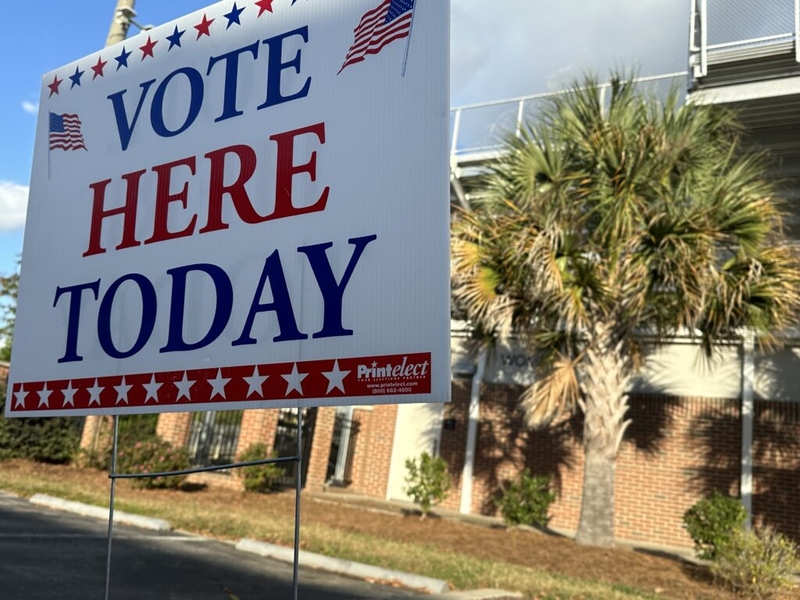
Polls in South Carolina's special GOP primary for the U.S. Senate are open from 7 a.m. to 7 p.m. Tuesday, Aug. 11, 2026. (File photo by Jessica Holdman/SC Daily Gazette)
COLUMBIA — Voters will choose Tuesday between 10 U.S. Senate candidates competing in a special GOP primary to replace the late Lindsey Graham on the ballot in November.
The tight timeline dictated by state law means the contest is being held exactly one month after Graham’s unexpected death at age 71.
Officially, the crowded field is competing for the chance to win the next six-year term. But in South Carolina, voters have a history of re-electing their senators as long as they want to stay. And in a state that hasn’t elected a Democrat to the job in 28 years, the Republican primary is typically the main event.
Graham’s win in June marked the third time he bested a crowded field of competitors to win the GOP primary outright. But none of the candidates seeking to replace him is expected to cross the 50% threshold needed to avoid a runoff. The top two vote-getters will face off Aug. 25. Calling a runoff “highly likely,” the state GOP scheduled a debate next week between whoever advances.
It’s not at all clear who those two will be. In many polls leading up to the contest, “undecided” remained the winner.
Graham’s younger sister, Darline Graham, who was appointed to fulfill her brother’s term that ends in January, jumped into the open contest with the encouragement of President Donald Trump. In a rally by telephone Monday night, Trump repeated his “complete and total endorsement” and urged people who called in to “go vote for Sen. Darline Graham.” She’s already been a “fantastic help,” he said, pointing to her votes enabling Todd Blanche to be sworn in Monday as U.S. attorney general.
Thanking the president, she called his endorsement “the gold standard in Republican politics.” She also has the support of her brother’s long-time staff, who now work for her.
But Trump’s surprise endorsement of a family member without a political record rankled many of the GOP faithful.
U.S. Rep. Russell Fry, who represents the 7th District, was widely expected to again get Trump’s backing. Fry, a former state legislator, first won the congressional seat anchored by the Grand Strand in 2022 with Trump’s endorsement. Trump’s decision to go with someone else didn’t stop him from jumping into the race. And he still campaigns as a Trump-supported candidate.
Some Republicans have criticized Fry’s decision to run for Senate while also seeking re-election to the U.S. House, potentially leaving the 7th District seat vacant for months during another special election. But Fry, who is endorsed by dozens of former colleagues in the Legislature, contends the ruby red seat will remain in GOP control.
Fry’s critics include U.S. Rep. Ralph Norman, who’s running for U.S. Senate after losing his bid for governor in June. So, he’s not already on November ballots.
His endorsers include U.S. Rep. Nancy Mace, legislators in the state Freedom Caucus that he helped launch, and former U.S. Sen. Jim DeMint, who in December 2012 announced his resignation in order to lead The Heritage Foundation, a conservative think tank.
Is the primary job of SC’s US senator to support Trump? Here’s how 5 candidates answered.
Like Fry, Norman is a former legislator. The Rock Hill developer first won the 5th District seat in a special election in 2017 after Mick Mulvaney resigned to join the first Trump administration.
Former Gov. Mark Sanford, also a former congressman, is running on his familiar message of bringing down bloated spending in Washington and reducing the national deficit he contends will ultimately lead to America’s demise.
On that front and the war in Iran, he’s willing to publicly oppose Trump, he noted on the debate stage. He’s done it before. He was a Trump critic toward the end of his last stint as the 1st District congressman and briefly entered the presidential race in 2019 to challenge Trump’s re-election.
While the notoriously frugal former governor has been preaching against deficit spending for decades, it matters more than ever now, he says, with the deficit quickly approaching $40 trillion and climbing. To make his point, he again brought pigs to the Statehouse last week, recreating a stunt 22 years earlier to protest the state budget.
Others in the field include Upstate businessman Mark Lynch, owner of Jeff Lynch Appliance Center in Greenville, which he says he’s grown from a 3,200-square-foot store in 1985 with five employees when he took over the family business to more than 130,000 square feet of retail space employing 110 people.
Like Darline Graham, Lynch embraces not being a politician.
Lynch, who placed a distant second to Lindsey Graham in the June primary, has turned an attack line into a positive.
Acknowledging he was a drug addict in the late ’70s and early ’80s, he talks about how he turned his life around with God’s grace and helps others do the same. He received a state pardon in 1990 for his convictions on drug and driving under the influence charges, according to the state’s pardon and parole board. He’s spending millions of his own money this year — which shows “skin in the game and commitment” — in a quest to turn the nation back to God.
“I’ll bring back biblical principles,” he told the SC Daily Gazette.
Other candidates who didn’t meet polling criteria to get into last week’s debates are Duke Buckner, a Walterboro attorney; Mark McBride, mayor of Myrtle Beach from 1998 through 2005; Glenda Gail Parker, a retired Air Force reservist and Department of Defense budget analyst; and Sam Shepherd, a biomedical engineer and entrepreneur.
Danny Ford II, son of Clemson’s first national football championship, is on the ballot by court order, after the state GOP disqualified him for not meeting a new party rule requiring candidates to vote in two of the last three statewide GOP primaries. It’s Ford’s second run for office after losing his bid for state agriculture commissioner in June.
Shepherd is the only first-time candidate of the field.
Parker, who moved to Myrtle Beach two years ago, has run for office multiple times in the last 20 years, just not in South Carolina. Her unsuccessful races in Virginia include campaigns for U.S. Senate in 2006 and 2008.
The only great-grandmother in the race, Parker also stands out as a self-proclaimed “conservative independent who leans Republican.” Like Sanford, she decries the national debt as unsustainable. But her solution is different, particularly for a GOP primary: Reducing the demand on fossil fuels, she says, will “make almost everything more affordable.” Her platform involves using high-speed rail and light rail to provide transportation, reduce congestion, and aid tourism in the state — particularly the Grand Strand.
The winner of the GOP contest will face Democrat Annie Andrews in November.
This is the first open contest to represent South Carolina in the U.S. Senate in 22 years.
The last Democrat to represent South Carolina in the U.S. Senate was the late Fritz Hollings, who decided not to seek re-election in 2004. He first won the job in 1966 when nearly all of the state’s politicians were Democrats. And unlike his colleagues, he never switched.
Lindsey Graham replaced U.S. Sen. Strom Thurmond when he decided not to seek re-election in 2002.
Thurmond, whose switch to the Republican Party in 1964 paved the way for others, continues to be the only senator ever to reach age 100 in office. His 47½ years in the U.S. Senate ranks fourth-longest in history. Hollings’ 38 years ranks 13th. Both Thurmond and Hollings were Democratic governors before voters sent them to the Senate.
Columbia