Homeland Security boss visits Omaha, talks tough on immigration, touts disaster response strides
Sep 14, 2026 | 8:49 pm ET

Description
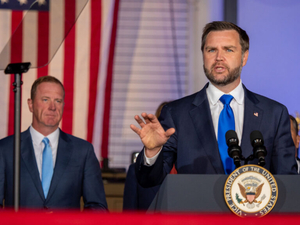
U.S. Homeland Security Secretary Markwayne Mullin is flanked by Republican U.S. Sen. Pete Ricketts on the left and the parents of Sarah Root, Michelle and Scott, on the right. Their daughter Sarah was killed in a 2016 car crash involving an undocumented migrant. Mullin was in Omaha Monday for two unrelated events. The other was to discuss his department's progress on streamlining federal disaster aid to communities. (Photo by Cindy Gonzalez/Nebraska Examiner)(Photo by Cindy Gonzalez/Nebraska Examiner)
OMAHA — The head of U.S. Homeland Security was in Omaha Monday nurturing partnerships he said helped send roughly $120 million in federal disaster aid to Nebraska since 2025, and to seek feedback on cutting costly “red tape” in the reimbursement process.
At another stop in the state’s most populous city, Homeland Security Secretary Markwayne Mullin switched to tough-talking about illegal immigration. He hosted a press conference with the family of Sarah Root, the 21-year-old killed a decade ago in an Omaha crash with an undocumented migrant who fled the country but was found and sentenced in February to up to 22 years in prison.
“I will hunt you down. Our agents will hunt you down and we’re going to send you back,” Mullin said during the livestreamed gathering where he and others laid out Root’s story and a 2025 law that Congress subsequently adopted.
ICE pacts rise in Nebraska
Mullin was accompanied on both Omaha stops by Republican U.S. Sen. Pete Ricketts, who is in a high-intensity battle with nonpartisan Dan Osborn, who is seeking to unseat Ricketts.

During the Root event, held in the federal building where immigration court cases are heard, Mullin told reporters that people often complain about the tactics of U.S. Immigration and Customs Enforcement officers. He dismissed such concerns and lauded the 2025 law and the work of officers involved in bringing “justice” to the Root family.
“Every single death at an illegal’s hands is 100% preventable,” said Mullin, who previously represented Oklahoma in the U.S. House and Senate.
Sworn into his current role in March, Mullin also commended Nebraska for increased enrollment in a 287(g) program in which local law enforcement agencies contract with Homeland Security to carry out certain ICE functions. Local agencies that participate receive training and reimbursement by the feds. Mullin said the pacts lead to more arrests and deportations of migrants in the country illegally.
Seven Nebraska agencies launched 287(g) pacts this year, according to the Homeland Security website. They formed after a Nebraska lawmaker this past February unsuccessfully sought new local requirements for 287(g) agreements that drew opposition from Gov. Jim Pillen’s administration. At that time, a handful of agencies had a partnership with ICE.
The Nebraska State Patrol is among participants, having started its pact in August 2025 with six troopers trained for the program. The number of troopers on the task force has grown to 16, a patrol spokesman told the Nebraska Examiner last month.
Asked by a reporter about community concerns that such ICE partnerships lead to more intense scrutiny and traffic stops of brown-skinned people, Mullin was quick to react.
“It’s a lie,” he said before noting that he is Cherokee. “There’s nothing racist about enforcing the nation’s laws.”
Sarah’s Law
Michelle and Scott Root, Sarah’s parents, told reporters that earlier in the day they met three federal agents who helped capture Eswin Mejia, who investigators said was speeding and had a blood alcohol content three times over the legal limit when his vehicle struck Sarah Root’s car from behind.
The Roots have met multiple times with President Donald Trump and have attended various White House and congressional events tied to immigration policy as the circumstances of their daughter’s death have been highlighted nationally.

Of the timing of Monday’s meeting, Mullin said, “We’re not forgetting about these families … We’re making sure people hear it. They need to hear the story about what’s taking place. They need to hear that narrative.”
Michelle Root said Mejia’s sentencing a decade later does not bring back her daughter but “does close that chapter and it lifts a weight off of our shoulders because we fought long and hard to make this a reality, to get justice for Sarah.”
Though Mejia initially was arrested after the crash, he was released the following month on a $5,000 bond and fled the country. In March 2025, Homeland Security agents tracked him down and said it marked the first time Honduras had extradited someone to the U.S. for homicide.
“Sarah’s Law” was added as an amendment to the Laken Riley Act, the first piece of legislation that President Donald Trump signed into law during his second term. The act mandates federal detention of undocumented immigrants arrested for crimes including burglary, theft and any that result in the death or serious bodily injury of another person.
Opinions of the Laken Riley Act vary across policy and advocacy groups. The National Immigration Law Center has argued that the law exploits a personal tragedy to scapegoat immigrants while weakening constitutional protections without proven benefit to public safety. The American Immigration Lawyers Association emphasizes due process concerns.
Proponents view the law as necessary for accountability and public safety.
Roundtable on disaster relief
Earlier Monday, at his first Omaha appearance, Mullin joined a roundtable discussion at the Omaha Fire Department that included Ricketts, Fire Chief Kathy Bossman, representatives of the Federal Emergency Management Agency and local emergency management administrators.
Both ICE and FEMA, which coordinates the federal government’s response to natural and man-made disasters, are under the auspices of Homeland Security.
Mullen said he has held such sessions across the country to strengthen partnerships and hear suggestions that can improve the flow and efficiency of federal emergency disaster recovery dollars. He said his agency is seeking to cut unnecessary and expensive bureaucracy.
“If we can get that dollar to the local governments, allow them to spend it, allow them to contract it, it’ll go farther and be more efficient.”

Too often, Mullin said, disagreements erupt between agencies despite having a common goal. He said the Trump administration’s goal is to change old ways, which he described as the federal government coming in to “tell everybody how to do it our way.”
“We’re trying to change that focus and saying we’re going to give you the ability to do it your way. You know your town. You know where the hot spots are …,” Mullin said.
He expects better response if agencies are confident “knowing that the money is going to come in.” And he encouraged the panel and local and state officials to provide feedback.
“We can’t fix it if we don’t know about it. And don’t think you’re going to get punished or get your hands slapped for doing it,” said Mullin.
Bossman said fire officials, in responding to emergencies, establish procedures and coordinate with outside agencies so that the most effective equipment is on site.
“We can feel confident that we can go ahead and perform at our highest level using the equipment that is most appropriate for the rescue or response knowing we can trust our state and federal partners to support us,” she said.
Mullin touted his personal and professional relationship with Ricketts, and encouraged local officials to turn to such elected officials as they seek federal emergency recovery aid.
“Relationships matter,” he said.
Lincoln, NE