Court pauses Pentagon blacklist for Middletown pharma plant co.
Aug 11, 2026 | 6:00 am ET
Description
Photo courtesy of Spotlight Delaware
Why Should Delaware Care?
The WuXi STA Pharma campus in Middletown has been hailed as a major economic development win for Delaware and it was backed by the largest taxpayer-backed grant of the Carney administration. Now concerns from the Pentagon over its alleged ties to the Chinese government could essentially prevent it from doing business with American companies in many scenarios.
Less than two months after being named to a Pentagon blacklist over alleged ties to the Chinese government, the company behind a major Middletown pharmaceutical manufacturing plant has won a reprieve in a federal court.
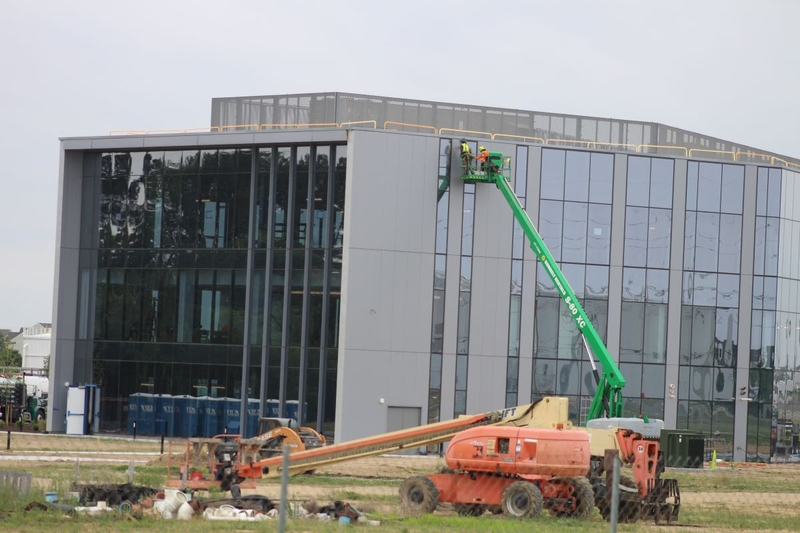
WuXi AppTec, the Shanghai-based parent company of WuXi STA Pharmaceuticals, which is nearing completion on a $600 million campus in Middletown, was granted a preliminary injunction Friday by the U.S. District Court for the District of Columbia.
The order pauses enforcement of WuXi AppTec’s inclusion on the so-called 1260H list, or a list of companies the U.S. Department of Defense designates as “Chinese military companies.” A 1260H designation can carry significant reputational and financial harm, particularly for biopharmaceutical companies, because named companies cannot contract with many federal agencies and their customers cannot use government funds on associated projects.
Chief Judge James Boasberg noted as much in the first line of his 35-page ruling, writing, “A scarlet letter sends a clear message: keep away.”
Boasberg, an Obama era appointee, spends much of his ruling recounting the errors made by the Department of Defense in its review of WuXi AppTec’s designation, calling it “arbitrary and capricious.”
In a statement, WuXi AppTec heralded the judge’s decision.
“We believe that the facts, as demonstrated in our court filings, will prevail after an objective and fair judicial review. In the meantime, our operations remain fully functional, and we remain focused on our commitment to serving our customers and the patients relying on the lifesaving and life-improving medicines they make,”a company spokesman wrote.
The company – one of the largest global contract pharmaceutical manufacturers – has eyed the Middletown facility as part of its major expansion into the United States. It remains on track to open later this year.
What happened?
After nearly two years of review and debate, the Trump administration added WuXi AppTec to the 1260H list in June.
For weeks, the public had little insight into the evidence that the Pentagon used to justify such a designation, but officials released their review as part of the court filings.
Officials made three assertions: that WuXi AppTec had received an investment from a fund linked to the Chinese government, that the company had partnered on medical research with universities affiliated with the Chinese government, and that it had partnered on a medical study with the Chinese military.
But Boasberg dismissed those claims, in part on sloppy math and elsewhere on a misrepresentation of the relationships in play.
The Pentagon asserted that a Chinese government-affiliated fund owned more than 5% of WuXi AppTec’s stock, which is publicly traded in Hong Kong and Shanghai.
But in reality, the fund reported that 5% of its portfolio holdings were of WuXi AppTec.
That translated to holding roughly $200,000 in publicly available stock, rather than a roughly $850 million investment that the Pentagon asserted.
“That is a surprising mistake. If a household puts 5% of its modest savings into a bluechip stock, that does not mean it owns 5% of the company,” the judge wrote.
On the latter two assertions, Boasberg details that WuXi AppTec was simply a third-party contractor that processed lab tests. It never applied for project approval or funding from the Chinese government to do the work, and the government-affiliated hospitals were simply the sites selected to run drug trials.
In fact, Western pharmaceutical companies like Novo Nordisk and American colleges, like the University of Michigan, were the primary applicants on some of the questioned studies.
“If [WuXi AppTec’s] more remote role suffices to establish a close association with [the Chinese State Administration of Science, Technology and Industry for National Defense], the report’s logic would make a member of the Big Ten a Chinese military company,” Boasberg wrote.
Harm has already begun
According to court filings, within days of the 1260H designation, WuXi AppTec began fielding a wave of concerned customers.
“Those were not idle inquiries. Customers across the company’s business lines began pausing, curtailing, and reassessing their engagement,” the company wrote.
Some customers said they would “award the company no new projects for the foreseeable future,” while others said they would take a “wait and see” approach while pausing all collaborations.
“In two further instances, customers terminated or redirected ongoing programs, each citing the need to preserve or obtain government funding that the Company’s 1260H designation could place at risk,” the company wrote.
Furthermore, WuXi AppTec disclosed that its vendors were beginning to pause or reassess their supply chains. One vendor even required that WuXi AppTec “certify that its products would not be used in any military project,” before they would ship components to the company’s factories.
Just the “naming and shaming” of WuXi AppTec had dealt significant blows with its customers and vendors. A lasting 1260H designation could be particularly damaging for WuXi, which saw two-thirds of global revenue come from America last year.
The timing of the designation comes after a banner first half of 2026, which saw the company double analysts’ projections for revenue. It is now on track to become the largest contract development and manufacturing organization in the world.
Middletown project proceeds
Over the last four years, WuXi has been building a 1.74 million-square-foot campus in southwest Middletown, where it plans to employ nearly 500 people.
The state’s economic development team worked for years to land the project at a 190-acre parcel in the fast-growing town. After all, the company is a heavyweight in its field, working on blockbuster drugs like AstraZeneca’s diabetes drug Farxiga or Pfizer’s COVID drug Paxlovid.
To lure WuXi to the First State, officials approved $19 million in taxpayer-backed grants for the project. It was the largest grant approval made during former Gov. John Carney’s term, totaling nearly four times that given to Amazon for its massive Boxwood Road fulfillment center.
Earlier this summer, WuXi hosted an open house at the Middletown facility for industry executives, according to a social media post. The company has been hiring for months to launch its drug research facility this winter for clinical and commercial drugs.
Following the initial building, the Middletown site is expected to continue growing next year, adding sterile manufacturing space for vials, cartridges and pre-filled syringes.

Dover