Plaintiffs call for Alabama Supreme Court to reverse Tuberville residency case dismissal
Aug 11, 2026 | 6:01 am ET
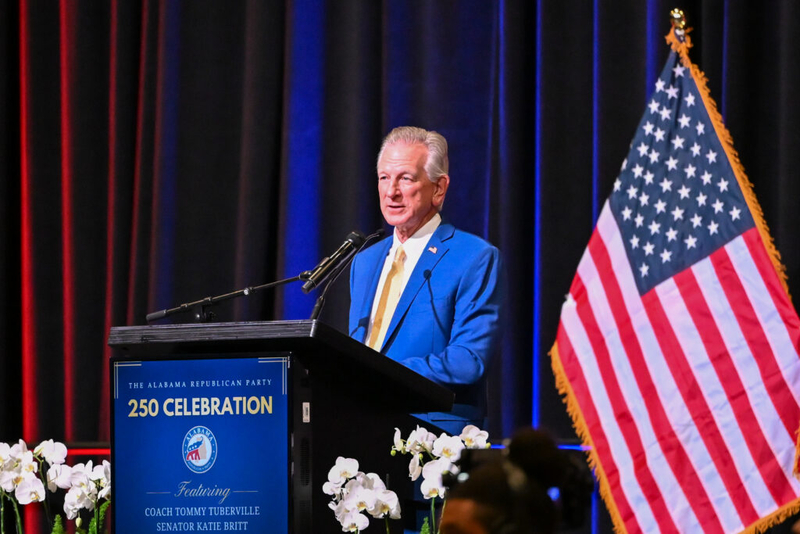
Description
U.S. Sen. and Republican gubernatorial nominee Tommy Tuberville speaking at the Alabama Republican Party's Summer Dinner on July 31, 2026, at the Renaissance Hotel in Montgomery, Alabama. Plaintiffs who argue Tuberville is ineligible for the governor's office asked the Alabama Supreme Court on Monday to reverse a lower court's dismissal of the case. (Photo by Anna Barrett/Alabama Reflector)
Plaintiffs challenging Republican gubernatorial nominee Tommy Tuberville’s candidacy on Monday argued that a lower court erred in dismissing the case.
The 45-page brief filed late Monday morning in the Alabama Supreme Court by Barry Ragsdale, one of the plaintiffs’ attorneys, argued that Alabama’s judicial branch has sole jurisdiction to decide if Tuberville meets the state constitution’s residency requirements to run for governor.
“Contrary to Sen. Tuberville’s assertion that only the Alabama Republican Party and the State Legislature can review the question of his constitutional eligibility for the office of governor, it is the judiciary that has the sole and exclusive function of adjudicating appellants’ quo warranto action,” the brief said.
The Reflector left a message Monday afternoon seeking comment from Tuberville’s campaign and legal team.
Tuberville has faced questions on his residency for years. The plaintiffs’ complaint echoes many previously reported media findings, like a homestead exemption in Auburn that Tuberville said he has been on since 2018 but was not added to until mid-2024, and a 2023 Florida driver’s license.
Tuberville has maintained, through eight months of varying election-related contests and years of questions, that he meets the requirements. The constitution requires candidates for governor and lieutenant governor to reside in the state for “seven years next” prior to a general election.
Plaintiffs also requested oral arguments, but only if the justices have questions that are not answered in briefs filed this month.
The lawsuit made its way to the Alabama Supreme Court after a Montgomery County judge dismissed the case in July due to a lack of jurisdiction after an hourslong hearing. The judge did not rule on the merits of the case.
During the hearing, Tuberville’s lawyers asserted that the Alabama Republican Party and the Alabama Legislature have the authority to decide if the U.S. Senator meets the constitutional requirements for governor. The Alabama Republican Party dismissed a primary election challenge against Tuberville in June.
The case before the supreme court is not challenging Tuberville’s May primary win.
“Sen. Tuberville is wrong when he asserts that the Legislature can divest the judicial branch of all jurisdiction to hear and decide Constitutional questions such as that presented in this case,” the brief said. “As the Circuit Court held, appellants ‘aver that they do not contest the validity of the Republican primary election, but rather, seek a judicial determination as to whether Sen. Tuberville as a certified nominee meets the constitutional residency requirement to hold the Office of Governor … Those are distinct inquiries.’”
The plaintiffs in the case are seeking relief known as quo warranto, Latin for “by what authority,” challenging Tuberville’s right to hold office. During the lower court hearing, Tuberville’s attorneys argued that quo warranto relief can only be applied to active public office holders. They said in June that quo warranto could not be applied because Alabama’s primary elections are operated by political parties, not the state.
Ragsdale argued then, and again in Monday’s brief, that it can be applied to “quasi officers” like Tuberville.
“Of course, appellants don’t dispute that a political party has the right to nominate, but that doesn’t mean that the courts must look the other way when a constitutional challenge is mounted against that nominee,” the brief argued. “Political parties have the right to make choices, but those choices have consequences, and there is accountability for those choices.”
Montgomery County Circuit Judge Brooke Reid struggled during the June hearing and her dismissal because there was not a specific Alabama case that allowed a circuit court to declare a gubernatorial nominee ineligible, especially in relation to quo warranto relief.
In the Monday brief, plaintiffs argued in the brief that just because the quo warranto option has never been used, does not mean it cannot be.
“Of course, it is also true that the court has encouraged the use of quo warranto to challenge a candidate’s eligibility to hold office and has never ruled it out as the proper remedy in this context.” the brief said. “Indeed, the cases cited above all strongly suggest that, when properly presented with the question, this court would find that quo warranto applied.”
Tuberville’s lawyers will have until Aug. 21 to file their brief. Plaintiffs will have until Aug. 28 to file a response.
Montgomery