Federal grant will help WV State University preserve historic Malden homes
Oct 05, 2026 | 6:00 am ET
Description
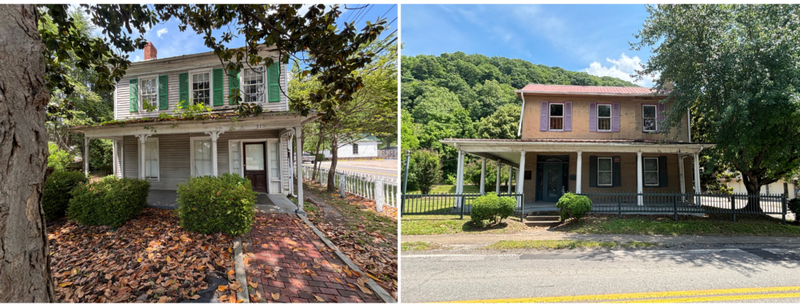
The historic Norton House (left) and Hale House (right) in Malden, West Virginia. West Virginia State University has received a nearly $400,000 federal historic preservation grant to preserve the structures, built in the 1800s. (Photos courtesy of West Virginia State University)
West Virginia State University is moving forward with a project to preserve two historic Kanawha Valley homes with the help of a federal grant.
The university was recently awarded a $398,000 historic preservation grant from the U.S. Department of Interior National Park Service through a program that helps preserve properties on the National Register of Historic Places.
The school aims to preserve two buildings it owns in the Malden Village Historic District in Kanawha County: the Hale House and the Norton House, it said in the news release Sept. 4.
“We are thankful to the National Park Service and to United States Senator Shelley Moore Capito, Congresswoman Carol Miller and former Senator Joe Manchin for their support in helping the university to secure this grant,” WVSU President Ericke S. Cage said in the release. “These historic properties listed on the National Register of Historic Places played a vital role in the history and evolution of the Kanawha Valley’s early salt industry, and we are hopeful this investment will help us to maintain these properties for the benefit of future generations.”
Built in 1938, Hale House was the one-time home of Dr. John Hale, an influential 1800s Kanawha Valley business and political leader. Hale was owner of possibly the largest salt works in North America, supplying the thriving meat-packing center of Cincinnati, according to the university.
Norton House is the oldest frame house in Malden, built around 1840 by Moses and James Norton, a father and son pair who were bookkeepers for salt makers in the area, the school said in the release.
Before any restoration work on the houses can begin, the school has hired an architectural firm to complete an engineering report of the structures. The report will help the school determine what next steps will be, said Curtis Johnson, the school’s executive advisor to the president for strategic initiatives and government affairs. Johnson is the lead coordinator on the grant for the school.
Johnson said the school does not yet know what the full cost to restore the homes will be. The $398,000 amount in the congressional directed spending grant was a guess, he said.
The homes are in need of repairs that could include foundation, porches, floors, ceilings, doors, roofs, restrooms, windows, HVAC systems and siding, Johnson said.
Leaders of the school — one of two historically black colleges and universities in the state — are getting the engineering report done in order to be the “best steward of the money that we’ve received,” Johnson said.
“There is concern that the true cost of restoration for these two homes will be in excess of the money that we currently have,” Johnson said. “But again, you can’t really ask for more money in a responsible manner unless you know how much money you need, and have some documentation as to that cost. So this was, I think, a plan with very good stewardship to be able to tackle that next feat.”
The school has hired WYK Associates, Inc, a Clarksburg architectural firm, to do the report, Johnson said.
He said the school may conceivably open the structures to the public in some manner when they’re restored, but that’s an idea the school still has to flesh out. Those are questions that will be answered at a later date when the school knows what it will cost to fully restore the homes, he said.
The university acquired the structures under a prior administration. In 2024 and 2023, the school conducted archeological field schools on the Hale House grounds, a spokesman for the school said.
“I don’t know precisely what the vision was for the prior administration that brought in (the homes) and how that aligns with the current day needs at the university and things,” Johnson said. “That’s the issue, of course. There has to be a lot of focus here on campus with regards to our mission to educate and serve the public here through our land grant mission.
“We are definitely wanting to make sure we honor the history of Malden, as well, and do that in a responsible manner,” Johnson said.
The university expects to have the engineering report by late November, if all goes as planned.
Charleston, WV