How Trump’s anti-DEI shift unraveled a successful federal investment in Maine schools
Aug 11, 2026 | 4:44 am ET
Description
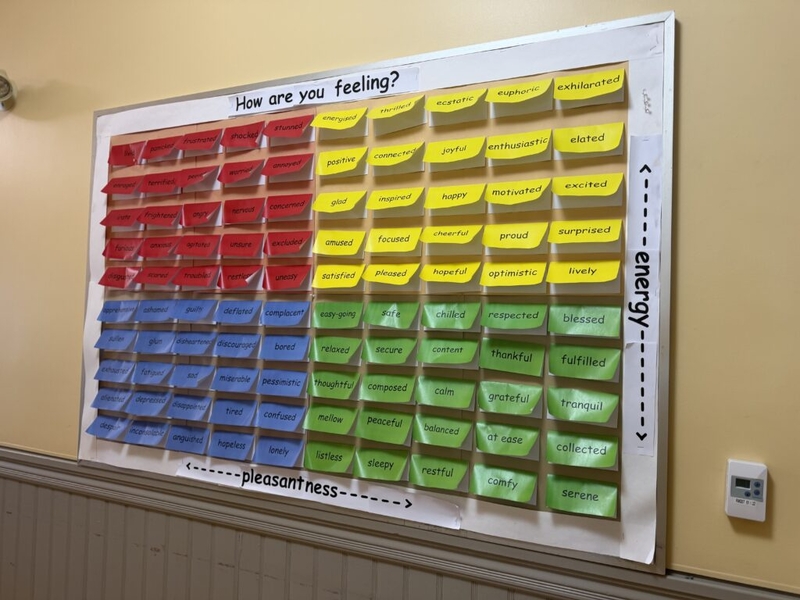
A sign assessing students' well-being posted in the hallway of Lewiston Public Schools' administrative headquarters on July 1, 2026. (Photo by Eesha Pendharkar/Maine Morning Star)
Three years ago, a handful of Maine school districts struggling with student mental health needs applied for a federal grant to help them hire school counselors and social workers. The grant applications included a commitment to hiring staff that represented their particular community and understood its needs.
The grant — part of the Bipartisan Safer Communities Act that Congress passed in 2022 in the wake of the Uvalde school shooting in Texas — provided about $1.7 million annually that the Maine Department of Education distributed among nine districts, most of them rural and small.
Thanks to the grant, Skowhegan schools, which had seen a string of student suicides, was now able to offer students clinical counseling. The number of students who said they had seriously considered suicide within the district dropped from 19.5% in 2023 to 11% in 2025, according to Assistant Superintendent Mark Hatch.
In Lewiston, schools hired mental health professionals to help both students and staff cope with the aftermath of the 2023 mass shooting, said Assistant Superintendent Karen Paquette.
And Somerville area-schools no longer had to rely on a single social worker to shuttle between five schools across three counties, said Deborah Taylor, Regional School Unit 12 director of curriculum and technology.
But last year, the grant — known as Expanding Access in School Environments, or EASE Maine —was inexplicably cut by the administration of President Donald Trump, which said in an April 2025 letter to the Maine DOE that it was among the “programs that reflect the prior Administration’s priorities and policy preferences and conflict with those of the current Administration.”
“We complied with all of the grant requirements, and felt like we had a good faith agreement with the federal government, and so to have that not be able to be counted on was frustrating to us,” Taylor said. “I don’t understand fundamentally the federal government’s qualms with this grant when the need is so obvious to us.”
Maine joined several other states in a lawsuit against those federal cuts last year, and in December a district court ordered the administration to release the mental health funding. Despite that order, Maine only received just over $688,000, which was less than half the annual allocation. It wasn’t until court proceedings in June that the Maine DOE found out that the Trump administration’s opposition to diversity, equity and inclusion programs was the reason behind the grant’s termination; it was never put in any official notice, said Bethany Cunningham, EASE grant manager for the Maine DOE.
“We’re really in a holding pattern, not knowing whether or not we will get additional funding, not knowing where the grant stands,” Cunningham said.
“So now schools are kind of being forced to adjust their budgets — if they can to include these positions or not — and we have providers who, some of them are not sure if they will be coming back in the fall.”
A question of DEI
One of Trump’s first actions in office was signing executive orders revoking diversity, equity, inclusion, and accessibility programs, which promote fair treatment and representation of people of all backgrounds, in the federal government. That stance had led to billions in canceled funding impacting every sector, including health, environment and education.
Despite the district court order, in early July, the U.S. Department of Education let the Maine DOE know it would pursue legal action to terminate the grant by the end of the month. Within a few days, 15 states including Maine responded with a follow-up lawsuit against the federal government, explicitly opposing the Trump administration’s decision to end the funding due to its anti-DEI policies.
“This legislation came at a critical time when our youth were experiencing a mental health crisis, a crisis that continues today. The [grants] tackled several aspects of this problem,” the lawsuit states.
“Although this crisis continues, the Department has been on a mission for over a year to end funding for a subset of … grants within Plaintiff States based on its belief that the grants do not effectuate Defendants’ new priorities because they support diversity, equity, and inclusion.”
That appears to be the first time in this case that the states connected the grant’s cancellation with the DEI-related question on the grant application. The Education Department did not respond to requests for comment.
I don't understand fundamentally the federal government's qualms with this grant when the need is so obvious to us.
“That’s frustrating, to be awarded a grant because you did something and then the grant be taken away because you did what they asked you to do in the first place,” said Hatch of Skowhegan schools.
By singling out the grant because the Trump administration believes it contains statements about DEI, the administration went against Congress’s directive to ensure equitable access when the grant was first established, the states argued. And by relying on internal memos to terminate DEI-related grants without allowing states the opportunity to work with the federal government, the administration also violated procedural protections that Congress had put in place.
On July 27, U.S. District Judge Kymberly Evanson sided with the states, writing that the department’s decision to terminate grants “reflects an unexplained change in Department policy, and that the the department’s plan fails to comply with its own regulations by basing terminations on ‘factors Congress did not intend the Department to consider.’”
Her order prevents the federal government from canceling the grant until August 24.
Chloe Teboe, spokesperson for the Maine DOE, said the states “continue to seek a more permanent solution. At this point, it is unclear how this or any future decision may impact additional funding.”
Meanwhile, Maine district leaders described the cancellation of the grant based on a “buzzword” to be frustrating.
“I quite honestly don’t even know what DEI means,” said RSU 12 Superintendent Howie Tuttle. “So I don’t believe that that is a reason to not provide mental health services.”

Mental health improvements
Maine has a history of not providing adequate youth mental health support. In 2024, the state settled with the U.S. Department of Justice for failing to provide support for behavioral and mental health. Gov. Janet Mills said at the time her administration and the Legislature will continue to invest in mental and behavioral health resources. In 2025, lawmakers provided $100,000 to help districts contract with mental health service providers.
More than 18% of Maine children have been diagnosed with anxiety, which is the highest rate in the country, according to data from the John T. Gorman Foundation. Further, 22% of Maine children have experienced two or more Adverse Childhood Experiences — higher than the national average of 17%. ACEs include experiences like violence or abuse, and research shows that the stress and trauma that accompanies them can have a lasting negative impact on a child’s well-being.
But there is evidence that increased awareness and investments in school mental health are improving outcomes. The biannual Maine Integrated Youth Health Survey that the Maine health and education departments collaborate on has shown fewer students experiencing depression, suicidal ideation or attempts, and more students seeking help from adults.
Three of the nine districts that had the EASE grant reported progress that has impacted the whole district.
Approximately 31% of all Lewiston Public Schools students, or 1,785 students, have received direct counseling services from grant-funded mental health providers during the final two years of the grant, according to Paquette.
Particularly in the aftermath of the Lewiston shooting, in which 18 people were killed and 13 injured, having four staff members dedicated to helping students and staff process that trauma was essential, she said.
“With any tragedy you have this flood of resources and supports, and then life goes on for others, and a lot of that sort of fades away,” she said.
“So the biggest benefit was that we had additional staff that could continue to support, not just students, but staff as well.”
In Skowhegan, the EASE grant helped expand on COVID-era investments by hiring three clinical counselors, Hatch said. The need for youth mental health support was already there, but until then it had to be met outside of school.
“That was a huge positive impact for students being able to get their needs met,” he said. “And it really helped out the community from the standpoint of parents who couldn’t really afford for whatever reason to be able to take time off from work to get their kids to appointments.”
Districts adjust
Upon receiving notice that the grant may not be continued, Skowhegan schools decided to switch to billing MaineCare to get student mental health needs reimbursed. According to the July lawsuit, many districts nationwide will have to rely on Medicaid, the federal healthcare program low-income families rely on, which is also facing federal cuts.
“Even supposing that state Medicaid programs could step in immediately to provide care in the event of a termination, which they could not, it would disrupt the provision of effective therapeutic care for students,” the states wrote in the filing, noting that students may have to change providers or leave school to receive services.
Lewiston Public Schools was able to keep funding its mental health staff positions through the school budget, but that means other positions may have to be eliminated, Paquette said.
“Our school committee had to make some tough decisions, but we’re grateful that they saw the value in those grant-funded positions and the people in those positions in terms of the impact that they were making,” she said.
“We were able to maintain those four positions for this coming school year. I hate to say this, but it’s at the cost of losing some other positions.”
However, because of the grant, Lewiston schools had previously paid for 10 staff members to pursue certification and graduate level courses in school-based mental health, which won’t continue.
RSU 12 has five schools spread across Lincoln, Kennebec and Waldo counties, which has made meeting student mental health needs challenging. The EASE grant funding allowed the district to hire an additional social worker, whose employment is still not guaranteed for the upcoming school year.
Tuttle, the superintendent, said the district has so far received a quarter of the expected funding, which means the grant-funded position does not have to be eliminated at the beginning of the school year, but the school committee will decide in October or November whether it can keep funding that role when the federal grant money runs out.
“We assumed we would lose our social worker because of this back and forth. We still may lose her,” he said. “It’s already difficult with staffing shortages and then to have funding promised and then taken away makes it even harder.”
Augusta, ME