A voter guide to Alabama’s special primary elections
Aug 10, 2026 | 6:01 am ET
Description
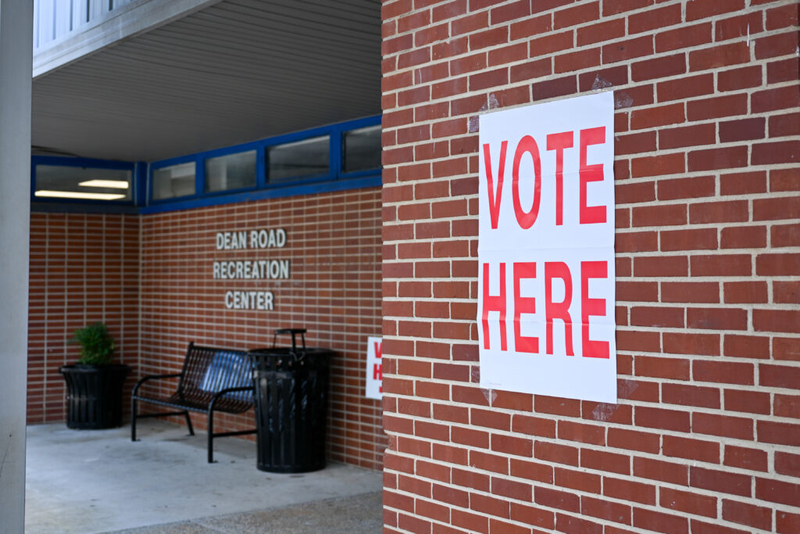
A sign saying "Vote Here" is seen at the Dean Road Recreation Center in Auburn, Alabama, on May 19, 2026. Voters in Alabama's 1st, 2nd, 6th and 7th Congressional Districts will vote in special primaries on Tuesday. (Anna Barrett/Alabama Reflector)
Voters in Alabama’s 1st, 2nd, 6th and 7th Congressional Districts will go to the polls Tuesday to vote in the state’s special primary election.
Following a special session held by the Alabama Legislature, Gov. Kay Ivey called for a special primary election in those districts after a U.S. Supreme Court order allowed the state to use a 2023 Legislature-approved map instead of a court ordered one. The 2023 map, previously struck down for being racially discriminatory, had led to two Black representatives being elected at the same time, first in Alabama’s history.
Democratic candidates have been largely decided in every race except for 6th Congressional District.
Sample ballots for counties having an election can be found on the Alabama Secretary of State’s website. Alabama has open primaries meaning voters will be allowed to pull either a Republican or Democratic ballot at their polling location.
There will be no runoff in the election, meaning the candidate who gets the most votes on Tuesday will be the nominee.
Alabama’s 1st Congressional District
Voters who pull a Republican ballot in south Alabama centered around Mobile will choose between Jerry Carl, John Mills and Austin Sidwell. The redrawn district covers all of Mobile, Baldwin and Escambia counties and part of Covington County.
The seat is currently held by U.S. Rep. Barry Moore, R-Enterprise, who is the Republican nominee for the U.S. Senate seat being vacated by U.S. Sen. Tommy Tuberville, who is running for governor.
Carl was elected to serve as U.S. Rep. for Alabama’s 1st Congressional District in 2020 and he lost re-election to Moore in 2024 according to election results. He said last month he wants to preserve an underwater petrified forest by turning it into a national park to prevent companies from harvesting the timber and said voters should choose him because of his experience in Congress.
Three Republican candidates in AL-01 face fears of low turnout in August special primary
Mills said last month he was running in the special election because he didn’t like any of the candidates running to replace Moore. If elected, Mills said he would ensure election integrity, border security and “stop reckless spending.”
Sidwell told the Reflector last month he wants to control government spending and address issues with Social Security.
The winner of the election will face Democratic nominee Clyde Jones in November. No other Democratic candidate qualified for the race.
Campaign finances: According to Federal Elections Commission filings through July 22, Carl has raised $1.2 million and spent $865,000; Sidwell has raised $199,000 and spent $194,000; Mills has raised $18,000 and spent $15,000.
Alabama’s 2nd Congressional District
Voters in Alabama’s 2nd Congressional District, centered on the Wiregrass in southeastern Alabama, will choose between Republican candidates Hampton Harris, Christian Horn, Rhett Marques, David Matthews, Joshua McKee and James Richardson. The district covers the southeastern part of the state including Geneva, Houston, Montgomery and Macon counties and a portion of Covington County.
Horn said in a recent interview that his top priority is affordability.
“People want to be able to have policies that are going to be able to give them an opportunity to save money at home, to be able for seniors to be able to not have to make the choice between food and their pharmaceuticals,” he said.
Marques, a state representative, has touted his endorsement from President Donald Trump, mentioning it six times during a Republican Republican candidate forum in Eufaula last week. Marques said afterward that he wanted to run to “help President Trump pass his agenda and help the state move forward.”
One week before primary, AL-02 GOP candidates pitch platforms at Barbour County forum
According to his website, Marques wants to strengthen rural areas through investments in broadband and infrastructure to support healthcare, economic opportunity and education.
Richardson said during the forum his top priority is addressing veterans’ healthcare. Richardson served in the Marine Corps and lost his father, a veteran, to suicide after he was unable to get mental health resources at the VA hospital.
Harris said he wants to focus on restricting acess to abortions and said he would not raise taxes for Alabamians. Harris previously criticized Marques for his vote to increase the gas tax through the Rebuild Alabama Act of 2019. Prior to the vote, the gas tax had not been raised in the state since 1992, and the Business Council of Alabama and other organizations supported the measure to provide improvements to Alabama’s infrastructure. The bill passed by comfortable margins, with Democratic and Republican support.
McKee said during the forum’s spur of the moment question and answer segment that he wanted to invest in communities to keep them sustainable.
Matthews, a former Trump appointee in the U.S. Department of Agriculture, said in an interview after the forum people should vote for him because he knows how D.C. policy works.
“Very rarely do people have the opportunity to elect somebody who understands how the executive branch works at a granular level,” he said. “I’ve dealt with infrastructure problems, and I’ve dealt with healthcare and housing and economic and business development, and I understand an aspect of governance that most people never get exposed to because usually people get elected into the legislative branch, and the way that they learn about the executive branch is through a superficial means.”
The winner of the primary will face U.S. Rep. Shomari Figures, D-Mobile, in the November general election. No other Democratic candidate qualified for the election.
2nd Congressional District: Marques has raised $1.3 million and spent $1.1 million; McKee has raised $521,000 and spent nearly $525,000; Harris has raised $246,000 and spent $82,000; Matthews has raised 48,000 and spent $36,000 and Richardson has raised $7,700 and spent $7,600. Horn has not reported any filings as of Friday afternoon.
Alabama’s 6th Congressional District
The 6th Congressional District in the southern Birmingham suburbs and central Alabama is the only district where both parties have contested primaries. The seat is solidly Republican.
Republican voters will choose between U.S. Rep. Gary Palmer, R-Hoover, and challenger Case Dixon. Democratic voters will choose between Jacob Bouma-Sims, Ashtyn Kennedy, Maurice Mercer and Keith Pilkington.
Palmer, the 12-year incumbent for the district, said on his campaign website that he believes in religious freedom and supports repealing the Affordable Care Act in favor of a healthcare program that will “free-market, patient-centered solutions that increase competition, expand choice, and put individuals back in control of their health care decisions.”
Dixon, Palmer’s only GOP challenger and a first-time candidate, told the Reflector last month he wants to reduce the cost of living and address affordability.
Longtime U.S. Rep. Gary Palmer faces first-time candidate in August special primary
Pilkington initially qualified for the 6th Congressional District seat in January as the only Democratic candidate on the ballot. He said last month he qualified for the special election because of persisting issues with affordability and immigration. Pilkington said he would focus on creating affordable housing options.
Ashtyn Kennedy, a social media content creator, said she wanted to create a data center moratorium in Alabama and would support a federal data center moratorium bill sponsored by U.S. Reps. Alexandria Ocasio-Cortez, D-New York, and Bernie Sanders, I-Vermont.
Mercer, a former Pelham City Councilman Maurice, said in a recent interview he wants to stop the current war in Iran.
“Whether that is working to see both sides peacefully stop the war, or just pulling the USA out. We have our sons and daughters over there, and right now, I think the American people still don’t know 100% why,” he said.
Bouma-Sims wants to address issues with Alabama Power by making an federal alternative program through a plan he calls the “Cahaba River Corporation.”
“It’s not a takeover of Alabama Power, it’s not abolishing Alabama Power with the swipe of a pen, it’s an alternative,” he said to the Reflector last month.
Four Democrats vie for central Alabama congressional seat in special primary election
Dixon and Mercer accused Palmer of breaking his term limit campaign promise. According to a 2023 report from Al.com, when Palmer initially ran for office, he pledged to only serve 10 years but changed his mind when he decided to seek reelection in 2024, saying God told him to run for another term.
The winners will move on to the November general election.
Campaign finances: Dixon has raised $25,200 and spent $25,000; Palmer has raised $1 million and spent $946,000; Kennedy has raised nearly $10,000 and spent $9,300 and Mercer has raised $6,500 and spent $4,700. Pilkington and Bouma-Sims had not reported any filings as of Friday afternoon.
Alabama’s 7th Congressional District
Two Republican candidates, Ammie Akin and David Perry, are running to represent west Alabama in the 7th Congressional District.
Akin told the Reflector last month that she wanted to address crime and affordability in the district and create educational opportunities.
Two Republicans vie for 7th congressional district nomination in special August primary
“You can’t create opportunity without education. This is why I love education, because education opens the door for everything,” she said.
Perry also said he wants to prioritize public safety in the district. According to a report from the Tuscaloosa Police Department, violent crime decreased from 2024 to 2025.
The winner of the election will face Democratic nominee and current U.S. Rep. Terri Sewell, D-Birmingham, in November. No other Democratic candidate qualified for the election.
Campaign finances: Akin has raised $151,000 and spent $35,000. Perry had not reported any filings as of Friday afternoon.
When do polls open?
Polls are open from 7 a.m. to 7 p.m. on Tuesday.
Where do I find my polling place?
The Alabama Secretary of State’s website allows you to check voter registration and the location of your polling place. You can find it here.
What do I need to vote?
Voters must present a valid photo ID before voting. Valid forms of ID include:
- Alabama driver’s license (not expired or expired less than 60 days)
- Alabama Law Enforcement Agency digital driver’s license
- Alabama Non-Driver ID (not expired or expired less than 60 days)
- Alabama Photo Voter ID card
- State-issued ID (Alabama or any other state)
- Federal-issued ID
- U.S. Passport
- Employee ID from the federal government; state of Alabama; county; municipality, board or other entity of Alabama
- Student or employee ID from a public or private post-secondary educational institution in Alabama or other states (including colleges, universities, postgraduate technical and professional schools)
- Digital student or employee ID from a public or private post-secondary educational institution in Alabama or other states (including colleges, universities, postgraduate technical and professional schools)
- Military ID
- Tribal ID
What happens after Tuesday?
Each nominee will face their counterpart in the general election on Nov. 3. Independent candidates have until election day to qualify.
When will we know the results?
When polling locations close at 7 p.m., local election offices will begin counting ballots and reporting results to their county probate offices. The Alabama Secretary of State’s office will post results as they become available Tuesday night.
The key points box was written by reporter Andrea Tinker.
Montgomery