Todd Blanche confirmed by the US Senate as attorney general; Collins, Murkowski vote no
Description
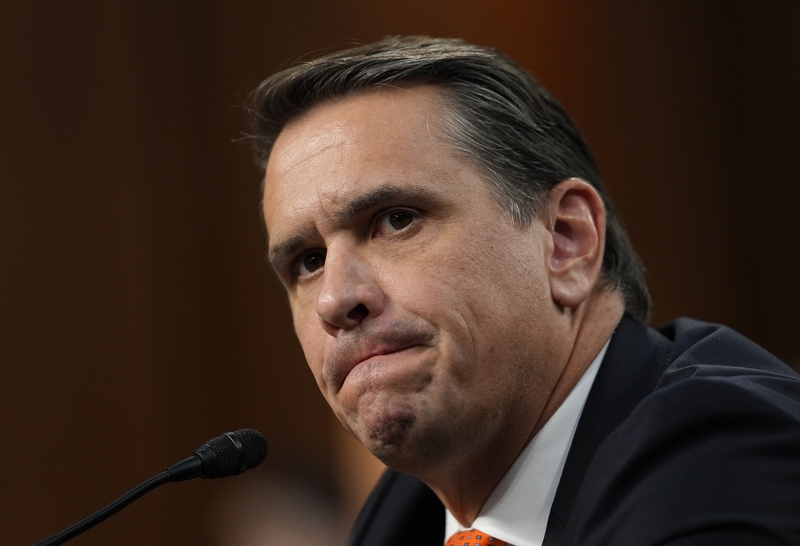
Todd Blanche, who was confirmed as attorney general on Aug. 8, 2026, appears at his confirmation hearing in front of the Senate Judiciary Committee on Capitol Hill July 15, 2026 in Washington, DC. (Photo by Eric Lee/Getty Images)
WASHINGTON — After a lengthy battle over the status of President Donald Trump’s nearly $1.8 billion “anti-weaponization” fund, Todd Blanche was confirmed as attorney general by the U.S. Senate early Saturday.
Blanche, the acting attorney general, won approval to take the role permanently after GOP Sen. Bill Cassidy of Louisiana said he would back him, a turning point for Blanche’s nomination push. The vote at about 4:30 a.m. Eastern was 50-49, with Sen. Mitch McConnell, R-Ky., absent due to health issues.
Republican Sens. Lisa Murkowski of Alaska and Susan Collins of Maine joined all Democrats in opposing the confirmation of Blanche, Trump’s personal defense attorney before joining the government at the start of Trump’s second term.
“I am deeply honored by the trust and confidence President Trump has placed in me to lead the Department of Justice as our great nation’s 88th Attorney General. I am grateful to the Senate for staying late to complete this process. To the dedicated public servants of the Department of Justice, thank you for your work each day to uphold the law and keep our country safe,” Blanche said in a statement on social media following the vote. “God bless America.”
Senate Minority Leader Chuck Schumer, D-N.Y., blasted Blanche’s confirmation.
“Senate Republicans have handed Trump an excuse on a silver platter to keep up his pervasive, breathtaking corruption,” he said in a statement. “If you want to wipe out corruption, you can’t have the president’s personal attorney as the Attorney General. You don’t need a PhD in political science to know that.
“Todd Blanche has no intention of stopping Trump’s corruption. He advanced his career enabling it. Every senator who voted to confirm him has now branded themselves as an enabler, too.”
The Senate adjourned for its summer recess about an hour after the vote and will not return to regular session until Sept. 14.
Cassidy explanation
Cassidy, who has long clashed with Trump, said in a Friday floor speech his vote was not a reflection of that relationship, but about the importance of having a Senate-confirmed attorney general who had the backing of U.S. attorneys in Louisiana and former Attorney General Bill Barr.
“Mr. Blanche is not perfect, and he will tell you this, but the choice is not between perfection and Mr. Blanche,” he said. “It is between Mr. Blanche and another acting attorney general who may not run the department effectively under President Trump… All considered, I will vote for Mr. Blanche.”
Cassidy held the determinative vote on Blanche following Murkowski’s announcement earlier Friday she would oppose his confirmation. Collins had said earlier in the week she would vote against confirmation.
Trump announced Blanche in June as his pick for the top role at the Justice Department, replacing Pam Bondi.
Cassidy alluded to his strained relationship with Trump. He voted to convict in Trump’s second impeachment trial that covered Trump’s conduct leading to the Jan. 6, 2021, attack on the U.S. Capitol. Cassidy lost his primary race to a Trump-backed challenger this year.
“I have a history with Mr. Trump,” he said. “But that history does not matter one bit.”
Murkowski opposition
In a social media post, Murkowski — another Republican at whom Trump has leveled strong criticism, including as recently as a podcast interview published early Friday morning — said the country needed an attorney general able to “check the worst impulses of this administration,” and that she lacked confidence in Blanche to do that.
Cassidy seemed to hold a similar objective, but reached a different conclusion about Blanche’s ability.
Trump is often unwilling to take advice, Cassidy said, but a competent, Senate-confirmed attorney general with whom Trump has a close relationship might be better equipped than whoever else Trump would choose to run the department.
Cassidy said that in a recent conversation with Barr, who had his own clashes with the president during and after his time as attorney general in Trump’s first term, the former attorney general endorsed Blanche as someone who could “run the department as effectively as anyone can under President Trump.”
“Some have called that faint praise,” Cassidy said. “I don't think that it is. I think it is a reality.”
Trump has expanded presidential decision-making at the Department of Justice, which, at least since the Watergate scandal of the 1970s, has been viewed as operating independently from the White House.
Ultimately, the attorney general answers to the president, Cassidy said.
‘Slush fund’ concerns
Cassidy criticized Blanche’s role in creating a fund for “victims of lawfare,” including those convicted of Jan. 6-related charges, and in approving a settlement with the IRS that gave Trump and his family broad immunity from tax prosecution.
“Mr. Blanche showed poor judgment in approving the anti-weaponization slush fund and exempting the president from IRS audits,” Cassidy said.
Blanche acknowledged those “mistakes” and “made efforts to kill the slush fund,” Cassidy said.
Blanche wrote a memo this week that said the fund would not move forward and that the IRS agreement only applied retroactively, not to future prosecutions. That move was enough to win over Republican holdouts on the Senate Judiciary Committee, Sens. Thom Tillis of North Carolina and John Cornyn of Texas.
Murkowski on Friday raised doubts that the fund would be dissolved if the Senate voted to confirm Blanche and loses leverage with the administration, but again, Cassidy appeared to reach a different conclusion.
Senate Judiciary Chairman Chuck Grassley, an Iowa Republican, praised the confirmation vote and spoke in favor of Blanche’s nomination on the Senate floor.
“Beyond his obvious qualifications and successful track record, Blanche has demonstrated extraordinary patience, compassion and tenacity as he’s made his way through the gauntlet of the Senate’s advice and consent process,” Grassley said in a statement. “He’s been forthcoming and responsive to my colleagues and has proven himself to be a steadfast advocate for the rule of law. Today, the United States Senate voted to confirm Todd Blanche’s nomination and advance the safety and security of Americans nationwide.”
Confirmation bestows legitimacy
Cassidy noted that Blanche did not need Senate approval, and that he could continue doing the job in an acting capacity.
But a major factor in voting to confirm Blanche was that people within the department viewed Senate confirmation as crucial to an attorney general’s influence.
“I am told that Senate confirmation is important in interactions with the president, with others in the Cabinet and is important to DOJ employees in general,” Cassidy said. “Being Senate-confirmed gives him greater leverage to push for things that should be pushed for.”
Cassidy also said he spoke to Louisiana U.S. Attorneys David Courcelle and Kurt Wall, who told him having a Senate-confirmed attorney general was important and that Blanche was more than capable.
They praised Blanche for quickly providing resources when they asked, Cassidy said.
“I cannot overstate Mr. Walls’ and Mr. Courcelle’s support for Mr. Blanche,” he said.
All States Newsroom content is free to republish. Read our republishing policy for more information.