NYC Tenants Sue Over Spying Operation in Public Housing
Aug 07, 2026 | 10:00 am ET
Description
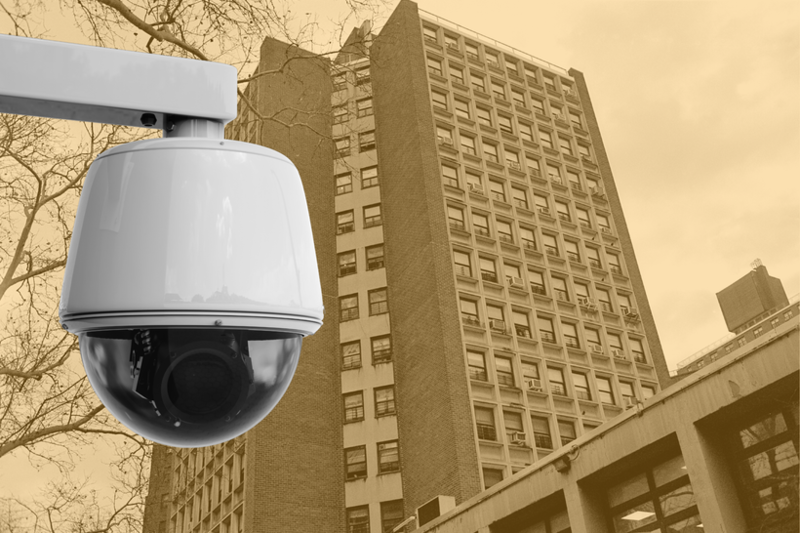
Public housing tenants allege that an Adams-era push to connect CCTV cameras to the NYPD's real-time surveillance system constitutes illegal surveillance. / Background photo: Zach Korb / Flickr; Security camera: Phonlamai Photo / Getty Images | Illustration: Leor Stylar
Public housing tenants are suing to block the New York City Police Department from implementing one of the biggest video surveillance expansions in the city’s history. The expansion, which was developed in secrecy under former Mayor Eric Adams until a New York Focus investigation and ensuing City Council hearing exposed it, is set to connect nearly 20,000 CCTV cameras in public housing to the police department’s controversial real-time surveillance system.
The litigation, filed this week by two public housing tenant associations, adds to the city’s extended legal fallout from the Adams administration, whose former aides and agency chiefs are facing old and new corruption charges pursued by local authorities and the feds. It also presents an opportunity for the courts to reassert oversight of the city’s sprawling surveillance tech, which has been exported to other municipalities around the country over the last decade.
The tenant associations allege that the Adams-era effort continues to violate multiple laws governing the use of surveillance technology and civil rights. New York City law requires the NYPD to publish comprehensive documents outlining how the department uses surveillance technologies months before they’re deployed. In this case, the NYPD never published those documents. Local law also explicitly prohibits “bias-based policing” practices, a reform that took effect after public outrage and judicial action on the NYPD’s “stop-and-frisk” policies, which disproportionately subjected Black and Latino youth to warrantless searches on the street.
The lawsuit claims that the public housing surveillance expansion flies in the face of all that precedent. “This constant surveillance of public housing residents is not supported by individualized suspicion, nor has it received judicial approval,” the filing, submitted on behalf of the Langston Hughes and Samuel J. Tilden tenant associations, reads. “This warrantless activity constitutes an unlawful search.”
By focusing on public housing complexes in particular, where the population is nearly 90 percent Black or Latino, the lawsuit also alleges that the surveillance expansion “evinces a discriminatory intent against Black and Latino families, producing a foreseeable disparate impact on these communities.”
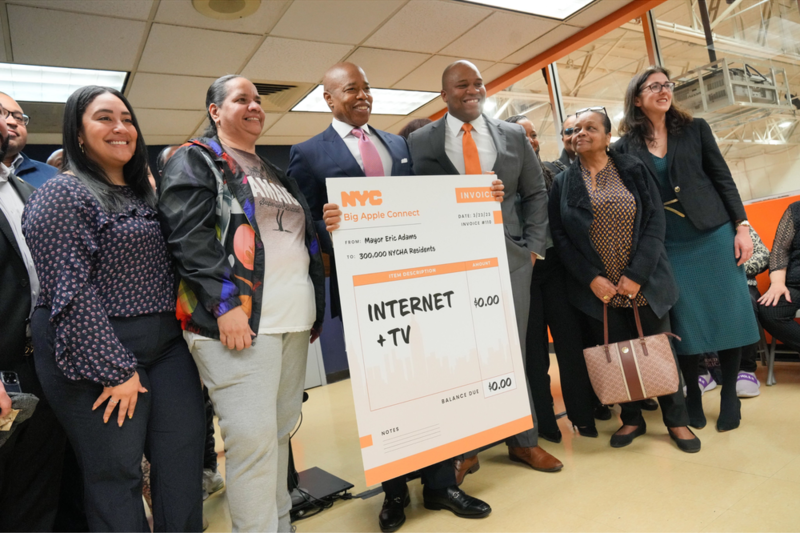
Years ago, the NYPD and the Adams administration went to elaborate lengths to hide this surveillance expansion from public view. Dipping into the contracting budget of the city’s technology agency, they covertly used infrastructure established under Adams’s much-hyped $100 million Big Apple Connect program, which eliminated the cost of basic internet plans for public housing residents. Under that program, the city installed new internet routers in common spaces throughout the city’s public housing complexes, allowing the NYPD to connect roughly 20,000 CCTV cameras operated by the New York City Housing Authority (NYCHA) directly to the police department’s real-time surveillance system.
The NYPD had sought to tap into NYCHA camera feeds for more than a decade without any luck. Instead, police officers previously had to request permission from the housing authority to review footage from those cameras on-site when investigating crimes.
The real-time video surveillance component of the free internet program remained under wraps until a New York Focus investigation last summer. Four committees of the New York City Council held an emergency oversight hearing on the program a couple months later, where NYPD and NYCHA officials confirmed that police were using the new internet connections to stream footage from a select number of public housing security cameras, a number that, the officials said, would soon grow to encompass nearly the entire NYCHA CCTV portfolio over the ensuing months.
The footage, the police department confirmed, now goes straight to the NYPD’s Domain Awareness System, a counterterrorism and anti-crime data fusion tool that the city developed after 9/11. The system collects an enormous amount of information from surveillance cameras, license plate readers, emergency call logs, and legal databases, and syncs it with pattern-matching and facial recognition tools to support the NYPD’s “predictive policing” approach, informing where and how to allocate police resources.
“I would prefer in person presence to them watching us behind cameras.”
—Ciprian Noel, tenant association president, NYCHA’s Langston Hughes Houses
Advocates have challenged the system before, arguing it infringes on privacy, reinforces racial bias in policing, chills freedom of expression, and may be used to support the federal government’s immigration crackdown. But details of how the program has been used thus far have been hard to come by. One of the lawsuit’s goals, in addition to halting the program, is to compel the NYPD to provide information about how it has used data collected through its expanded real-time surveillance footprint in police work and in court. “We’ve tried to get that information and we haven’t been able to,” said Anca Grigore, a senior attorney at the Brooklyn Defender Services and lead counsel on the case. “We can’t possibly know what discovery and what footage has been part of this program.”
Public housing tenants say they’ve also been kept in the dark about the program. Ciprian Noel, who serves as president of the tenant association at NYCHA’s Langston Hughes Houses and as vice president of one of the NYPD’s local community councils in Brooklyn, wrote in a sworn affirmation that despite his leadership role liaising with NYCHA and the police he was never informed of the surveillance expansion. He worries that the program, developed as it was with no independent oversight or room for public discussion, “will destroy bridges rather than build them” between police and public housing residents.
“I would prefer in person presence to them watching us behind cameras,” Noel wrote. “We want young people and officers to try to talk to and understand one another.”
Gina Boatright, who leads the tenant association at NYCHA’s Samuel J. Tilden Houses in Brooklyn, voiced similar concerns in another sworn affirmation submitted in the New York Supreme Court this week. “If I had been timely informed of this new surveillance arrangement and given an opportunity to do so, I would have personally submitted a public comment expressing my concern that residents will be harassed as a result of this access and surveillance,” she wrote. “When a crime has been committed, law enforcement can already obtain NYCHA’s permission to review the cameras. In my view, if law enforcement is given unrestricted access, officers will take advantage of that access.”
The NYPD and New York City’s Mayor’s Office did not respond to a request for comment.

Albany