


$10M Omaha residential facility for combat-maimed vets aims to heal wounds medicine can’t
Sep 12, 2026 | 9:00 am ET
Description
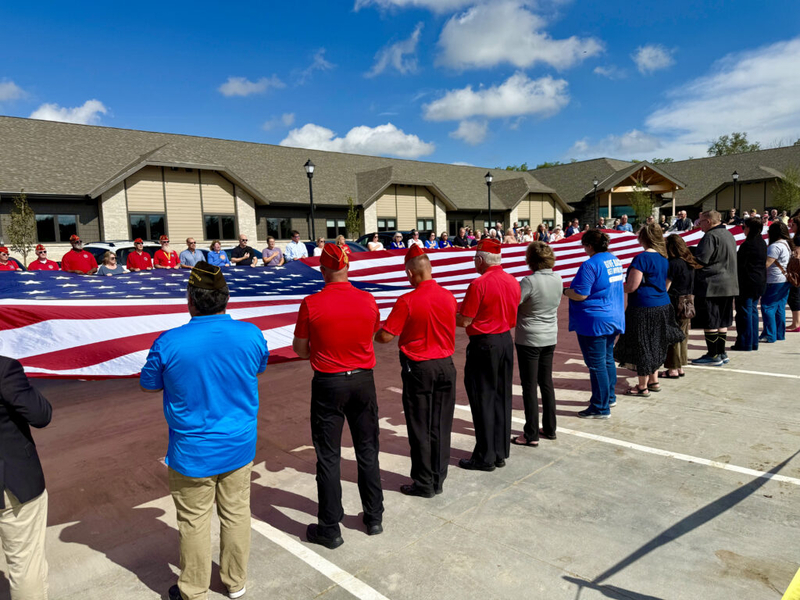
A dedication event for the Dunham House in Omaha, a long-term assisted living facility for veterans severely maimed in combat, kicked off Friday with a flag ceremony. The 30-unit residential complex is in the background. (Photo by Cindy Gonzalez/Nebraska Examiner)
OMAHA — The scene was seared into John Folsom’s mind.
On a visit to Bethesda Naval Hospital around 2010, he met a young soldier severely brain-damaged by a war device that exploded near his head during a mission in Iraq.
The patient’s mom was at his bedside, holding her son’s hand. He was unable to speak, but his eyes seemed to light up when a guitarist started to serenade a familiar tune, recalled Folsom, a retired U.S. Marine colonel. Also a parent, Folsom couldn’t shake his worry for the impaired veteran’s future, wondering what would happen once aging caretaker parents were gone.
“I call it my epiphany,” said Folsom, a Nebraskan who recently relocated to Florida. “That’s what moved me to say, ‘We’ve got to do something here.’ It’s taken years and years and years … ”
But on Friday, coinciding with the anniversary of 9/11, Folsom and a few hundred supporters gathered to dedicate the “long time coming” project he helped plan and raise roughly $10 million to build: an assisted living care facility tailored for vets severely maimed in combat.
Folsom calls the 30-unit Dunham House a pioneering place that also will tend to spiritual wounds that medicine can’t heal.
The idea, said Folsom, its executive director, is to provide a residence and activities where younger generations of vets with shared experiences can bond and have a dignified, better quality of life.
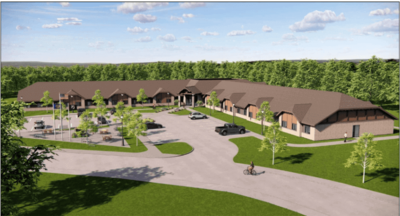
The 27,000-square-foot complex sits on about nine acres of a 40-acre rural setting property near 60th and State streets. It is expected to open to tenants before the year’s end, after final touches.
‘Incredible day’
All funding came from private donations, Kate McCauley, president and CEO of the nonprofit Wounded Warriors Family Support told those gathered for the outdoor event. She called the Dunham House a legacy project that will become part of programming and operations of Omaha-based WWFS, which Folsom founded in 2003.
The Dunham House, organized as an independent nonprofit with its own board of directors, is accepting rental applications. Leaders hope to attract vets from across the country dealing with multiple amputations or traumatic brain injury.
Friday’s event drew out-of-state guests including retired U.S. Army Lt. Gen. John Sylvester of Texas, a WWFS board member who declared it “an incredible day.”
He noted that military ceremonies for fallen soldiers feature upright rifles stuck in the dirt and topped with a helmet — a somber sign that “we lost somebody.” In comparison, Sylvester said, the groundbreaking last year for the Dunham House spotlighted upright shovels topped with construction hats.
“That means we’re here to help somebody,” he told the gathering. “We’re here to see if we can’t make life better for these kids that come home with traumatic brain injuries and other kinds of injuries that mean they’re unable to care for themselves and oh, by the way, they no longer have a caregiver.”
Scheduled to coincide with the 25th anniversary of the Sept. 11 attacks, Friday’s event kicked off with a flag ceremony. Folsom said the 9/11 terrorist strike that stole nearly 3,000 lives and destroyed two signature skyscrapers was a jarring reminder of enemy forces intent on hurting the U.S.
“Our country was forever changed,” he said. “September 11 woke us up to the fact that there are people out there who would do us harm. … We found ourselves in a world that was quite unsettled and really dangerous.”
Folsom said 9/11 also marked the rise of the IED, or improvised explosive device — the “scourge” of modern conflicts that left many younger service members deployed to Iraq and Afghanistan with traumatic brain injuries and multiple amputations.
It’s that post-9/11 veteran suffering from catastrophic combat wounds that the Dunham House was made for, he said.
The facility itself is named after Cpl. Jason Dunham, who, at age 23, threw his body over a grenade to save fellow Marines. Portraits and other mementos of Dunham were unveiled at the event.
Many cited the Dunham House mantra, which is rooted in a Bible verse: “No greater love than this — that one lays down his life for his friends.”
Unexpected but welcome guest
An unexpected guest summoned to the mic drew applause. Katie Saybolt was a Navy nurse who treated the mortally wounded Dunham in Iraq when he was brought to the trauma bay.
She and her family moved to Omaha from another state last year and was shocked to read about the local Dunham House project in a veterans-related newsletter. Saybolt emailed Folsom to talk about the connection. She said she felt “called” to attend Friday with her husband, Greg.
“This is just really beautiful,” Saybolt told Sylvester after the ceremony. Sylvester said he would continue to “hound” Saybolt until she agreed to work at the facility.
“It’s going to be more beautiful when we fill it up,” Sylvester added.
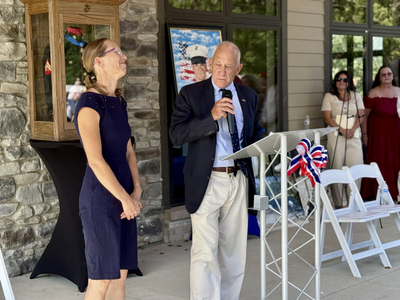
Other speakers included former Omaha Mayor Hal Daub, who is on the Dunham House board. He acknowledged other former and current officeholders, including former Omaha City Councilman Garry Gernandt and current City Councilman Brinker Harding, who he said helped pave the way for various city permits and a street naming. The campus’s official address is 6000 Jason Dunham Drive.
Daub said he envisions growth on the property, including additional residential units for wounded vets.
Folsom, in an interview, recounted the challenging path leading to Friday. He said capital campaign fundraising was lengthy, as many donors prefer to invest in projects with a quicker turnaround.
Despite reaching the dedication milestone, Folsom said he remains unsettled and turns his thoughts to resident recruitment, programming and “what will happen inside the facility.”
“It’s not mission complete yet,” he said.
Still in the works
Still in the works is a plan to create a permanent national memorial at the Dunham House to honor American soldiers killed in action. Folsom and his board want to construct the tribute to service members who died in combat between October 2001 and 2021, including in Operations Enduring Freedom, Iraqi Freedom and other missions connected to post-9/11 wars.
Estimated by Folsom to cost up to $700,000, the memorial is to be constructed using sunset granite quarried in South Dakota, with each name engraved into the stone.
Research is ongoing to identify the service members.
Folsom, 73, started his military career as a CH-46 helicopter pilot, serving in multiple overseas deployments. In 1986, he left active duty and remained a Marine Corps Reserves member but was called back after the Sept. 11 terrorist attacks. He served in Iraq as “Air Boss” in western Anbar province, oversaw Marine attack helicopters and Army Black Hawk medevac air birds.
Upon retirement, the Bronze Star recipient focused on the Omaha Dunham House.
Folsom said his longer-term wish is to see a chain of Dunham Houses across other states. Sylvester agreed.
Lincoln, NE


