Bill introduced by Alaska’s Murkowski aims to promote use of eDNA analysis in fishery management
Aug 07, 2026 | 9:55 am ET
Description
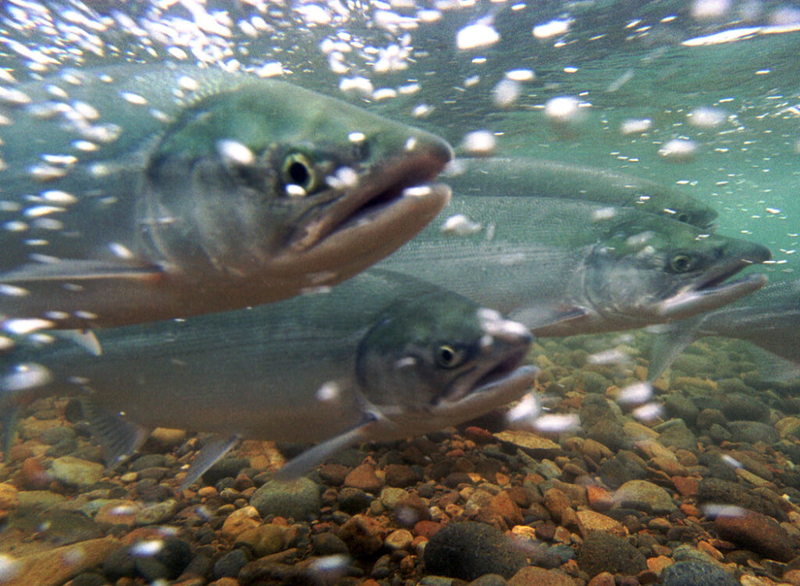
Migrating salmon are seen in late 2011 in the waters of Western Alaska's Togiak National Wildlife Refuge. A bipartisan bill introduced in the U.S. Senate would enable the use of enevironmental DNA to help inform federal fishery science and management. Flakes from fish scales and other materials deposit eDNA into marine and freshwater systems.
Federal fishery managers would start analyzing the DNA collected in ocean waters to help inform their decisions, under a bipartisan bill introduced in the U.S. Senate, Alaska’s Republican U.S. Sen. Lisa Murkowski said on Thursday.
Called the Fisheries Science Modernization Act, the bill would set up a system for the use of environmental DNA, known as eDNA, in fishery management. The bill would establish a National Oceanic and Atmospheric Administration pilot program using eDNA to assess fishery stocks, require NOAA to develop an agency-wide eDNA implementation plan and direct the agency to routinely collect eDNA samples and integrate that form of surveillance into its fisheries research and ecosystem monitoring.
Along with Murkowski, Sen. Sheldon Whitehouse, D-Rhode Island, is a prime sponsor of the measure. Cosponsors are Sens. Dan Sullivan, R-Alaska; Jeff Merkley. D-Oregon; Chris Van Hollen, D-Maryland; Patty Murray, D-Washington; Angus King, I-Maine; and Adam Schiff, D-California.
The measure comes as Trump administration cuts have reduced NOAA Fisheries’ science capabilities. Mass firings, coupled with the prolonged government shutdown of late 2025, hampered NOAA Fisheries’ ability to assess Alaska fish stocks just as managers were preparing to set this year’s harvest limits, for example.
Surveillance by eDNA detects the presence of species by analyzing fragments of genetic material left in water, soil or other environmental settings. It is considered a useful emerging tool for a variety of scientific studies, including fisheries science.
A key advantage of eDNA is its cost-effectiveness, compared to traditional surveying. In a statement, Murkowski referred to that attribute.
“Environmental DNA is an innovative, cost-effective tool that will give our scientists a clearer picture of our fisheries while expanding survey coverage and reducing costs. This legislation is the product of extensive collaboration with NOAA, Alaska fishermen, Tribal partners, academia, and industry to modernize how we assess fish stocks using the best available science,” Murkowski said in the statement.
Other advantages include the ability to track abundance of species regardless of developmental stage and the ability to detect the presence of rare or invasive species.
Shortcomings include the potential for disturbances or contamination of DNA fragments left in the environment and time lags that may make species distribution analysis inaccurate.
The Fisheries Science Modernization Act does not intend for eDNA analysis to replace traditional surveys. Rather, this type of analysis would be a supplement, according to Murkowski’s statement.
The idea has support from several Alaska fishing organizations, as well as from environmental groups and scientists.
“Environmental DNA is a promising new tool for fisheries and ecosystem assessment that could improve fisheries management while also lowering costs,” Linda Behnken, executive director of the Alaska Longline Fishermen’s Association, said in Murkowski’s statement. “Senator Murkowski’s Fisheries Science Modernization Act will advance this technology while also improving oversight and collaboration.”
David Lodge, a Cornell University ecologist specializing in eDNA research, also welcomed the development.
“I am delighted to see this legislative effort to accelerate the use of eDNA in government decision making. The bill builds on on-going efforts by NOAA to bring the best available technology to fisheries stock assessments to enable better, cheaper and more timely future stock assessments,” he said in a social media post.
Juneau