Farm bill stalls, leaving Kansas farm leader concerned about whether it will pass this year
Aug 06, 2026 | 9:28 pm ET
Description
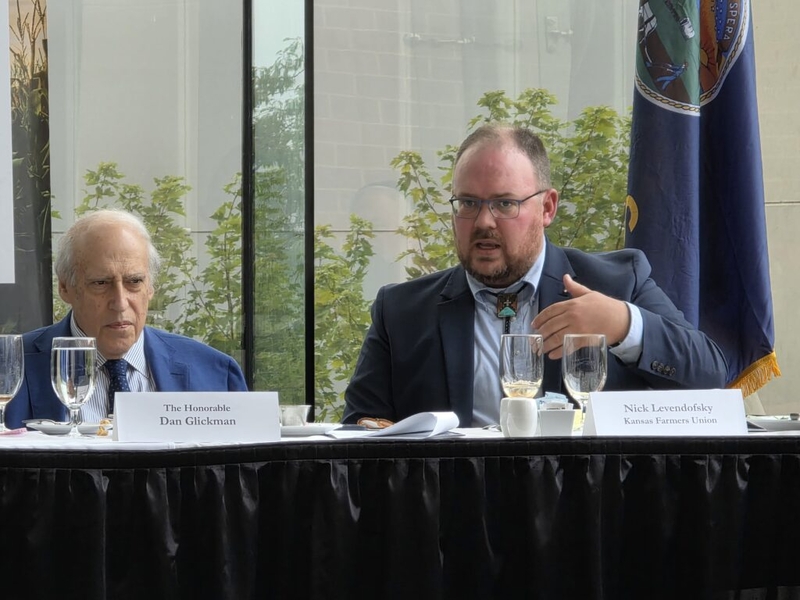
Nick Levendofsky (right), executive director of the Kansas Farmers Union, is concerned the failure to move a farm bill out of the Senate Agriculture Committee on Aug. 6, 2026, means the bill won't happen this year. He's shown here speaking about agriculture with former U.S. Agriculture Secretary Dan Glickman during a U.S. Global Leadership Coalition meeting in 2025, in Overland Park. (Photo by Morgan Chilson/Kansas Reflector)
TOPEKA — A top Kansas agriculture advocate lost some of his optimism regarding the farm bill after the U.S. Senate Agriculture Committee failed to move the bill forward Thursday.
Nick Levendofsky, executive director of the Kansas Farmers Union, said he had hoped the nation would see the much-needed passage of a farm bill this year — the first since 2018 — until Thursday afternoon.
“At the end of the day, it boils down to the cuts that were made through reconciliation, primarily on (Supplemental Nutrition Assistance Program), have caused a lot of division within the committee itself, and there’s pretty tight (voting) margins to begin with,” Levendofsky said, noting that Sen. Mitch McConnell, the Kentucky Republican who fell ill weeks ago, serves on that committee and is not attending.
In the Trump administration reconciliation bill, states will absorb more administrative costs for the SNAP program and bear costs based on the state’s error rate. Advocates have asked to delay the implementation of costs that affect state budgets. The farm bill includes a one-year delay but an increase in the percentage of administrative costs a state would share.
Kansas farmers need a farm bill to pass, Levendofsky said.
“Usually — our hope is anyway — that the Senate tends to be the adults in the room, and that they can kind of come together,” he said. “But I think given the time that we’re in right now and the politics, it’s proving to be even more and more of a challenge.”
The farm bill is a big piece of legislation, Levendofsky said, that touches every part of agriculture and every person in the country.
Given that it’s an election year and legislators are about ready to recess, Levendofsky said, it will probably be another year without a bill passing.
“The world has changed a lot since 2018,” Levendofsky said. “We survived a pandemic. We have seen a lot of challenges with climate change. We’ve seen a lot of challenges with different administrations and different priorities that they bring forward.”
The holdup in the agriculture committee is over one of the priorities outlined in Project 2025, a document created by the Heritage Foundation compiling a conservative agenda, he said. One goal was to cut food assistance programs such as SNAP.
“We’ve got to learn how to put politics aside, and we’ve got to learn how to be more bipartisan and truly compromise on things,” Levendofsky said. “I know that that’s a dirty word in D.C., ‘compromise,’ but that’s how we’ve gotten farm bills in the past, and it’s worked.”
Farm bills help those in the agriculture industry strategize and enjoy some certainty, even as they deal with uncertainty that’s part of the profession.
Levendofsky said a good farm bill needs to keep pace with rising production costs, lessen the expense of crop insurance, and strengthen and modernize programs to reflect the economic realities today.
“There’s got to be some flexibility in there. There’s got to be a better structure to allow for that,” he said. “Disaster assistance is another thing. With more and more extreme weather events, climate change, whatever you want to call it, that is a big issue for a lot of farmers that they’re dealing with.”
For instance, Kansas saw both droughts and floods this year, Levendofsky said. Specifics he’d like to see in the bill include mandatory country of origin labeling for meat and poultry, year-round E-15 or ethanol, and local food procurement funding.

Topeka, KS