22 years later, Mark Sanford brings pigs back to the Statehouse, this time over DC spending
Aug 06, 2026 | 3:03 pm ET
Description
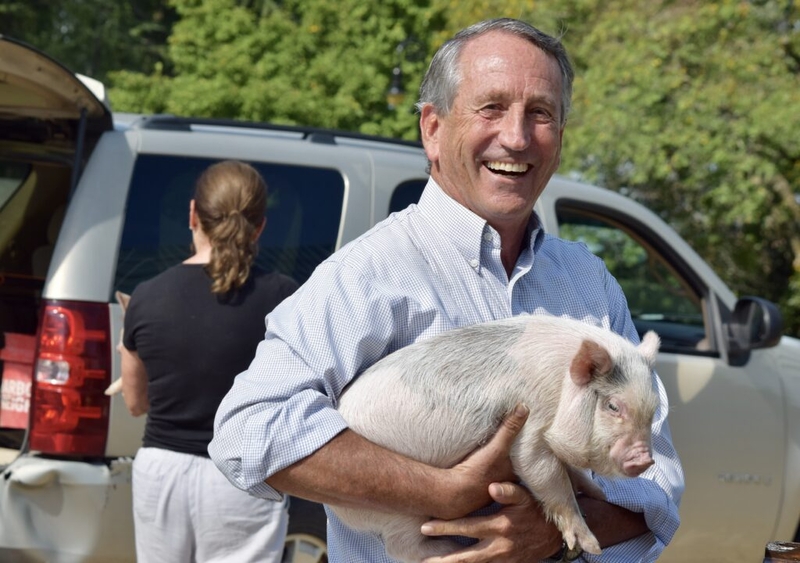
U.S. Senate candidate Mark Sanford carries a pig to a lectern set outside the Statehouse for his news conference Thursday, Aug. 6, 2026, in Columbia, S.C. It echoed the time in 2004 that Sanford, then the governor, brought a pair of piglets he called Pork and Barrel into the Statehouse lobby to protest legislators' quick overrides of his budget vetoes. (Photo by Jessica Holdman/SC Daily Gazette)
COLUMBIA — More than two decades after then-Gov. Mark Sanford carried two piglets into the Statehouse to protest the state budget, the now-U.S. Senate candidate reproduced the stunt — at least, as close as he could — to show he’s the best candidate to fight overspending in Washington.
The former governor and 1st District congressman is among 10 candidates competing in the special GOP primary to replace the late Sen. Lindsey Graham on November general election ballots.
Early voting ends at 5 p.m. Friday for the Aug. 11 primary. If no candidate gets more than 50% of the vote, the top two vote-getters advance to an Aug. 25 runoff.
Sanford argues what distinguishes him in the crowded field is his demonstrated resolve to combat deficits. In 2004, that included carrying “Pork” and “Barrel” into the Statehouse as a visual representation of what he called waste and to oppose how quickly legislators dispensed with his attempted cuts.
His administration “got into the weeds” of spending, he said, noting he was the first governor to create a real budget proposal ahead of the legislative process.
“Should I go to Washington, I would get in and look under the hood as I did in Columbia at the way money is being spent,” he said in another Statehouse news conference with swine.
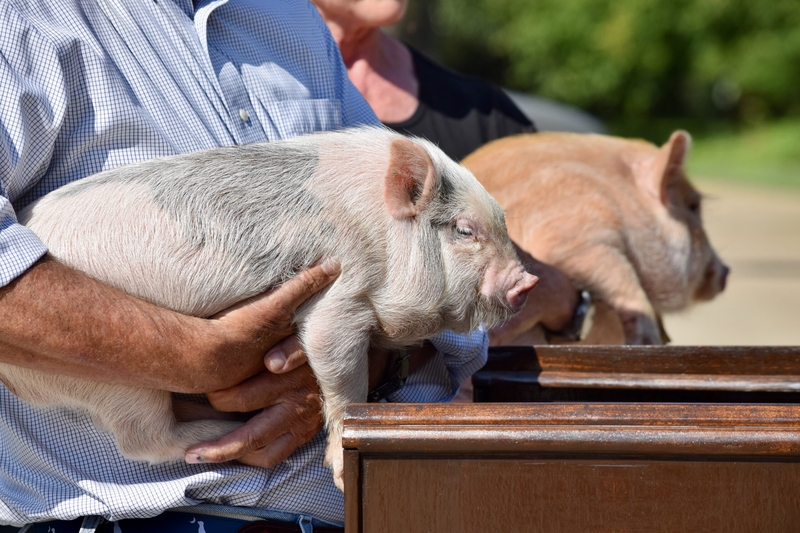
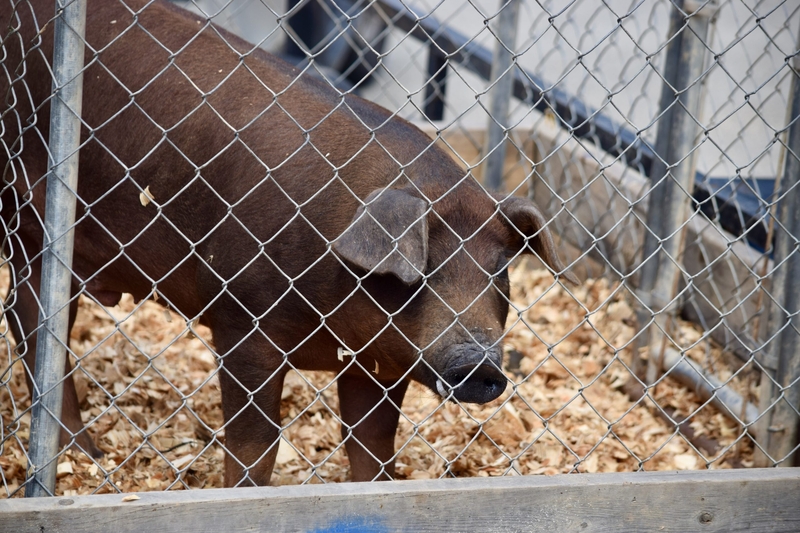
This time, he talked to reporters outside and brought three pigs: A 400-pound Berkshire hog stayed in a pen pulled by a trailer onto the grounds. It represented federal spending, he said.
“Everybody knows how a pig eats, how it’s unrelenting, how it wants more and more, and is that not true of the budget in Washington, D.C.?” he said, noting that 700- and 500-pound hogs at the Greenville farm where they got the swine couldn’t be caged.
Sanford again held a small pig under each arm, but only briefly, as one squealed so loudly, he couldn’t talk above it. The kunekune swine calmed down after he passed it to his sister.
Asked their names, he decided on Debt and Deficit.
“I begin with pig math,” he said, noting that if Pork and Barrel had lived for the last 22 years, they could’ve had 880 piglets, based on normal reproduction. He equated their offspring to compounded interest.
“We’ve seen that math at work against us in Washington, D.C.,” he said. “Pig math doesn’t work for any of us as taxpayers. It will hurt every one of us.”
He’s been preaching against deficits for decades. As governor, that included refusing $700 million of federal stimulus money approved by Congress in 2009 to help states deal with Great Recession-caused holes — until an order by the state Supreme Court forced him to request the aid designated primarily to public schools.
That’s another example of the public spats between the GOP-controlled Legislature and Republican governor, who often used props as he took his arguments directly to the public. In 2005, he used a horse-drawn carriage as the backdrop, as he argued that South Carolina’s government still operated like it was the 19th century. (The legislation he was advocating failed.)
The defecating piglets, which received national attention, provided arguably the most memorable visuals of his complaints about spending.
In May 2004, he stood outside House chambers with a piglet in each arm a day after the chamber overturned more than 100 of his vetoes in less than two hours. The squealing piglets — along with the mess they made on the carpet — infuriated legislators, who continued to overturn his vetoes that day and throughout his tenure. In 2006, ahead of his re-election, Sanford vetoed the entire budget package, which legislators overrode even easier.
And while Sanford’s office created the first detailed executive budget — rather than broad proposals that didn’t balance spending, as prior administrations — his recommendations were largely discarded by the Legislature.
Asked Thursday how he would be more successful as a senator, he acknowledged that he “had many, many vetoes not sustained.”
But what’s not remembered about the pig story, he said, is that it worked.
In 2004, lawmakers needed to dig out of a $155 million deficit carried over from previous fiscal years. While mostly covering it, the budget that Sanford protested with poo on his jacket still left a $16 million hole.
“People got it back home: ‘You’re right,'” he said of how South Carolinians responded.
Legislators were “putting pork barrel spending ahead of a constitutional requirement” to balance the budget, he said.
Ultimately, the debt was erased when the 2003-04 fiscal year closed with higher-than-expected revenues.
Sanford recognizes that his concerns about the federal deficit didn’t gain traction in the past. But with the national debt now at $39.8 trillion, payments on interest alone surpassing spending on major programs, and unaffordability putting the American Dream out of reach for many, he believes the argument matters more than ever.
“No civilization can outrun math, including the United States,” he said.
Earlier this year, Sanford jumped into the open contest for the 1st District in an effort to win back the coastal congressional seat he held before and after his tenure as governor. He ended that bid a month later, saying he planned to form a nonprofit to bring attention to the debt.
He’s still in the process of creating that nonprofit. What becomes of those plans depends on the outcome of the upcoming contests, he said Thursday.
Columbia