Utility reports preview South Dakota’s future, if anybody’s paying attention
Aug 06, 2026 | 5:42 pm ET
Description
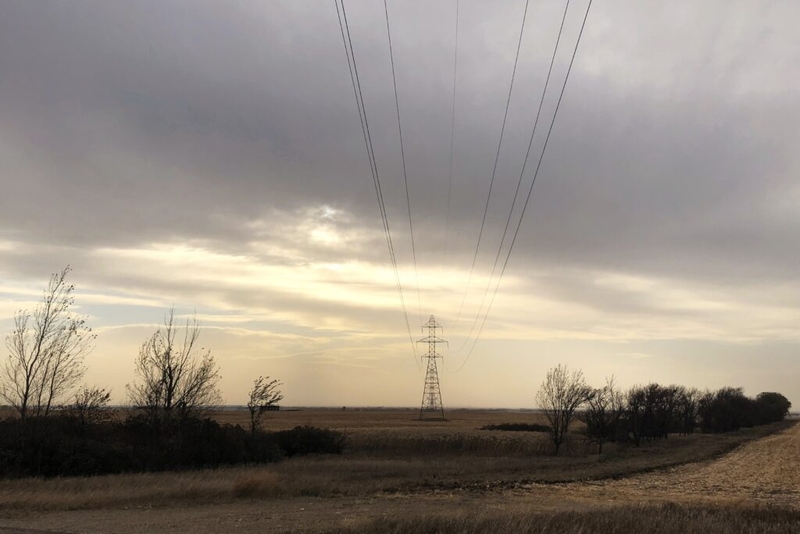
Electric transmission lines near Clark, South Dakota. (Photo by Robert Zullo/States Newsroom)
Five utility planning reports landed at the South Dakota Public Utilities Commission on July 1.
At first glance, they looked like ideal reading for anyone struggling with insomnia.
Load forecasts. Transmission studies. Generation plans. Enough utility jargon to make the owner’s manual for a new grain dryer seem almost exciting.
Stay awake long enough to read all five, though, and a much larger story comes into view.
The filings outline more than $1 billion in publicly disclosed generation projects in South Dakota, plus utility-scale battery storage, new substations and major transmission expansion. And that’s before counting the regional transmission investment likely to follow.
South Dakota inches toward studying nuclear power as data center energy demands loom
New natural-gas plants are proposed near Aberdeen, Rapid City and Toronto. A large battery project is being planned in Codington County. High-voltage transmission lines are being designed to move electricity across the Upper Midwest for decades.
Viewed one at a time, they’re projects. Read together, they’re a strategy. Utilities don’t plan more than a billion dollars in projects because they hope someone shows up. They do it because they believe someone will.
And that matters because South Dakota’s ordinary electric use isn’t growing fast enough to explain everything on the drawing board. More homes, businesses and manufacturing will add demand, but not on this scale.
The utilities are preparing for industrial customers capable of using more electricity than entire cities.
For a glimpse of that future, look just across the state line.
Ellendale, North Dakota, sits about 40 miles north of Aberdeen. A data center there already uses up to 180 megawatts. Another proposed campus could require as much as 350 megawatts.
Together, that’s roughly 530 megawatts — a level of demand in a town of barely 1,000 people roughly equivalent to the average electricity use of about 430,000 homes. South Dakota does not have that many households.
For comparison, NorthWestern Energy’s proposed Aberdeen III natural-gas plant would generate about 131 megawatts.
There’s no public evidence that Aberdeen III is being built to serve Ellendale. Different utilities are involved, and the regional grid is complicated enough without pretending otherwise.
But electricity doesn’t stop at the state line.
Ellendale isn’t some distant curiosity. It’s a nearby example of the size of the customers utilities are preparing to serve. A customer that large doesn’t show up with an extension cord.
And this isn’t only an Aberdeen story.
Western South Dakota is seeing the same shift. East of Rapid City, the 128-megawatt Wild Springs Solar Project is the largest operating solar facility in the state. Black Hills Energy is also building the 99-megawatt Lange II natural-gas generating station in Rapid City.
That’s 227 megawatts of recent or new generation in the Rapid City region alone.
The Toronto plant matters for the same reason. So does the battery project in Codington County. So do the transmission lines that will cross farms, ranches and wildlife habitat to connect the pieces.
These aren’t isolated dots on a map. They’re parts of the same regional picture.
That’s why the five utility reports deserve more than a quick regulatory glance before disappearing onto a government website.
They’re economic development blueprints written by engineers.
The Public Utilities Commission is where many of those plans eventually become permits, rates, contracts and ownership decisions. That makes the commission one of the most important places where South Dakota’s economic future is being shaped, even though most people rarely think about it.
South Dakota should be thinking about what role it wants in this changing economy. Does the state want to produce power, move power or recruit industries that consume enormous amounts of it?
There could be construction jobs, permanent employment, tax revenue and economic growth. There will also be tradeoffs.
Who pays for the infrastructure? How do local communities benefit? How will private property, productive farmland, wetlands and wildlife habitat be protected?
Those questions should be asked before a permit application arrives — not after a route has already been drawn across someone’s land.
For years, South Dakota has debated wind farms, pipelines and transmission lines one project at a time. By then, the argument is usually over a route, a setback or a particular piece of ground.
Those questions matter, but they aren’t the first question. The first is what kind of South Dakota all this power is being built to serve.
The utilities are already planning for that future.
It might be wise for the rest of us to stay awake and do the same.

Pierre, SD