Huntington community organizers start ballot initiative to prohibit Flock cameras
Aug 06, 2026 | 6:00 am ET
Description
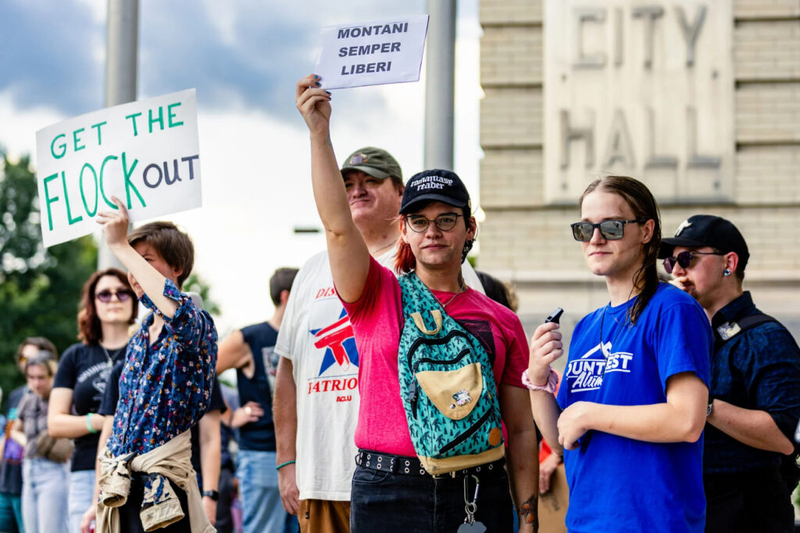
Protestors gather outside of Huntington City Hall as they respond in opposition to Flock Safety items listed on the Huntington City Council agenda on Monday, July 13, 2026, in downtown Huntington. (Photo by Ryan Fischer/The Herald-Dispatch)
Weeks after Huntington City Council voted to move forward with the purchase of a $2.1 million Flock surveillance system, organizers against the proposal are starting an effort that, if successful, would prohibit the devices in the city.
The Huntington Community Action Group launched its “Get the Flock Out” ballot initiative at a rally Wednesday at Marshall University. The group wants to pass an ordinance prohibiting mass surveillance systems in the city. One provision of the ordinance would require the city to void the contracts with Flock Safety it approved last month.
Council members voted 6-4 to approve the contracts for audio detection, live video cameras, drone services and license plate recognition at a July 14 meeting that stretched several hours into the early morning. More than 50 people spoke against using the contracts with Flock, a company that’s been criticized for privacy and civil liberties concerns in other municipalities where they’ve contracted. Huntington Community Action Group also led a rally against the systems before the council meeting.
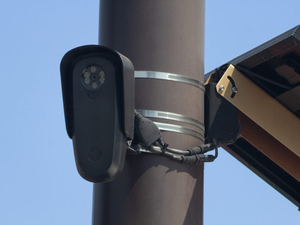
According to the ACLU, between 80,000 and 100,000 Flock devices have been installed on urban and rural areas of highways. The automated license plate readers are more powerful than typical license plate readers and analyze the make, model and color of cars they see, along with other identifiers like scratches and dents, and even pedestrians passing by, according to the ACLU.
The systems analyze recordings and upload data to a national surveillance platform and store it in a way that’s accessible by law enforcement and Flock users everywhere, according to ACLU.
During the meeting, Huntington Mayor Patrick Farrell spoke in support of the Flock system, saying the devices would lead to convictions of people harming the community. He said license plate readers had been used in another city to arrest a man suspected in the shooting death of Huntington resident Jackie Harper on July 7.
The American Civil Liberties Union of West Virginia filed a lawsuit against the city over the cameras in Cabell County Circuit Court, alleging the city neglected key procedural matters in awarding the contract.
Matthew Lebo, HCAG’s treasurer and an organizer within its Democracy Task Group, told West Virginia Watch Wednesday afternoon that the organization’s rally that evening would serve as canvassing training for volunteers who will go door-to-door in the city collecting signatures for the ballot initiative.
“That is where most of our energy has been spent the past week, creating the materials and training we need to go door-to-door,” Lebo said. “In addition to that, we are going to be sending people to special events with a couple clipboards to do some crowd canvassing, and we will be arranging a regular series of special events, rallies, and town halls across Huntington, also to collect signatures.”
According to the Huntington city charter, initiative petitions must be signed by at least 10% of the number of registered voters during the last municipal election.
Chrisa Hayes, communications director for the city of Huntington, said that 13,574 ballots were cast during the 2024 city mayoral race. She declined to comment on the initiative.
Lebo said the organization’s goal is to collect 4,000 Huntington signatures — or a little more than 10% of the 27,000 Huntington residents who were registered to vote during that election. The extra signatures will account for those the city invalidates for various reasons, like signatures not matching, or a voter not updating their address, or believing they lived within the city limits when they don’t, he said.
The organization hopes to collect the signatures by the end of September, though that deadline is not a requirement in the city charter.
If the city deems the petition to have the sufficient number of signatures, city council must consider the proposed ordinance within 60 days, according to the charter. If council does not approve the ordinance or changes it, it must refer the ordinance to a vote by the city. The election must then take place between 30 days and one year later. If there’s no regular election during that time frame, the city must provide a special election on the proposed ordinance.
The ballot initiative is also being supported by the ACLU-WV, West Virginia Citizen Action Group and West Virginia Can’t Wait.
Lebo said the group is learning the ballot initiative process as it goes along. There’s not a template for the process other than what’s in city charter and state code, he said. The group wrote a letter to the city’s attorney for guidance, but got no response, he said.
“We have asked for a template petition,” he said. “We have submitted Freedom of Information Act requests, trying to find template petitions. There are none. We are building this ship as we sail it.”
Lebo said he’s been surprised by how excited people are to support the work to reject Flock. Several times in the past month, he said, he’s walked into city businesses and heard people talking about it, or people have recognised him from a city council meeting or town hall organizing meeting, he said.
Posts about Flock cameras on the group’s social media page have received about 140,000 views and more than 13,000 engagements. The organization’s number of followers have quadrupled in the last month, he said.
“There is so much public excitement, not and not just from Huntington either,” he said. “Our organizing and the pressure we are applying in Huntington is rippling out throughout the region.”
After the July 14 meeting, city leaders in Barboursville and Ironton, Ohio have come against the use of Flock cameras. St. Albans voted to reject the systems. The backlash led to Putnam County officials pausing the implementation of the Flock cameras that they had already purchased, but not installed.
“People are so fired up in Huntington to ban mass surveillance that everyone in the region seems to be taking notice,” Lebo said.
Charleston, WV