Moore: New deal allows state to direct the future of Preakness
Aug 06, 2026 | 4:32 am ET
Description
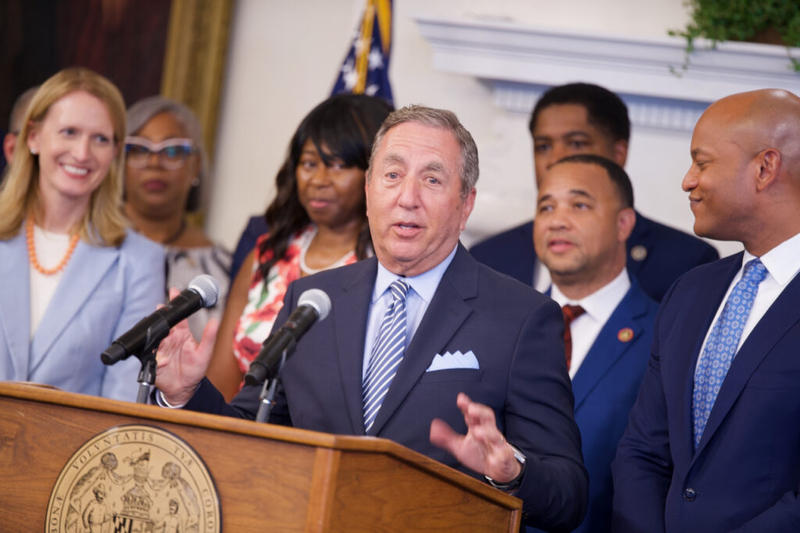
Jon Miller, president of acquisitions and partnerships at NBC Sports, and Gov. Wes Moore (D) announce a new six-year network television deal to broadcast the Preakness and other thoroughbred horse racing in Maryland. (Photo Bryan P. Sears/Maryland Matters)
Changes lie ahead for Maryland’s signature thoroughbred horse race, including a new, later race day and a new, expanded network television contract.
Gov. Wes Moore (D) announced the changes Wednesday to the Preakness Stakes, historically the second event in racing’s Triple Crown. It was the latest in a week of rapid-fire developments that saw the state buy rights to the Preakness away from Kentucky Derby owner Churchill Downs, which responded by announcing a new national thoroughbred racing series that excludes the Preakness.
Wednesday’s changes mean that a race always run on the third Saturday of May — two weeks after the Kentucky Derby — will happen a week later. And on a Sunday. As part of expanded television coverage for a planned Memorial Day weekend of racing, with the state-owned Black-Eyed Susan Stakes being run on Saturday.
Moore said the new television deal and race day changes are meant to ensure the growth of the taxpayer-owned Preakness, the thoroughbred racing industry in the state and the neighboring Park Heights Community.
“Because I will always bet on Maryland, today, this Preakness deal joins the list of things that will not just grow our economy, but continue to show that in Maryland, we control our own destinies, and we don’t need others’ help to do it,” Moore said. “The Preakness can and will remain the second jewel of the Triple Crown, and nothing will change that.”
The changes will start with the 2027 Preakness.
Preakness, Pimlico left out of new race series by Churchill Downs, Belmont
Moving the Preakness back a week was seen as important because trainers of horses that run in the Kentucky Derby — including winners — have sometimes decided to skip the race in Baltimore to rest their horses for the longer Belmont Stakes in New York, the third leg of the Triple Crown. Doing so eliminates the potential for a Triple Crown winner and the public attention that comes with that possibility.
“The Triple Crown will continue to be one of the marquee sports events of the year, and we’ll continue having Preakness be at the center,” Moore told reporters.
NBC and the Maryland Jockey Club reached an agreement on a new six-year deal that includes coverage of the Preakness as well as the Black-Eyed Susan stakes and two other races — Preakness Preview Day in April and Maryland Million Day in October.
Maryland Jockey Club President and General Manager Bill Knauf said the focus is on showcasing the Preakness.
“Triple Crown has been going for 100 years, and it’s going to be around for 100 more, and it will always run through Pimlico,” he said.
The network, Maryland Jockey Club and Moore declined to provide financial details of the agreement.
Jon Miller, president of acquisitions and partnerships at NBC Sport, suggested the deal could include some sort of incentives possibly tied to viewership. NBC had long sought moving the race back a week in hopes of luring Kentucky Derby champions to the second jewel of the Triple Crown.
“When this process began, we showed them not only the benefits of obviously getting more horses in, but also the increased ratings,” Miller said. “Increased ratings create more revenue opportunities for us. More revenue opportunities for us gives us more money that we can turn around and pay the Preakness and the State of Maryland. So it works out.”
The announcement was applauded by Mark Anthony Thomas, president of the Greater Baltimore Committee.
“Ten years from now, we’re going to look back at this moment and this will be one of the smartest investments Maryland has made in one of its most prominent assets,” Thomas said.
Moore’s announcement follows a flurry of activity in which the state announced the purchase of the intellectual property rights for the race.
“You cannot control your future if you do not own it,” Moore said. “You do not control what the future brings if you aren’t the ones making the decision about what the future brings. Maryland now owns the rights. Marylanders now own the assets. Marylanders will make the decisions.”
Ownership came with a cost. The purchase of two racetracks, the ill-fated purchase of a Carroll County farm meant to be a training center and $85 million for the intellectual property rights for the Preakness and Black-Eyed Susan. All in an industry that has its share of struggles as it tries to reinvent itself and attract new fans.
Maryland now effectively owns and controls the thoroughbred racing industry in the state.
“The Governor stated Maryland controls its own destiny,” said Senate Minority Leader Stephen S. Hershey Jr. (R-Upper Shore). “Maryland controls the Preakness. It doesn’t control Churchill Downs. It doesn’t control NYRA (New York Racing Association). And it doesn’t control where the nation’s best horses choose to run.”
Churchill Downs had offered $85 million to buy the intellectual property rights to the Preakness and Black-Eyed Susan Stakes from 1/ST Racing, but the state had a right to match that offer and it did, closing the sale last week. Days later, Churchill Downs and the New York Racing Authority, which owns the Belmont, announced a championship race series. The first two races in the six-race series are the Derby and the Belmont Stakes — the bookends of thoroughbred racing’s Triple Crown.
Senate President Bill Ferguson (D-Baltimore City), speaking Tuesday, had not been briefed on Moore’s announcement but said the Churchill Downs announcement was worrisome.
State finalizes deal to buy rights to Preakness for $85 million
“I don’t think the timing is a coincidence,” Ferguson said.
When asked if it was meant to be punitive, Ferguson said: “It’s not for me to say, but the timing certainly is. It appears to be quite highly correlated.”
Ferguson and other officials have questioned the state’s continued and deepening involvement in thoroughbred racing. The Preakness being left off the championship schedule has not diminished those concerns.
“My first read is this isn’t good, but I’m waiting for details to make sure that we’re not making decisions out of haste,” Ferguson said.
The exclusion raises questions about the fate of the Triple Crown and how that might affect the Preakness.
“The Thoroughbred Championship Series is designed around horses progressing from the Kentucky Derby to the Belmont Stakes and then through the rest of the championship season,” said Hershey. “If trainers are pursuing points in the Thoroughbred Championship Series, what incentive do they, other than the Derby winner, have to interrupt a five-week preparation for the Belmont Stakes by running in the Preakness two weeks earlier?”
Moore told reporters he is open to further discussions with Churchill Downs.
“You know we’re eager to continue conversations with Churchill Downs, but we’re also just very clear that maintaining the ownership of the Preakness is important to Maryland,” Moore said.
“Maintaining ownership of the assets connected to Preakness is important to Maryland. Making sure that we’re investing in not just the track but also our communities is important to Maryland,” he said. “So we’re always looking to partner with anybody to include Churchill Downs, but we’re also very clear about what the terms of those conversations are.”
Annapolis, MD