Amazon abandons plans for data center campus at Calvert Cliffs
Aug 04, 2026 | 1:43 pm ET
Description
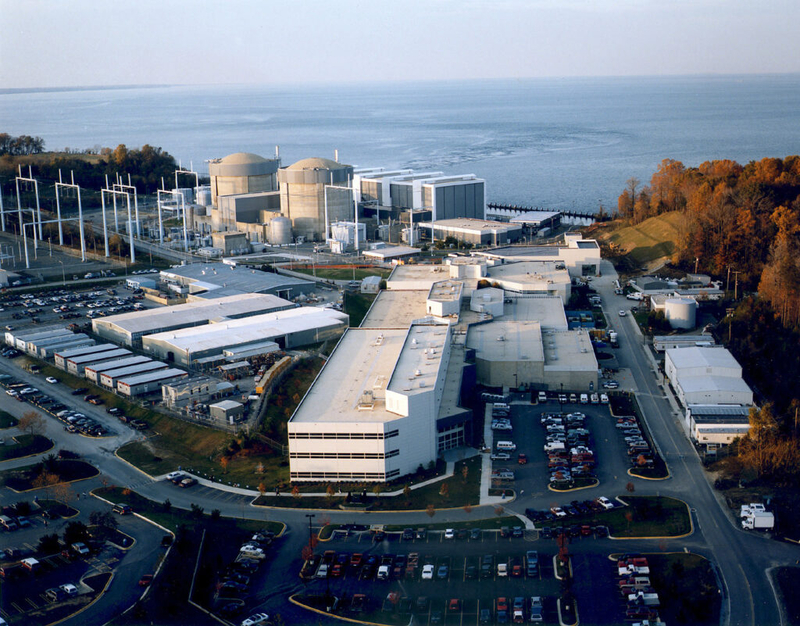
The Calvert Cliffs Nuclear Power Plant Units 1 and 2 are located near Lusby. (Photo courtesy the Nuclear Regulatory Commission)
Amazon Web Services is abandoning its plans to develop data centers on the campus of Southern Maryland’s Calvert Cliffs Nuclear Power Plant, according to a news release issued Tuesday by Calvert County government.
It comes after fierce voter pushback against hyperscale data centers in Calvert County’s primary election on June 23.
The three county commissioners who previously voted against a pause on data centers were all ousted in their primaries by candidates who took issue with the trajectory of data center development in the county thus far. The commission president and vice president, Todd Ireland (R) and Mark C. Cox Sr. (R), both lost their races, as did commissioner Earl F. “Buddy” Hance (R).
The Amazon proposal was for “multiple data center campuses” at Calvert Cliffs, covering 2.4 million square feet, according to a planning document published on the Calvert County government website. The company submitted its proposal to Calvert in early May.
“Calvert County Government remains committed to transparency and will continue to provide updates on significant development proposals and application activity,” read Tuesday’s news release. “Keeping residents informed through accurate, timely and accessible communication remains a priority.”
On Aug. 18, the county will host a public meeting to consider a “temporary six-month moratorium on site plan approvals for data center development projects,” according to another news release issued Tuesday.
Data center frustrations cause upheaval in county primary elections
“The proposed ordinance would establish a temporary moratorium to allow time to review and adopt regulations and zoning ordinance text amendments related to data centers and heavy industrial use conditions, and to complete any necessary studies or analysis,” the news release reads.
In a statement Tuesday, an Amazon spokesperson said the company “appreciated the engagement” of Calvert County residents, but insisted that this was purely a business decision. The company will continue to assess opportunities in Maryland and it remains “a valued partner” to Constellation Energy, the spokesperson said.
“After careful evaluation, Amazon has decided not to move forward with the proposed site development in Calvert County at this time,” the statement said. “We regularly evaluate infrastructure opportunities based on a range of factors, including development timelines, operational requirements, and our ability to deliver quickly for customers.”
The stament said Amazon “remains deeply committed to Maryland.”
Calvert Cliffs owner Constellation argued in a statement that although AWS has withdrawn its plans, “the opportunity continues in Maryland and Calvert County to create jobs, grow the economy and support in-state federal agencies through investment in digital infrastructure.”
“All of this can be done responsibly while protecting and expanding the Calvert Cliffs Clean Energy Center, Maryland’s largest source of clean, reliable energy. Constellation looks forward to continuing to work with the county and state on this opportunity,” read the statement.
In addition to the proposal for a data center on the Calvert Cliffs site in Lusby, another company, called Natelli Holdings, has also proposed a data center close by. That facility, if built, would be located along Route 4 near Calvert Cliffs State Park, as well as an existing landfill, wastewater treatment facility and county-owned gun range.
The electoral result in Calvert was perhaps the most acute example statewide of data centers’ growing impact on local politics, though voters in Frederick County also ousted their council chair, Brad Young, after the council voted to expand an existing data center zone in Adamstown, while restricting data centers in other parts of the county.
After the election, Frederick County Executive Jessica Fitzwater enacted, via executive order, a pause on data center development through the end of the year. In a statement, Fitzwater said that during the pause, county officials hope to educate voters about data centers and the zoning change during a series of public meetings. But county leaders still plan to move forward with the data center campus, currently planned at 2,500 acres.
In other counties in Maryland, the pauses, or moratoriums, are longer-term. Prince George’s County currently has the longest ban, a two-year hold that was enacted in July.
Melissa Emmal, a resident who started an online petition calling for a data center moratorium in Calvert County, said Amazon’s withdrawal is “a welcome development.” But the company could still resubmit a proposal, she noted. And the news “doesn’t change what we’re asking for,” she said.
“We’re continuing to gather signatures on the petition and asking the community to show up strong on August 18 in support of the moratorium. We need the time for the appropriate studies and zoning changes before any of these projects move forward,” read a statement from Emmal, whose Change.org petition has attracted over 10,000 signatures.
In a joint statement, board members for Save Lusby Inc. — a local nonprofit that opposes what it sees as excessive development in the area — also called on the county government to take further steps.
“We look forward to hearing what the current and future County Commissioners will enact with Moratoriums and Zoning Ordinances to ensure the preservation of our unique county is met with community involvement and thorough research,” read a statement from the board.
According to a news release issued last month by the Chesapeake Climate Action Network (CCAN), nearly 77% of Maryland’s population currently lives under some kind of data center moratorium.
Many of the state’s most populous counties have adopted measures, including Montgomery, Prince George’s, Baltimore County and Baltimore City. Harford County enacted a ban with no time limit.
Smaller and more rural jurisdictions have also adopted one-year pauses, including Queen Anne’s County on the Eastern Shore and Washington County in Western Maryland.
“Grassroots outrage from across the state has made it clear that a moratorium is the most reasonable course of action that can be taken right now,” said Brittany Baker, Maryland director at CCAN Action Fund. “The playing field has quickly shifted in the last few months, which is why I expect the Maryland General Assembly will likely take a serious look at statewide moratorium bills during the 2027 session.”
— This story has been updated to add comments from Amazon, from Constellation and from local activists.
Annapolis, MD