Mental Health Courts Help Divert People From Jail. Why Don’t More NY Counties Have Them?
Aug 04, 2026 | 5:00 am ET
Description
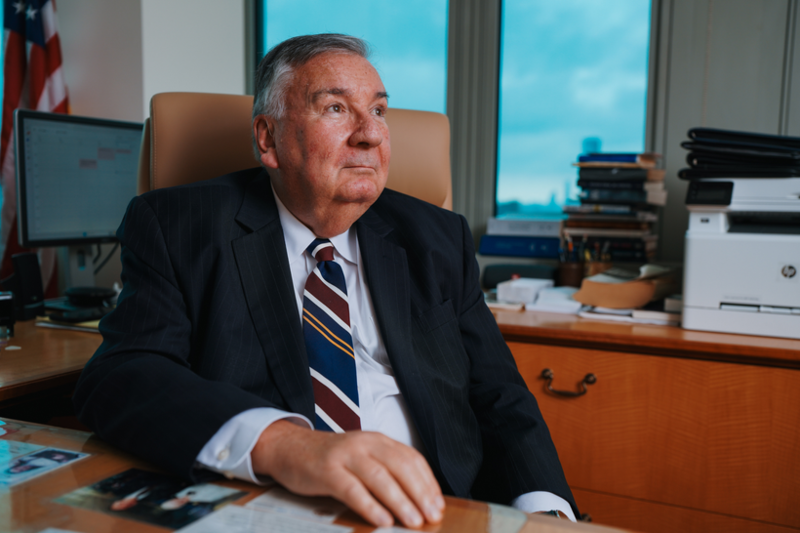
On a recent July morning, a defendant appeared in a New York courtroom in a loose-fitting white dress shirt, his wrists handcuffed at his back.
“The DA’s fed up, they say you belong in prison,” Judge Matthew D’Emic told the man. “I’m not saying that. I’m trying to help you.”
D’Emic runs the Brooklyn Mental Health Court. Instead of sending the man back to jail, he was releasing him to a residential treatment facility. Colorful decorations softened the courtroom. A banner on D’Emic’s bench read, “Hello summer,” and images of tropical fruit adorned the walls.
“The question is,” D’Emic said, “How do we give you a foundation for the rest of your life that is built on bedrock and not on sand?”
The defendants on D’Emic’s docket typically live with serious mental illnesses like schizophrenia or bipolar disorder. Most arrive in his courtroom facing felony charges related to assault, robbery, or burglary. In exchange for a guilty plea, they can access community-based mental health treatment, supportive housing, and other services. If they complete the court-supervised program, their charges are generally reduced or dismissed.
For many participants, it pays off. Recent graduation rates from the program have ranged from 73 to 87 percent, according to data from the Center for Justice Innovation, which runs the court in partnership with the state judicial system. An evaluation of the court found that participants tend to see significant reductions in re-arrest.
More than 40 mental health courts like D’Emic’s have sprung up across New York state since the early 2000s, part of a growing effort to provide alternatives to incarceration. Their goal, proponents say, is to stabilize vulnerable New Yorkers, interrupt cycles of hospitalization and incarceration, and create safer communities. Research, though limited, suggests that they can be effective at reducing recidivism and driving increased use of mental health services.
But while New York state’s network of mental health courts has expanded in recent years, its reach remains modest. Roughly 1,700 people were active, compliant participants in mental health courts statewide last year, according to data from the Office of Court Administration for the New York State Unified Court System obtained through a FOIL request.
About half of New York’s 62 counties still don’t have a mental health court. Unlike drug courts, which serve people with substance use issues, mental health courts aren’t required by state law. “You walk over an invisible line that divides two counties, and the legal outcomes are completely different,” said Leanne Lapp, the public defender in Ontario County, near Rochester. (A law signed by Governor Kathy Hochul in December provides a stopgap, allowing a case to be transferred from a county that doesn’t have a mental health court to a neighboring one that does.)
Graphic: Eliza Fawcett / New York Focus
At the Brooklyn Mental Health Court, widely seen as a model for judicial diversion, a total of 1,560 people have graduated from the program from when it opened in 2002 to the end of last year. Meanwhile, about 1,600 people with a serious mental illness were incarcerated in New York City jails in December alone. Judicial diversion can be powerfully effective, participants and advocates say, but it’s a path that’s open to very few New Yorkers who might benefit from it.
In a statement, Al Baker, spokesperson for the Office of Court Administration, said that the court system “relies on deep, differentiated assessments of every individual” to determine eligibility for mental health courts. Many incarcerated people who have been diagnosed with a mental illness don’t meet the criteria for diversion, he noted, and some who would be eligible for diversion choose to litigate their cases.
The leadership of the state’s court system has pledged to expand access to these courts. A dozen counties have mental health courts in development, in addition to the 30 counties with existing programs, according to Baker.
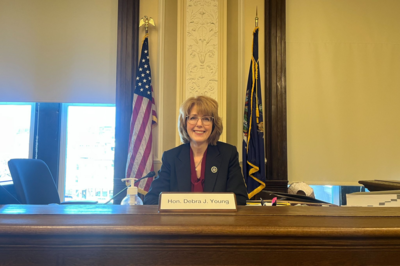
“Our goal is to have one in every county as soon as we possibly can,” Judge Debra Young, who coordinates statewide problem-solving courts, told New York Focus during an interview in her Troy courtroom. “I’m approving documents for new courts on an almost daily basis.”
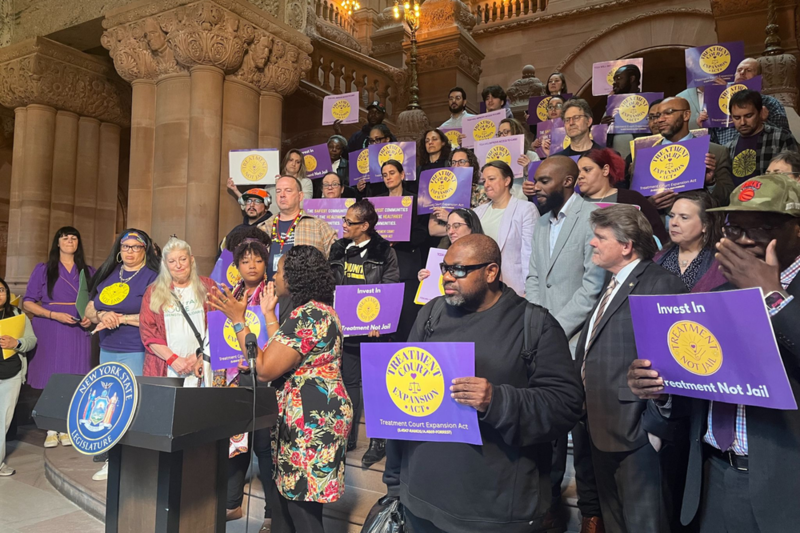
Proponents of mental health courts say the legislature needs to invest more resources in this system and enshrine it in state law to maximize its impact. A proposed reform, the Treatment Court Expansion Act, would standardize mental health courts, widen eligibility for diversion, and reduce plea requirements, among other changes. The bill has repeatedly stalled in the state legislature in recent years, despite support from Court of Appeals Chief Judge Rowan Wilson and Chief Administrative Judge Joseph Zayas.
New York City Mayor Zohran Mamdani has also expressed support for the measure, which he described earlier this year as “one part of what it can look like to ensure that we are closing Rikers Island.” His office did not respond to requests for comment.
At a rally at the state capitol in May, Assemblymember Phara Souffrant Forrest, who represents parts of Brooklyn and has sponsored the Assembly version of the bill, urged the governor to support the bill. “It’s a damn shame,” she said, “that when we have somebody facing a psychotic break, or they’re struggling with depression, or they’re struggling with trauma, we say at this time, ‘The only answer that you’ll get is punishment.’”
While mental health courts can be life-altering, routing a defendant into treatment can be an exceedingly slow process. Some delays in the diversion process are inevitable, like waiting for the right services to come together. But extending incarceration has a serious cost, and can exacerbate symptoms of mental illness.
In early 2019, Tracy Barber, a longtime Manhattan resident, was in a destabilizing period of her life. She was in a troubled relationship, struggling with alcoholism, and had uneven access to her antipsychotic medication. One night, she pushed an acquaintance during a dispute and landed on Rikers Island with a felony assault charge.
While incarcerated, her mental health sharply declined.
“I just was not in touch with reality,” said Barber, 48, who has been diagnosed with borderline personality disorder and bipolar disorder. “The social workers would come by to see me, and I would just stare at them.”
Barber had difficulty accessing the right medication and spent a couple months at a jail psychiatric ward. She started hearing voices, stopped eating, and lost a significant amount of weight.
Many months later, a reprieve arrived: diversion into the Manhattan Mental Health Court. Over the next year, she participated in an outpatient rehabilitation program, worked with a therapist, and attended regular court dates.
“Mental health court is wonderful,” Barber said. “Obviously, what brings people into mental health court is not. But it’s the process of mentorship, and within the community, which is where I think change can really happen. I don’t know if jail really reforms anyone, rehabilitates anyone. I think it just breaks people.”
At the Brooklyn Mental Health Court, it can take more than a year to divert a case from jail, according to Center for Justice Innovation data. Last year, the median time from arrest date to first contact with mental health court clinical staff was 265 days — nearly nine months. For the typical participant, it took another 104 days to find out if they were eligible for the court, followed by an additional 56 days to actually start the program.
Demand for the court has been increasing. Aside from a dip during the pandemic, the court’s number of active participants has grown modestly but steadily, from 308 in 2019 to 364 last year. Referrals — typically from public defenders — are also up, and have increasingly outpaced the number of new participants the court accepts each year.
Graphic: Eliza Fawcett / New York Focus
In Manhattan, the drawn-out process can be “very discouraging” for people with serious mental illness, said Rebecca Azuga, a trial attorney at New York County Defender Services.
One of Azuga’s clients, a woman with schizophrenia facing multiple felony charges, recently spent about 10 months on Rikers Island, waiting to see if she could enter the Manhattan Mental Health Court. She was motivated to access treatment and wanted to be reunited with her young daughter, Azuga said. But leaving jail hinged on how a prosecutor evaluated her case. Diversion typically involves a risk assessment and the victim’s consent.
In April, Azuga said that her client often felt “hopeless,” because it seemed like nothing was happening. The following month, after nearly a year in jail, she was able to enter the Manhattan Mental Health Court.
“She was almost in disbelief that it was going to happen because of how much it had been pushed back,” Azuga said.
When Azuga’s client was released, she had one request: that her mother bring her Chipotle. In the months since then, she has settled into her residential treatment program, consistently following her treatment plan. Her daughter has been able to come for visits.
“Mental health court provides that sort of final diversion point that can actually be transformative because of its intensity.”
—Nathan McLaughlin, NAMI New York State
Baker, spokesperson for the Office of Court Administration, said in a statement that the court system “works closely with all our partners to streamline procedures and reduce delays wherever possible while ensuring that each case is carefully reviewed to protect the safety and security of participants and preserve the integrity of our court initiatives.”
In a late June New York City Council hearing focused on addressing delays in case processing across the court system, Chief Administrative Judge Zayas emphasized the importance of efficient diversion into mental health courts and other specialized programs.
“The faster we engage these individuals with the services and treatments they need, the more likely these interventions are able to be effective,” he said.
Mental health courts aren’t universally accepted as a solution to the significant proportion of people with mental illness in jails and prisons. Critics point to the risk of making access to treatment contingent on arrest and the reality that some participants don’t graduate and are ultimately sentenced to incarceration. Ira Burnim, senior counsel at the Bazelon Center for Mental Health Law, said that instead of bolstering judicial systems, deeper investments should be made in earlier interventions like crisis services, wraparound outpatient treatment programs, supportive housing, and employment assistance.
Advocates of these courts, like Nathan McLaughlin, the executive director of NAMI New York State, agree that early interventions are critical. But they argue that some people with serious mental illness will still land in jail — and deserve an off-ramp.
“Mental health court provides that sort of final diversion point that can actually be transformative because of its intensity,” McLaughlin said.
Still, even the most well-intentioned efforts to divert vulnerable people from jail hinge on the availability of local providers — residential treatment programs, supportive housing placements, and other services to which diversion courts refer their participants.
Dr. J. Steven Lamberti, a professor of psychiatry at the University of Rochester Medical Center, said he sees mental health courts as an important option for people with serious mental disorders facing criminal charges. But the expansion of diversion programs must be matched with investments in community mental health systems, he emphasized.
“Any diversion approach is only as effective as the services that people are diverted to,” Lamberti said.
The mental health court in Ontario County, perched near one of the Finger Lakes, sees just a few cases each week. The county doesn’t have the service resources of nearby Rochester, said Lapp, the public defender.
Finding housing for mental health court program participants can be a challenge, Lapp said, as can identifying treatment options for people with complex cases.
“It’s my hope that when we expand mental health courts — and I think we will — that treatment providers will rise up to meet that need,” said Lapp, who supports the Treatment Court Expansion Act.
Similar hurdles persist in New York City, including significant waitlists for supportive housing, which offers tenants health care and social services in addition to a place to live, and the limited availability of beds in residential treatment programs.
“I don’t know if jail really reforms anyone, rehabilitates anyone. I think it just breaks people.”
—Tracy Barber, whose case was diverted to the Manhattan Mental Health Court
Harbor House is a rare program that offers residential treatment for people with both serious mental illness and substance use disorders. Mental health court participants fill many of its 116 beds in the Bronx, said Miriam Vega, the CEO of Argus Community, the social services provider that runs the program. Harbor House clients receive integrated mental health treatment and substance use disorder counseling, as well as trauma-informed therapy, she said.
A typical stay at Harbor House is about 350 days, reflecting the significance of clients’ needs, she noted, and clients are often discharged to family or to supportive housing — which is often in short supply. As of late June, there were 36 people on Harbor House’s waitlist, according to Vega.
“If we could, we would open up one in every borough,” she said.
Experts and clinicians say that New York state needs deeper investments in treatment and housing programs for those in mental health court programs — and to ensure continued access to support after court supervision ends.
“Diversion is just the off-ramp from the criminal justice system,” said Ruth O’Sullivan, senior director of clinical practice at the Center for Justice Innovation. “But recovery is a lifelong process.”
At the Brooklyn Mental Health Court, participants often spend a year or more in the program, and their progress rarely follows a straight line. Some turn up in the emergency room, or disappear on their way to supportive housing. But the court is a place of second, third — and fourth — chances.
Judge D’Emic described a case of a woman who seemed to thrive in a residential treatment program for half a year, only to disappear and later resurface with a petty theft charge. She’ll receive another chance at diversion, he said, “because the balance between public safety and trying to do right by her hasn’t tipped to public safety.”
David Kelly, chief of the mental health unit at the Brooklyn District Attorney’s Office, pointed to the community benefit of helping people manage their mental illness and the cost-effectiveness of judicial diversion. But some time ago, he said, he had “a little bit of an epiphany.”
“I said to myself, ‘You know what? This is just the fair, the right way to resolve a lot of cases,’” he said. “I’m not so sure that I think it’s really the most important cost-saving thing to do. It might be the thing that’s most right and just.”

Albany