Empty Homes Tax: Some Like The Idea. Oʻahu Politicians Won’t Hear Of It
Aug 03, 2026 | 6:01 am ET
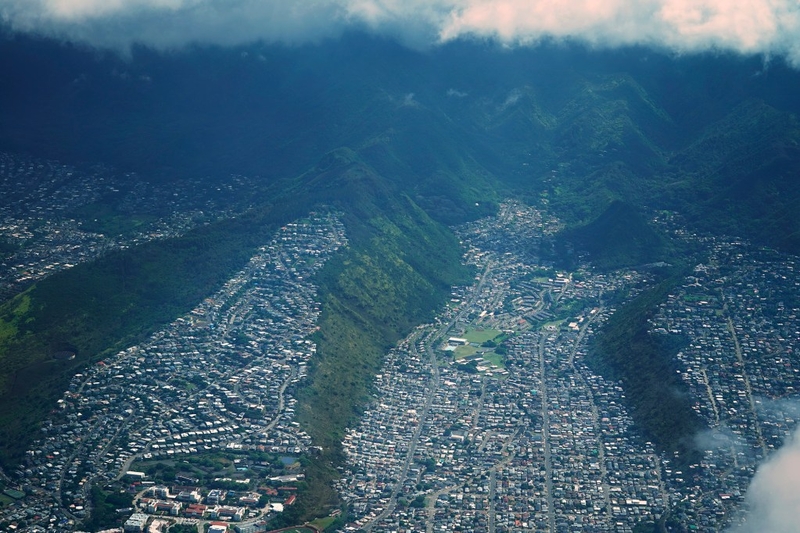
Description
Photo courtesy of Honolulu Civil Beat
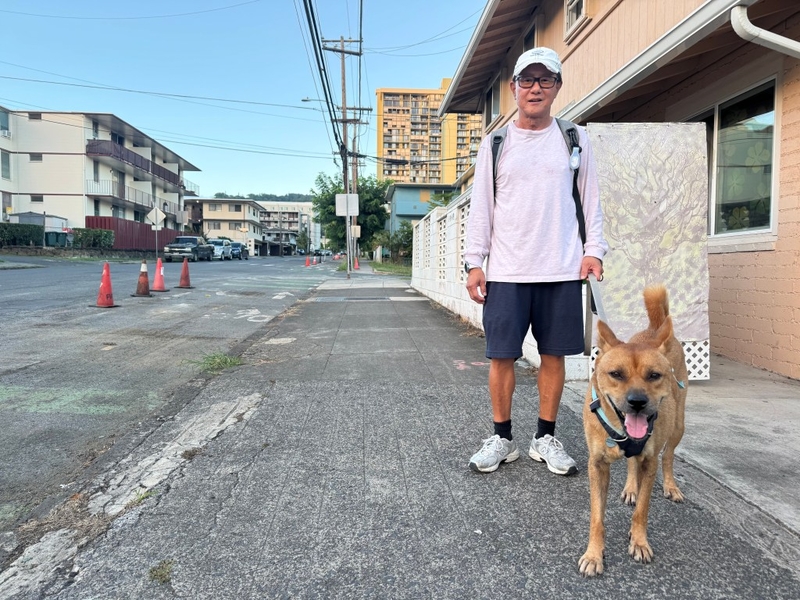
Housing in Hawaiʻi has been expensive for a long time. And for Wes Tashiro, who raised a family in ʻEwa Beach before downsizing to Makiki, it feels like there’s never any relief.
“It feels like it’s getting worse,” said Tashiro, who is retired after a career working at Hawaiian Electric Co. “I’ve just seen prices just go up out the door.”
Tashiro, 66, likes one solution that’s been proposed: taxing empty homes. Implementation could be tricky, he said, but he thinks it could help tame the housing market.
The idea of an empty homes tax has animated Honolulu housing advocates who want to incentivize property owners to fill unused units on an island where land is scarce and new construction is expensive. A city study found it could bring in tens of millions of dollars in tax revenue annually and put up to 2,000 properties on the market over the next 10 years. While the proposal wouldn’t single-handedly end Oʻahu’s relentless housing crisis, they say, it could tamp down demand from offshore investors who purchase homes they leave vacant while locals struggle to find housing they can afford.
But the concept has hit a wall at the Honolulu City Council, which refused to hold a vote on a bill, and in Mayor Rick Blangiardi’s administration, which canceled an effort to even study the idea.
Now, supporters of the concept have found themselves without a say in the matter. The Honolulu Charter Commission recently dismissed a proposal to allow voters to weigh in on an empty homes tax during this year's general election. The measure was just one vote shy of making it onto the ballot.
“It’s really disappointing,” said Robert Perkinson, a history professor at the University of Hawaiʻi Mānoa who had testified in support of the now-defeated empty homes tax bill. “All of the tens of thousands of people in Hawaiʻi who are struggling to have one home – struggling and often failing – were outshouted by the very small number of people who have two or more homes.”
The proposal, heavily opposed by the real estate industry, received two key points of criticism. The first was that local residents who possess second homes, through inheritance or otherwise, would be hurt by it. The second was that the city simply lacked the capacity to administer it.
“We don’t throw half-assed solutions up against the wall expecting they’re going to work,” Blangiardi said in June. “This one sounded good. When we did the deep dive, it wasn’t. That’s why it never went anywhere.”
Honolulu killed its proposal while the idea of taxing empty homes is gaining some traction nationally, including a new pied-a-terre tax that takes effect in New York City this year.
Similar taxes have been implemented in the Bay Area, including in Berkeley and Oakland. Voters in neighboring San Francisco approved an empty homes tax that exempted single-family homes, but the San Francisco Superior Court struck it down, and the city’s appeal is currently pending.
Flood Of Testimony
Honolulu’s proposal would tax empty housing units at a higher rate to encourage their owners to either rent out the units or sell them to someone else, increasing Oʻahu’s supply of housing. And for owners who keep their properties empty and pay the tax, the revenue could help fund affordable housing projects or other city functions.
Homes left unoccupied at least six months out of the year would be classified as empty, according to the most recent version of Bill 46. The tax would represent a new tax category rather than an additional surcharge. Details have varied among different proposals over the years, but the tax rate discussed tended to be between 1% and 3% of a home’s assessed value. Residences under $1 million not occupied by their owners are currently taxed at 0.4%, while those over $1 million pay 1.14%.
Tax revenue from people who chose to leave their units empty could collectively contribute tens of millions of dollars to the city.
Supporters, including housing advocates from the coalition Housing Now! and Council Chair Tommy Waters, who co-introduced the bill, marketed the proposal as targeting wealthy offshore investors. But during a series of long and often passionate hearings, council members also heard from local residents worried they would end up as collateral damage.
Waikīkī resident Robert St. Onge, who testified to the council in 2024, worried an empty homes tax would threaten his family’s future plans.
St. Onge’s husband is from New Mexico, and he bought a house there a couple decades ago that he currently rents to a long-term tenant. The couple’s plan in the coming years is to split time between their New Mexico house and their current apartment in Waikīkī, making them potentially liable to pay Honolulu’s proposed empty homes tax.
“My husband is the 12th of 15 children and has all his siblings, all retired, all waiting for us to spend more time with them,” he said in a recent interview.
St. Onge said he doesn’t want to rent his home out when he’s out of town.
“To suggest that my home is empty when I'm not in it is so rude,” St. Onge said. “I mean, it's filled with my furniture, my jewelry, my original artwork, my food, my mattress that I don't really want someone else to sleep on.”
He said he wants the ability to travel freely between Hawaiʻi and New Mexico and to see his elderly mother in Rhode Island without worrying about a higher tax bill.
“To suggest that I'm now going to have to pay a bazillion dollars in property tax to spend more time with my blood relatives after 45 years of working in Hawaiʻi is just – it's ridiculous,” he said.
Other homeowners who opposed the bill testified with their own stories of how an empty homes tax might affect them. Some feared it would raise their property taxes to such an exorbitant level that they wouldn’t be able to maintain a second home closer to aging relatives or along the beach. Many testifiers who opposed the bill were real estate agents who said the bill would be an administrative nightmare and wouldn’t help alleviate Oʻahu’s high housing costs.
“The majority of first-time homebuyers and those in need of rentals will not be able to afford the properties that this bill may be adding to our inventory,” realtor Julie Meier testified. “I want my son and his family to move home from the mainland, but they cannot afford to buy a million-dollar property or pay $5,000 to $10,000 in rents.”
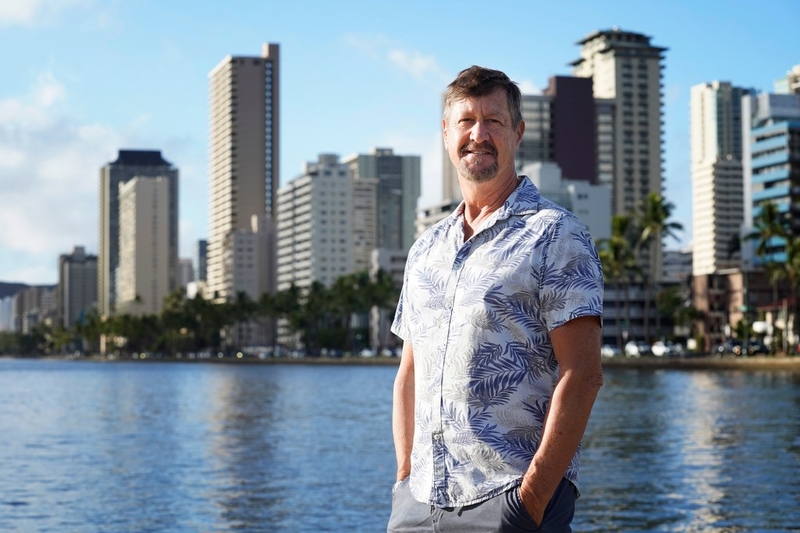
Many other residents supported the proposal’s concept.
Makiki resident and IT worker Sonam Wangchuk, 55, rides TheBus to work each day. As his bus passes through Chinatown, he said on a recent Wednesday evening, he’s struck by the number of homeless people he sees on the streets, and he wishes there were more places for them to go for shelter.
“I am a little bit surprised that there are empty homes that can be used,” he said. “I see so many homeless around, and I really feel bad for them.”
Wangchuk thinks a higher tax on empty homes would be a good idea.
“The implementation part,” he said, “I don’t think it should be that hard.”
Rebecca Soon, an empty homes tax supporter who worked in the city administration under former mayor Kirk Caldwell, agrees.
In a recent interview, she said the Department of Budget and Fiscal Services could handle implementation in a similar way it already handles an exemption it gives to owner-occupants: Ask homeowners to attest whether they live in the home, and audit a small sample of respondents each year to ensure compliance.
Still, city officials said implementation could be a headache. To figure out how to handle it, they hired the consultant Ernst and Young in 2024 for a yearlong contract.
EY had already provided a similar service for Vancouver, Canada, and that city had become a poster child for the concept’s success.
EY presented the first half of its findings in April 2025, estimating the city could collect $30 million to $55 million per year with a yearly overhead cost of $4 million to $6 million. The consultants also estimated between 640 and 2,000 properties could return to the market over the course of a decade as a result of the tax.
But budget director Andy Kawano quietly cancelled the rest of the study after that, saying it didn’t seem worth the effort.
Lack Of Political Will
Mayor Rick Blangiardi was open to taxing vacant homes during his first campaign in 2020. When he ran for reelection in 2024, he said in an interview that he still intended to pursue the policy, and that he just hadn’t gotten around to tackling it yet.
“It takes political will for the council to want to do that,” he said at the time. “I’m in support of that. I will stay in support of that … Just because it hasn’t happened yet doesn’t mean it’s not going to happen.”
But Blangiardi did not stay in support. His Department of Budget and Fiscal Services, led by Kawano, raised concerns that they didn’t have the capacity to ensure that people weren’t cheating the system, which Blangiardi said helped sway him.
“I have a thing about: Never create a policy that causes people to lie,” the mayor said in an interview in June. “You create a policy like that, you’re opening up Pandora's box here. Not good.”
It makes sense that potential administrative issues turned the mayor against the bill, according Colin Moore, a political scientist at the University of Hawaiʻi Mānoa.
While the proposal's initial narrative was its targeting wealthy offshore investors, he said, real estate interests successfully changed the conversation by focusing on cases where local families and elderly people who want to keep a family home would be hit with big bills.
"That, in Hawaiʻi, is just toxic," Moore said.
He said the possibility of headline-grabbing administrative issues also likely caused the mayor to rethink the proposal. Data errors that could lead to the wrong people being charged a higher tax rate are "the stuff of nightmares for mayors," Moore said, and it would be Blangiardi's responsibility to explain those errors to the public.
An empty homes tax has been proposed on Oʻahu for years. Each attempt so far has ended the same way: with the automatic death destined for every Honolulu City Council bill that fails to pass within two years of being introduced.
There was Bill 69 from 2018, introduced by former council member Ikaika Anderson, which died in 2020. Bill 9 from 2022, introduced by councilmember Waters, attempted to set up a new tax of 3% of the assessed value of empty homes. It died in 2024.
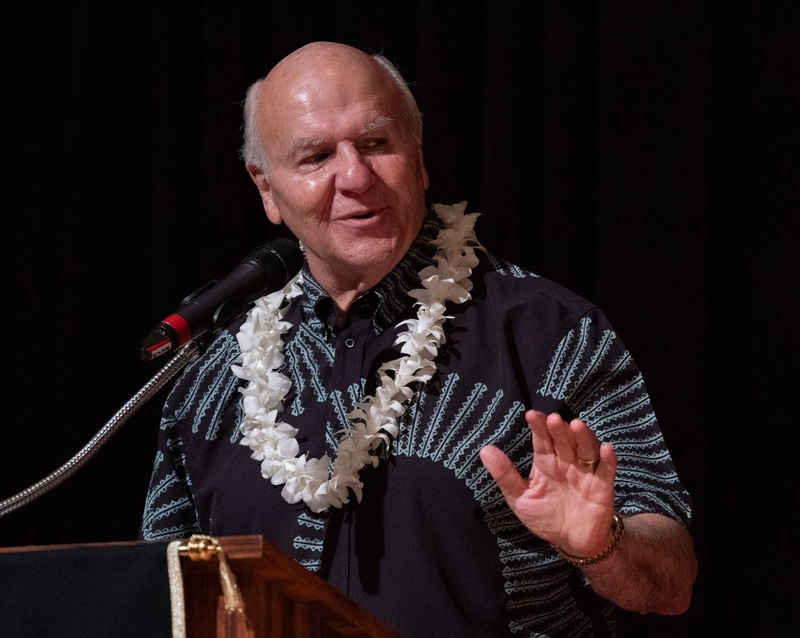
Bill 46, co-introduced by Waters and council member Radiant Cordero in 2024, attempted to create a new property tax rate for vacant homes. Their initial proposal started at 1% of assessed value per year before climbing to 2% the next year and finally 3% the year after that. Despite attracting controversy, the bill chugged forward to a final vote that December, when council members decided to postpone the vote and said they would come back to it later.
Waters said in an interview this past May that he would schedule a final vote on the proposal for the council’s July 8 meeting.
“I’m not going to let it die,” he said.
But a final vote never occurred. The bill automatically died on Saturday, two years after it was introduced, leaving supporters back at square one.
Waters, Cordero, and council members Tyler Dos Santos-Tam and Matt Weyer told Civil Beat they would have supported the bill if it had come up again for a final vote, which is the same bloc that would have voted to approve it in December 2024.
Council members Augie Tulba and Val Okimoto said they would have voted no. Council member Andria Tupola declined to comment, and council member Scott Nishimoto did not respond to multiple calls and texts asking his position.
Waters said in May that he thought council member Esther Kiaʻāina – who in a recent interview said she planned to vote no on the bill in December 2024 – could become a yes vote, which would have given it the support it needed to pass. In February, her constituents on the Kailua Neighborhood Board passed a resolution supporting the proposal, becoming Oʻahu's eighth neighborhood board to do so.
Kiaʻāina said last week that if the bill had been scheduled again, she’s not sure how she would have voted.
“I do know that more people in my community, my district, have expressed support for it,” she said. “So I will take their comments into consideration. But no, I have not made a final determination on what the vote would have been.”
Kiaʻāina has long been a skeptic of an empty homes tax, saying she worried local families who inherited second homes could be saddled with giant tax bills.
In a written statement, Waters said he didn’t schedule a final vote on Bill 46 because it lacked sufficient political support.
“The Council remained divided, and the Administration had consistently opposed the measure, including by criticizing and eventually canceling its own-procured Ernst & Young study,” he said.
Even if the bill became law, Waters said, opposition from the administration might have prevented it from being effective.
“Moving the bill forward under those circumstances would have created public expectations without a credible path to deliver results,” he said.
Moore, the political scientist, expects the proposal will come up again at some point in the future.
"There are only so many tools in the toolbox, he said, "and this is a pretty useful one that people support in principle."
Figuring out how to fairly administer the tax will always be a challenge, Moore said, but he doesn't think that should means the idea should be discarded.
"I think that whatever problems there were with this," he said, "it doesn't demonstrate a lot of political courage on the council's part."
Perkinson, the UH history professor, said he teaches a social movements class that involves having his students choose a cause to advocate for and focusing on it throughout the semester. In the fall of 2024, his students chose the city’s empty homes tax.
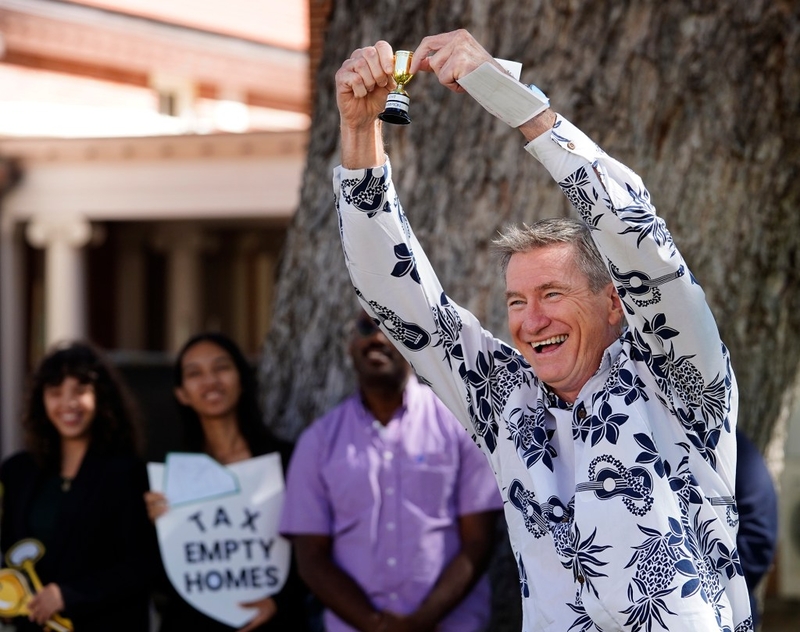
Students testified. They brought Waters into their class to talk. They staged a press conference outside Honolulu Hale to gain attention, where they bestowed Waters with a miniature trophy declaring him to be an empty homes tax champion.
“The trophy thing was a technique,” Perkinson said, “to try to get City Council members to commit, to kind of lock them in a little bit.”
The class aims to teach students through experience what it feels like to advocate for a cause and what obstacles can get in the way, Perkinson said.
“As I tell them at the beginning of the class,” he said, “social movements from below – which are like, people without resources trying to get resources, or people without power trying to get power – of course, they're usually going to lose precisely because they don't have resources and they don't have power.”
Honolulu, HI