Michigan Medicaid supporters mark 61st anniversary while warning about the impact of federal cuts
Jul 30, 2026 | 5:19 pm ET
Description
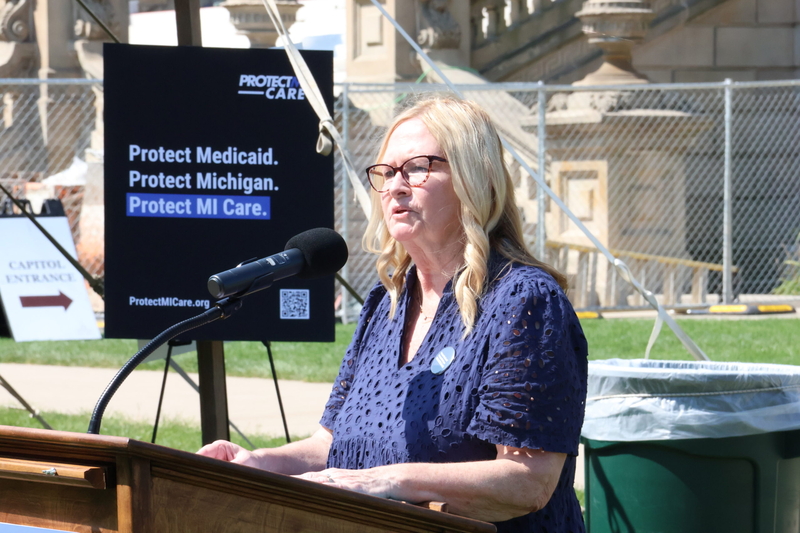
Amy Zaagman, the executive director of the Michigan Council for Maternal and Child Health discusses how Medicaid provides coverage for Michigan children at the Protect MI Care Coalition's March For Medicaid. July 30, 2026 | Photo by Kyle Davidson/Michigan Advance
Marking the 61st year since President Lyndon B. Johnson signed Medicaid into law, a coalition of health providers and advocates gathered on the Michigan Capitol Lawn Thursday to stand up for the program as federal changes threaten health coverage access for roughly 200,000 residents.
Established as part of Johnson’s “Great Society” agenda, Medicaid provides health insurance to individuals with limited income. About one in four Michigan residents receives some form of Medicaid coverage, according to the University of Michigan.
“It is the child getting a checkup before the school year starts. It’s the senior receiving nursing home care with dignity. It’s the new mom, the worker between jobs, the neighbor living with a disability,” Karen Holcomb-Merrill, acting President and CEO of the Michigan League for Public Policy, told attendees. “Medicaid keeps our hospitals open, our communities healthy and our families whole.”
However, changes from the One Big Beautiful Bill Act championed by President Donald Trump and congressional Republicans have put additional restrictions on who can access the program, while slashing funding for Medicaid by an estimated $911 billion between 2025 and 2034.
Beginning Jan. 1, 2027, states will need to implement new work requirements for Medicaid recipients, and require recipients to redetermine their eligibility every six months, rather than annually.
Alongside extra paperwork for Medicaid enrollees, these stipulations carry additional burden for the states to ensure they’re in line with federal requirements, with Michigan’s Fiscal Year 2027 state budget spending $184.3 million to implement requirements for Medicaid and Supplemental Nutrition Assistance Program.
Additionally, an August 2025 presentation from the Michigan Department of Health and Human Services projected the state could lose $635 million in annual revenue due to Medicaid financing changes at the federal level.
With these changes on the horizon, Meghan Groen, the state’s Medicaid director, emphasized that the Department of Health and Human Services is working every day to ensure those receiving Michigan Medicaid do not lose their health coverage because they didn’t jump through a bureaucratic hoop.
“A couple years ago, we started really looking at how much paperwork do we need? Is there a way to ask people for less information? What if we already know your information because you told your food assistance program, you told your unemployment insurance. Is there a way to make sure that we don’t have to ask you again?” Groen said. “And the answer to that question is yes. So for today, for about 65% of our beneficiaries, we’re able to automatically renew those folks.”
As part of the Fiscal Year 2027 State Budget, the state has set aside funds to hire 421 new staff members to help implement changes to Medicaid and SNAP. Groen said the department is also planning to begin sending paperwork to SNAP recipients three months after they’ve renewed their eligibility, so they can begin the process again.
Still. about 200,000 people are still expected to lose coverage, Groen said, calling on community health partners and other health advocates to spread awareness of the changing eligibility rules.
“When people fall off coverage, they don’t stop getting sick,” Groen said. “They wait to get care. They come in. They come to the emergency room. They’re missing out on preventative care. This is not the way that we want our system to work. It’s not fair for our providers. It’s not fair for the beneficiaries who do not deserve to go into medical debt because of additional bureaucratic hoops.”
In addition to being the largest insurer, Medicaid is the largest payer of mental health services, long-term care services like nursing homes, home and community-based care and births, Groen said, with Medicaid paying for 45% of births in the state.
Amy Zaagman, the executive director of the Michigan Council for Maternal and Child Health, noted that 1 million children in the state are covered by Medicaid, ensuring they have access to wellness visits, immunizations and developmental screenings.
Additionally, of the 50,000 children receiving Children’s Special Health Care Services for chronic conditions or other healthcare needs, 70% are enrolled in Medicaid, Zaagman said. Medicaid also provides health coverage for 99% of children in foster care, she said.

Courtney Gilmore of Grand Rapids discussed how Medicaid had helped her family provide care for her seven-year-old son Andrew, who was diagnosed with cerebral palsy after a birth injury.
“When the social worker at the children’s hospital came into Andrew’s NICU room one day to talk to us about Medicaid, I thought we didn’t need it,” Gilmore said. “We were employed. We had good health insurance through our employers. I had no idea what it meant. We quickly learned that private insurance coverage can be capped, that there’s exclusions, things that would leave us with medical bills that no family could handle, no matter how prepared we were.”
Through Medicaid, Andrew can access community living services, Gilmore said, which means another hand to help their family meet his needs.
“It lets Andrew be a kid, and every once in a while, I get to just be his mom and not a therapist and a PT and a nurse and everything else,” Gilmore said. “It means I can meet my daughter’s needs. I can show up as a wife and as a friend.”
Michigan Lt. Gov. Garlin Gilchrist told the audience that everyone in the state knows somebody who relies on Medicaid, noting that his grandmother spent the last 10 years of her life receiving care at a nursing facility on Detroit’s west side which was paid for by Medicaid.
“I want to make sure everyone knows what they can do, whether it’s this primary season or this general election season, make sure you participate as a Medicaid voter,” Gilchrist said. “We all have a responsibility to vote for healthcare, to vote for freedom, and to vote to fix systems that fail us when Republicans in Washington cut them.”
Lansing, MI