With a tight timeline looming, inspector general search panel agrees to open applications Friday
Jul 30, 2026 | 4:18 pm ET
Description
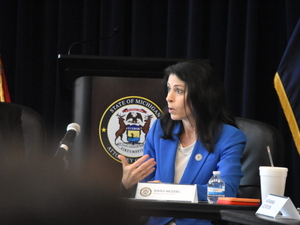
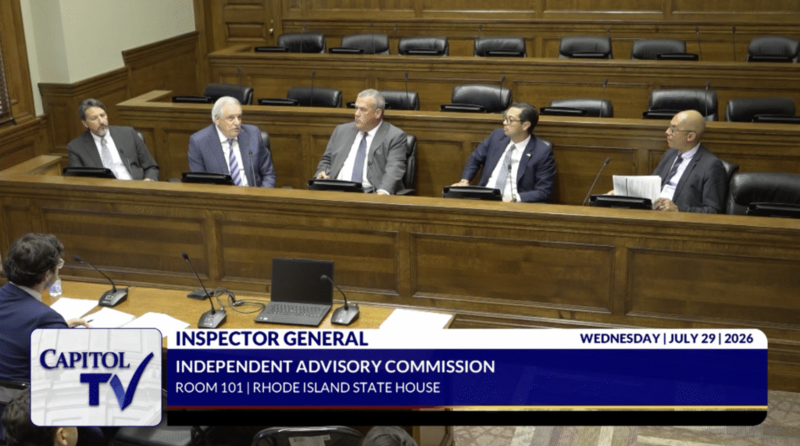
Attorney General Peter Neronha, second from left, speaks to the other members of the Inspector General Independent Advisory Commission at its meeting Wednesday, July 29, 2026, at the State House. Jason Gramitt, executive director of the Ethics Commission, is to Neronha's left. Secretary of State Gregg Amore, General Treasurer James Diossa and Will Fletcher, president of the Association of Inspectors General, seated left to right, make up the rest of the commission. (Screenshot: CapitolTV)
The search for Rhode Island’s first-ever inspector general is almost on.
The five-member Inspector General Independent Advisory Commission agreed Wednesday to open applications for the state’s newest statewide position on Friday, July 31. They’ll close after three weeks on Friday, Aug. 21, at 4 p.m.
The commission — created in this year’s budget, alongside the new statewide office — will need to interview and recommend three finalists to the governor by Sept. 28. After an inaugural meeting last week to work out the kinks, its five members had to make a dent in its laundry list of logistics to sort out.
It did so Wednesday afternoon, ending an almost two-hour meeting broken up by an executive session with plans for a finalized job description, qualifications and an application.
The inspector general will be tasked with detecting and investigating “fraud, waste, abuse, and mismanagement in the expenditure of public funds” by government agencies, according to the state budget that established the position. It gives the inspector general powers typically only granted to constitutional officers, many of which overlap with the state’s attorney general, including producing subpoenas and investigative reports on government agencies.
“This job, to me, is as close to a constitutional officer as you can get without being a constitutional officer,” said Attorney General Peter Neronha, who is joined on the commission by Secretary of State Gregg Amore, General Treasurer James Diossa, Will Fletcher, president of the New York-based Association of Inspectors General, and Jason Gramitt, executive director of the Ethics Commission.
Neronha suggested that those responsibilities, along with the task of shaping the new office, warranted a salary of $175,000 to $225,000, up from the $155,000 to $175,000 Amore’s office initially proposed. The other members agreed, with Fletcher calling the higher salary “competitive” with inspector general positions in other states.
Neronha — who is term limited and the only one of the three general officeholders on the commission not running for reelection — assured the room that his idea for the raise had no ulterior motive.
“I can guarantee and promise the people of the state of Rhode Island that I will never, ever apply for this job,” Neronha said.
‘Let’s not put any blinders on’
The members’ most spirited debate was in response to Amore’s proposal for the application process.
Inspired by Delaware, which swore in its first inspector general in May, the proposal included a blind ranking process in which Department of State staff would eliminate unqualified candidates and send anonymous applications to the commission members. They would score those applicants, and staff would compile those ratings to help members select a final pool to interview, at which point their names would become public.
Diossa and Fletcher didn’t have much feedback. Gramitt had two brief suggestions about the Ethics Commission’s role. Neronha had more to offer.
“I’m the appointee. I don’t need staff to help me make that decision,” Neronha said. “Let’s not put any blinders on.”
Neronha argued candidates for the public office shouldn’t need the condition of anonymity. Amore said the intent was to avoid a biased selection process, which Gramitt said he supported.
“I am thrilled that we’re going to anonymously score them,” Gramitt said. “Whoever came up with that is a genius.”
The commission ultimately accepted Neronha’s suggestions, meaning each member will review every applicant, name included, before deciding who to move forward with as a group.
The members also agreed on the original suggestion to interview six finalists before whittling the pool down to three for the governor’s consideration. It tabled the logistics of State Police-conducted background checks, and left the final application design to staffers at the Department of State and AG’s office.
Qualifications confusion
The budget provides concise guidelines on qualifications candidates must have: at least 10 years of relevant experience, a bachelor’s degree or higher in a related field and a professional certification from the Association of Inspectors General.
The commission approved all three requirements for the job listing with no additions. But before being approved, the timing of when candidates needed to be certified prompted some confusion — and a more than 30-minute closed-door session to discuss the legal risks of misinterpreting the budget’s language. The member’s consensus was that candidates must be certificated at the time of applying.
As Neronha pointed out in the commission’s first meeting, that requirement limits the pool. Fletcher told the commission Wednesday that his organization has a current record of 1,129 certified inspectors general and 2,141 certified inspector general investigators.
Diossa ended Wednesday’s meeting with more talk of finances. Following advice from the Department of Administration in a July 21 letter, the members agreed with Diossa’s proposal to cover costs for the commission with the $1.3 million allocated for the office in the state’s fiscal year 2027 budget.
Those costs include advertising the position and travel to the commission for candidates and members.
The budget gives commission members 90 days from its effective date — until Sept. 28 — to submit three names to the governor, who has another 90 days to send a nominee to the Senate for confirmation. Once chosen, the inaugural officeholder may serve for five years and be eligible for reappointment for one term of the same duration.

Providence, RI