Judiciary commission members criticized for not revealing campaign contributions to ex-House speaker
Jul 30, 2026 | 2:55 pm ET
Description
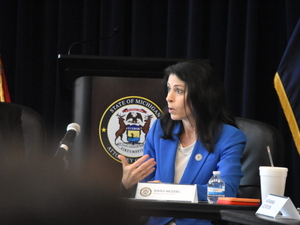
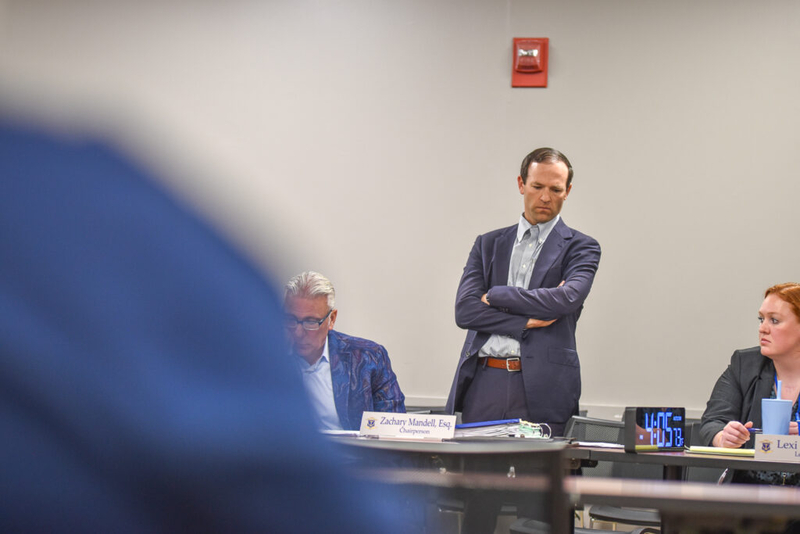
Zachary Mandell, chairman of the Rhode Island Judicial Nominating Commission, prepares to begin the panel's meeting on Tuesday, July 28, 2026. Mandell donated $10,835 to former House Speaker K. Joseph Shekarchi’s campaigns between 2015 and 2026, according to state finance records. (Photo by Christopher Shea/Rhode Island Current)
More than half of the Judicial Nominating Commission members who voted to advance former House Speaker K. Joseph Shekarchi’s bid to fill an opening on the Rhode Island Supreme Court have donated to his political campaigns in recent years, state finance records show.
Four of the panel’s nine members collectively contributed over $30,000 to the Warwick Democrat’s campaign account since he first ran for office in 2012.
“The fact that four members of the Commission have contributed more than $30,000 to that account, and none of the four disclosed that at the public meeting is disappointing,” John Marion, executive director of Common Cause Rhode Island, said in a statement to Rhode Island Current. Marion has been an outspoken opponent of Shekarchi’s nomination.
The donations were first reported Wednesday by GoLocal Providence, one day after the commission recommended five finalists to fill the vacancy created by Rhode Island Supreme Court Justice Maureen McKenna Goldberg’s retirement in March.
All nine members voted in favor of four of the candidates: Assistant Attorney General Christopher Bush, Family Court Judge Laureen D’Ambra, Superior Court Judge Luis Matos and attorney John Roberts.
Commission members David Holley and Lamel Moore, both of whom were appointed by the General Assembly’s Republican leaders, declined to advance Shekarchi’s application to the governor for consideration.
The commissioners who donated to Shekarchi were Chairman Zachary Mandell, Thomas Casale, James Lepore and Raffaele Liguori.
Thomas Dickinson, Shekarchi’s attorney, said the former House speaker has complied with campaign finance reporting requirements since his first election in 2012.
“All donations have been posted by the Board of Elections, and they are online and available for public review,” he said in an emailed statement Thursday.
Shekarchi makes the list of Rhode Island Supreme Court potential nominees. But will he make the cut?
Mandell, a personal injury attorney who was appointed chairman of the commission by Gov. Dan McKee in February, donated $10,835 to Shekarchi’s campaigns between 2015 and 2026 — most recently contributing $1,000 on Jan. 12, according to filings made with the Rhode Island Board of Elections.
Casale, a Johnston auto body shop owner who was appointed to the commission in 2020 by then-Speaker Nicholas Mattiello and then-Senate President Dominick Ruggerio, has donated $10,400 to Shekarchi since 2017. Records show a $2,000 contribution was made Jan. 22.
Lepore, a criminal defense attorney appointed to the commission in 2019 by Ruggerio, has given Shekarchi $4,050 since 2012. He contributed $500 on Jan. 2, records show.
Liguori, a personal attorney who was appointed by McKee in June, has donated $4,750 to Shekarchi since 2017, including $500 on Jan. 12.
Neither of the four members immediately responded to requests for comment from Rhode Island Current. Casale told WPRI-12 Wednesday he hadn’t considered recusing himself and that he’s given “to the whole General Assembly.”
The state’s Code of Ethics exempts campaign contributions from factoring into the analysis of whether a conflict of interest exists. But good government advocates like Marion argue the four commissioners’ lack of disclosure during Tuesday’s meeting “reflects a profound lack of judgment.”
“Rhode Islanders have every reason to question the independence of those commissioners who chose not to disclose their donations to Rep. Shekarchi,” Marion said.
Shekarchi stepped down as House speaker May 7 as he announced his application for the lifetime spot on Rhode Island’s highest bench. Questions about what he will do with his $4.7 million campaign account lingered throughout the process, including during his interview before the Judicial Nominating Commission Tuesday.
The Rhode Island Code of Judicial Conduct prohibits judges and judicial nominees from making contributions to political organizations and candidates. Judicial applicants can still spend the money as they please before their name is submitted by the governor to the General Assembly for confirmation.
Shekarchi has pledged not to touch his campaign account and, if nominated, would seek guidance on how to properly dispose of the money. His application also raised ethical concerns that an immediate leap from the legislative branch to the judiciary violates the state’s revolving-door rules that bar a lawmaker from taking a state job within a year of leaving office.
Superior Court Judge Richard Licht ruled otherwise Monday, siding with Shekarchi’s legal arguments that the Supreme Court is a constitutional position exempt from the state’s ethics law.
“This controversy is exactly why a revolving door is so important,” Marion said. “When someone no longer holds elected office, no one can question whether they are being influenced by campaign donations and no one can question whether the donation will buy access or influence with the elected official.”
The governor has until Aug. 18 to pick one of the five finalists as his nominee, who must then be confirmed by the House and Senate.
Providence, RI