Appeals court overturns ruling declaring Act 10 unconstitutional
Jul 29, 2026 | 5:23 pm ET
Description
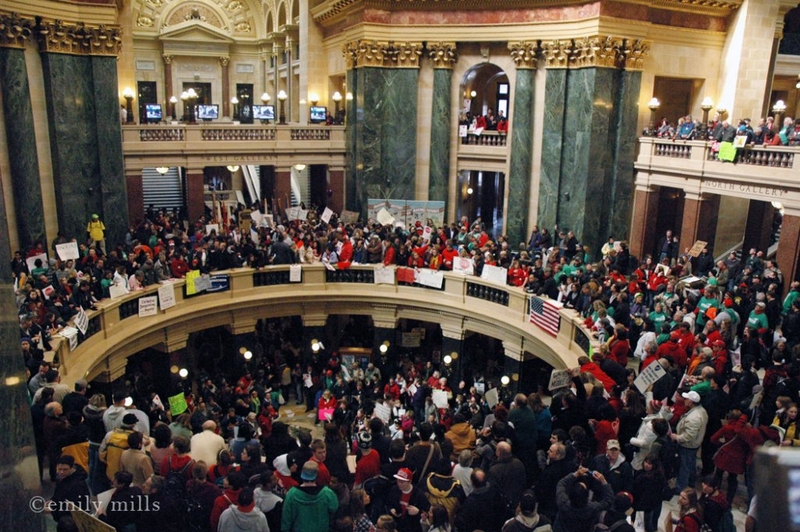
Protesters filled the Wisconsin Capitol in 2011 to protest the legislation that ultimately passed as Wisconsin Act 10, eliminating most union rights for most public employees. (Photo by Emily Mills. Used by permission)
In a 2-1 decision, Wisconsin’s 2nd District Court of Appeals overturned a previous Dane County Circuit Court ruling that found Act 10, the controversial 2011 law that severely restricted the collective bargaining rights of most public employees, unconstitutional.
In late 2024, Dane County Judge Jacob Frost ruled that the law violates the state constitution’s equal protections clause because it made some public safety workers exempt from the law’s limits on unions while excluding other workers with similar jobs from those protections.
In their majority decision, conservative Judges Mark Gundrum and Shelley Grogan said that it’s not up to the courts to weigh in on the merits of the Legislature’s reasoning for making the distinction, only to determine “any reasonably conceivable state of facts that could provide a rational basis for the classification.”
The decision argues that the Legislature excluded enough public safety employees to be able to maintain public safety and emergency services if in the wake of Act 10’s passage, every public employee union in the state, including the excluded groups, went on an illegal strike.
“Under these standards, we can easily locate a reason for the choices the Legislature made,” the majority decision, written by Gundrum, states. “We can conceive of facts for the public safety distinctions, and we can hypothesize a sound reason for why some public safety employees were not included in Act 10’s public safety group. Namely, the groups included in the public safety group were the minimum number of groups the Legislature deemed essential to perform public safety-related services, and it selected employees it determined were necessary to maintain public safety in the event of labor unrest.”
In a dissent, Judge Lisa Neubauer noted that the unions allowed to maintain their bargaining rights had all supported the campaign of former Gov. Scott Walker just months before he was elected and signed Act 10 into law.
She argued that the interpretation of the state’s equal protections clause requires that the Legislature’s reasoning be “rational” and that financial savings aren’t enough, writing that the Legislature’s reasoning doesn’t make sense because of the similarities among public safety employees across both groups.
“The inclusion of some employees engaged in public safety in the protected category, and exclusion of others, is not based on any identified ‘substantial distinction’ that makes the first group really different from the other,” Neubauer writes. “The lack of a substantial distinction is obvious, and it is alone fatal to the Legislature’s position. It is an analysis that the majority fails to address altogether. To pass constitutional muster, there must be something inherently different between the two groups whose members are all engaged in public safety — active law enforcement, fire suppression and prevention, and emergency services — dangerous jobs that require a high degree of conditioning. Employees who perform the same types of services and are putting themselves in harm’s way are being treated dramatically differently under the law.”
She adds that the “pinch-hit hypothesis” put forth by the Legislature in the appeal that it excluded enough employees to maintain public safety in the event of a mass strike that didn’t happen “is preposterous.”
That is particularly true, she wrote, because the state Capitol Police were excluded.
“Aside from the failure of the Legislature’s attempts to distinguish these occupations, the inclusion of state motor vehicle inspectors and exclusion of Capitol police is clearly not germane to the purpose of ensuring public safety during a mass illegal labor strike — the Capitol police are the law enforcement officers statutorily responsible for ensuring the continuity of government and protecting legislative and executive officials, justices and judges, and state employees,” she wrote. “Moreover, any mass labor unrest would undoubtedly take place in Madison, and yet the Capitol and university police are excluded, while state motor vehicle inspectors are included. If public safety is the stated purpose, it would be irrational to exclude the very law enforcement officials we would need to protect our elected officials in the event of mass labor unrest.”
Candidates for governor react
The Court’s decision Wednesday rippled through the state’s gubernatorial race as the Democrats running in the crowded primary, who have all promised to repeal Act 10 if elected, weighed in.
Former Lt. Gov. Mandela Barnes said the ruling was a reminder that “Wisconsin’s workers live in a broken system.”
“Wisconsin workers are being failed by the status quo. Our fight continues until every worker in every community across Wisconsin has the rights they deserve,” he wrote on social media.
Former Department of Administration Secretary Joel Brennan said the ruling was a “setback” but that the “fight isn’t over.”
“Scott Walker spent years tearing down workers’ rights in this state, and Wisconsin families have been paying for it ever since,” Brennan said. “I know how to clean up Scott Walker’s messes because I’ve done it. When Gov. [Tony] Evers asked me to help fix the damage that Walker left behind, we rolled up our sleeves and got to work — and we created the largest budget surplus in state history. I’ll do it again as governor. I will repeal Act 10, restore collective bargaining rights for Wisconsin’s workers, and make sure the people who show up every day to teach our kids and serve our communities finally have a voice again.”
Milwaukee County Executive David Crowley said the decision “was not unexpected” but a reminder of the long wait since working families in the state had their rights “ripped away” by Act 10.
“Wisconsin teachers, nurses, sanitation workers, and public servants deserve the right to collectively bargain for fair pay, safe workplaces, and a voice on the job,” he said. “We must continue fighting to restore collective bargaining rights for every public employee in every corner of our state.
State Rep. Francesca Hong (D-Madison), the frontrunner in the Democratic primary, said Wednesday’s ruling was a “painful reminder of what this disastrous law” has done to Wisconsin workers.
“The court itself describes a rationale of putting as many public employees as possible into the category stripped of meaningful collective bargaining rights in order to achieve budget savings,” she said. “For 15 years, Wisconsin’s teachers, nurses, correctional officers and other hardworking public servants have lived with the consequences of Scott Walker’s attack on organized labor. Workers are the backbone of this state, and they deserve better than being treated like a line item.”
State Sen. Kelda Roys (D-Madison) said the state is “better off when workers have a say in their workplaces.”
“Act 10 was an assault on all of our rights and our economy, engineered by Scott Walker with the help of Tom Tiffany, to disempower working people and weaken public schools,” Roys said. “The courts should restore every workers’ right to organize and collectively bargain, and the legislature should act to protect those rights in perpetuity. As Governor, I will continue to champion people over the powerful and will work with the legislature to rebuild the infrastructure for public sector bargaining.
Wisconsin Supreme Court up next
The Wisconsin Education Association Council, which is part of the group of unions who brought the initial lawsuit, said after the ruling Wednesday morning that the group remains “confident in the merits of our case” and that they’re “considering all options available.”
The Wisconsin Supreme Court is weeks away from the investiture of Appeals Court Judge Chris Taylor as its newest member. Taylor joining the Court gives liberals a 5-2 majority on the panel. However, Justice Brian Hagedorn has already recused himself from previous procedural decisions involving this case because he served as Walker’s legal counsel and played a major role in writing Act 10.
If the Supreme Court were to take up the case, it’s likely a final decision wouldn’t be reached until after November’s elections and the inauguration of a new governor and start of a new legislative session in January. With Democrats hopeful they’ll be able to win trifecta control of state government, the actions of the other two branches of government could render the lawsuit moot.
In a concurrence to the majority decision, Grogan argued the courts should be careful about weighing in on political issues such as Act 10.
“A law’s constitutionality does not ebb and flow with a court’s composition, and the judicial branch must not be used to advance political agendas on either side of the political spectrum,” she wrote. “However, in seeking to unwind legislation that both the federal court and the Wisconsin Supreme Court have upheld as constitutional for over a decade, this lawsuit seeks to do exactly that. At this juncture, if the People want to overturn these decisions, they must do so through the legislative branch, which, unlike the judicial branch, is necessarily political.”

Madison, WI