On second thought: Late-moving legislative action injects ‘ambiguity’ into ballot questions
Jul 29, 2026 | 10:35 am ET
Description
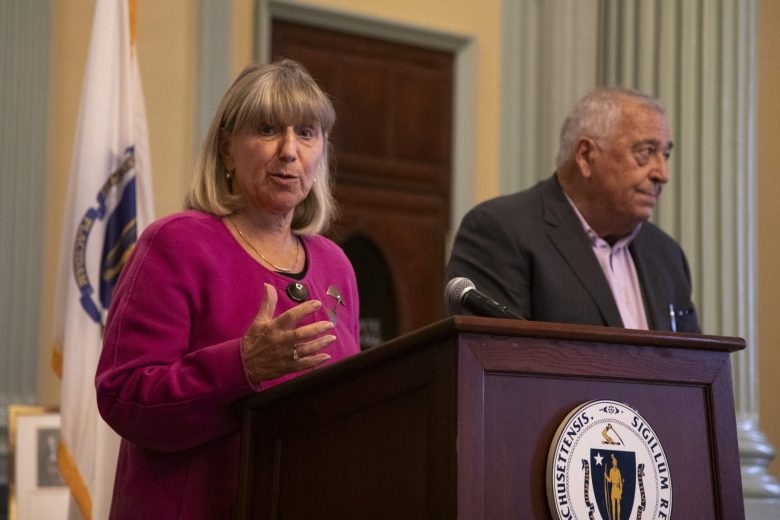
Senate President Karen Spilka (left) speaks with the press on November 3, 2025, joined by House Speaker Ron Mariano (right).
LEGISLATIVE LEADERS have not been shy about their disdain for the surge in initiative petitions that’s put a nearly unprecedented volume of major policy choices in the hands of voters in the form of ballot questions. Now, they might turn that irritation into controversial action.
Lawmakers — as well as many policy experts — routinely warn against lawmaking by ballot question, arguing that the yes-or-no votes on complex issues are a blunt instrument and a poor substitute for the give-and-take of the deliberative process of hashing out legislation. Even some campaign leaders acknowledge privately that they prefer the traditional route through the House and Senate to the ballot whenever possible.
Recognizing that fact, the ballot question process has a built-in, if informal, schedule for the Legislature to engage with advocates about possible compromise legislation that would satisfy proponents enough to get them to drop their campaigns.
In recent years, the Legislature even established a formal system for examining all potential ballot questions with a single committee of House and Senate members. But that review process came and went this spring, and lawmakers made no overtures suggesting interest in discussing such compromise.
Now, however, with a record-tying nine questions locked in for the November ballot, top Democrats are seriously considering a tactic nearly unprecedented in recent decades: taking last-minute action of their own that could significantly reshape or even upend two of the decisions their constituents will make.
Depending on the course of House-Senate negotiations, Beacon Hill might take the bite out of a tax rebate law at the same time that voters are deciding whether to expand it. Both branches are also eyeing a legal lever that, if pulled, could force their preferred, more limited version of public records reforms to supersede whatever voters decide on a ballot question that would extend the reach of the state public records law to lawmakers and the governor. And in each case, lawmakers could wait until the lame-duck stretch after the November 3 elections to play their cards.
Those moves are not sitting well with advocates who spent months — and, in many cases, millions of dollars — gathering tens of thousands of voter signatures and clearing every hurdle required to place a question on the ballot.
Scotia Hille, executive director of the Act on Mass group supporting a measure to expand the public records law to the governor, House, and Senate, accused legislative leaders of displaying “contempt for the initiative petition process that is reserved for the public in our constitution.”
The changes lawmakers are weighing to public records and the tax cap law, if finalized, would also inject confusion into the ballot campaigns. If both pending legislative proposals pass, it “will add ambiguity to the policy impact of those two ballot questions,” according to Andrew London, a partner at law firm Foley Hoag who has worked on cases challenging ballot questions.
Lawmakers have resisted complying with public records requirements for years, and they bristled at the ballot question in recent months. House and Senate Democrats argue they should not be required to abide by the same records requirements as other government entities because that would give the secretary of state, who enforces the current records statute, undue power over the legislative branch in violation of the constitutional separation of powers.
“The simple reality is that the public records ballot question and the existing public records framework use a method of enforcement that we believe to be clearly unconstitutional when applied to the legislative branch,” House Speaker Ron Mariano said in a speech in June, when the House approved legislation creating a different public records approach for the Legislature.
The Senate is set to follow suit with its own records bill this week, which like the House’s would make many documents available, but not lawmakers’ correspondence.
Both versions also include a sentence that could prove key, declaring that the legislation “shall constitute the sole and exclusive remedy” for acquiring House and Senate records, and that any other segment of the public records law does not apply to the Legislature. That line seems designed to make the Legislature’s version supersede the language of the ballot question, essentially rendering changes voters might embrace meaningless.
London, who is not involved in either the records campaign or the tax cap campaign, said it’s a “complicated legal question” to figure out what would happen if both the public records ballot question and the changes the House and Senate are weighing ultimately pass. He added it would likely prompt litigation to sort matters out.
The outlook is especially complicated for the ballot question changing the tax cap and rebate system, which four years ago forced Beacon Hill to return $3 billion to taxpayers. The question, backed by some business groups and the free-market-oriented Pioneer Institute, would change the formula for the tax cap, making it more likely the state owes money back to taxpayers in a given year.
Senate Democrats initially eyed a straight repeal of the underlying law, a move that would have rendered the measure on the ballot moot. However, they balked at nuking the law entirely and instead settled on adding a new condition: the state would not owe any refunds under Chapter 62F unless net state tax revenues for the year were at least 7.5 percent of total statewide personal income.
Sen. Jason Lewis, who authored both the original amendment and the redrafted version, described it as an additional “test” to determine if Beacon Hill must return money to taxpayers that does not imperil the ballot question.
“They would sit alongside each other,” he said of his proposal and the ballot measure. “Essentially, both would need to be triggered in order to result in a refund to taxpayers.”
What Lewis calls an added test to be folded into the law, however, backers of the initiative petition see as a backdoor move to undercut the law — and by extension their ballot question.
The latest Senate maneuver is “a cunningly worded amendment designed to gut the original law without formally repealing it,” the Pioneer Institute said in a statement.
Though Lewis’s updated idea does not outright sink the ballot question, it would effectively limit the impact of the language that will go before voters. If the ballot question passes and the Senate measure becomes law, it would be harder for Beacon Hill to hit the tax refund trigger than it would be if the ballot question alone passed.
“Reading these two changes together will likely reduce the frequency of rebates under Chapter 62F – which undermines the objectives of the ballot question’s proponents,” said London.
It’s not clear if the House will go along with the last-minute Senate change. Mariano said he personally likes the idea of repealing Chapter 62F altogether, but is wary of the outrage it could generate among voters.

Officially, legislators have limited options during the time allotted to them to review ballot questions: approve a measure as drafted by proponents, or take no action. But in the past, they’ve used their position to negotiate with campaigns about a compromise — say, if the House and Senate approve a somewhat scaled-back bill targeting the same issue, organizers will drop their question before it reaches voters.
Eight years ago, as initiative petitions dealing with minimum wage, taxation, and paid family and medical leave wound their way toward the ballot, lawmakers and then-Gov. Charlie Baker convened an extensive series of negotiations with supporters and opponents of the proposals. Those talks led to the “grand bargain,” a bill passed by the Legislature and signed by Baker that addressed those myriad policies satisfactorily enough for each campaign to halt its efforts before their questions were locked in for the general election.
That did not happen this year. There appear to have been no substantive talks about legislative compromises to either the public records ballot question or the Chapter 62F overhaul. (The one would-be ballot question on which there were initial discussions of a possible legislative compromise was a rent control measure, which was ultimately doomed by courts.)
Now, lawmakers are considering changes to both the tax cap law and the public records law in their end-of-July burst of activity, after the final deadline for any campaigns to keep their questions off the ballot.
So whatever decisions the House and Senate make, voters will still have questions to answer in November — even if it’s not clear how much decision-making power they’ll actually have, adding more confusion to a year where Bay Staters might already be overwhelmed by the sheer number of ballot measures.
Further muddying the picture, newly adopted legislative rules this term mean that legislative leaders can wait as long as they want to take up a final bill as long as each branch approves a preliminary version before July 31.
Hille, the Act on Mass leader, said she’s concerned House and Senate negotiators will wait until after the November 3 election to surface a deal on the records legislation, which could give lawmakers a lame-duck opportunity to change or even spike the outcome of the ballot question. Such a move, The Boston Globe‘s editorial board wrote Wednesday, “would be downright shameful.”
“That is a part of this that is really alarming to us as good-government advocates,” Hille said.
The closest corollary in recent history is 2012, when proponents and opponents of an automotive “right-to-repair” proposal agreed to a deal after the question had already locked in a spot on the ballot. The Legislature enacted the compromise legislation in the final hours of its formal sessions for the term in July, and the campaigns initially agreed to urge voters to simply skip the question.
One side changed its mind in the fall, however, and resumed campaigning. Voters then approved the question, putting two competing laws on the books — one enacted by the Legislature, and one that came from the ballot box. The following year, lawmakers moved to untangle the mess by reconciling the two statutes.
In that case, however, the Legislature was acting with input from at least some of the entities behind the right-to-repair campaign. The new public records and tax cap proposals in play before lawmakers have not involved any discussion with the ballot question proponents.
“The fact that the Legislature can try everything to fight a ballot question, and then, in the last few days of the legislative session, pass legislation that would essentially nullify the impact of the ballot question — I think it absolutely sets an alarming precedent about our right as citizens to make laws by initiative petition,” Hille said.

Boston