Sheep Creek mine operators wanted exemption from DEQ review; DEQ denies request
Jul 28, 2026 | 12:39 pm ET
Description
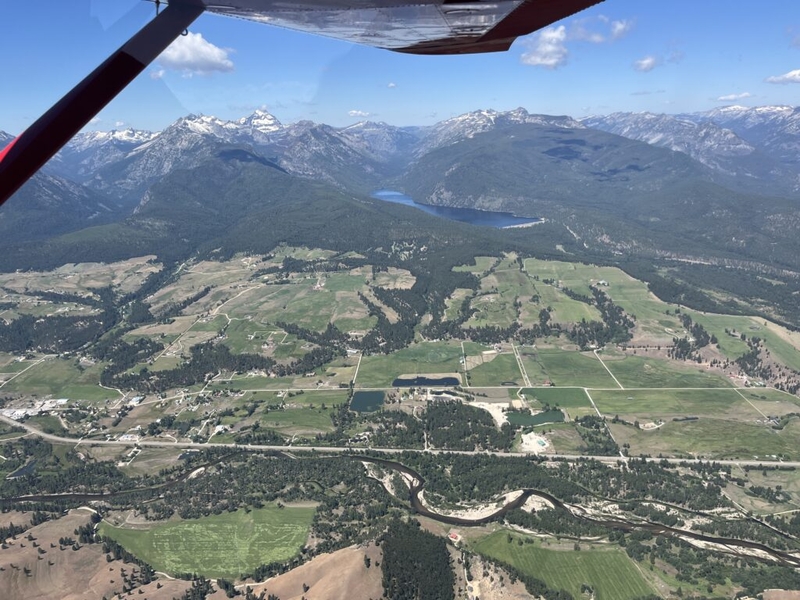
The Bitterroot River runs up the Bitterroot Valley, part of an $80 million tourism economy. (Keila Szpaller/The Daily Montanan/Aerial support provided by LightHawk)
U.S. Critical Materials tried to argue its mine exploration project at Sheep Creek doesn’t need state agency review under the Montana Metal Mine Reclamation Act.
The Montana Department of Environmental Quality disagreed, and a Bitterroot Valley lawmaker said the request by the company showed disrespect for Montanans.
“USCM’s letter to DEQ demonstrates — whether intentionally or not — contempt for the state of Montana and the people who live here,” said Rep. David Bedey, R-Hamilton. “It also is tone deaf regarding the value Montanans place on the quality of life we enjoy.”
U.S. Critical Materials wants to mine at the headwaters of the Bitterroot River, and it has filed an exploration proposal to the U.S. Forest Service.
The project calls for pulling 3,000 short tons of raw material out of a sensitive area for wildlife and the water source that feeds the Bitterroot Valley, and it has garnered significant opposition from residents and local lawmakers.
In an email on July 20, U.S. Critical Materials CEO Scott Osterman asked the DEQ to find the Metal Mine Reclamation Act didn’t apply to the Sheep Creek project.
He told the Daily Montanan there’s nothing disrespectful about asking a legitimate legal question.
The Metal Mine Reclamation Act prevents “unreasonable depletion and degradation of natural resources.” It says mineral extraction contributes to the economy, but it says proper reclamation is necessary.
DEQ Director Sonja Nowakowski told Osterman the agency did not have the authority to offer the company an exemption from such a review.
The July 23 letter from the DEQ said the proper step for U.S. Critical Materials to take is to submit an application for an exploratory license.
It said the DEQ would review it for compliance with the Metal Mine Reclamation Act and the Montana Environmental Policy Act.
Osterman told the Daily Montanan on Monday that U.S. Critical Materials hasn’t yet decided whether to file an application or dispute the decision from the DEQ.
But he said the company sought clarification and will move forward, which is how the process is supposed to work.
In an email, a DEQ spokesperson said the agency isn’t aware of any administrative appeal process that would apply to the request.
The company argues that its project at Sheep Creek represents “a critical near-term opportunity” to advance the federal government’s national security priority for domestic rare-earth minerals.
Those minerals are used across industries, including health care, consumer electronics and defense.
Bedey, who provided the correspondence to the Daily Montanan, said on Monday he agrees that developing a domestic source of critical minerals is “vital for national security.”
“But it does not follow that the Sheep Creek Mine should go forward without careful scrutiny of the catastrophic environmental effects the mine could have on the river and the communities that depend on it,” Bedey wrote in a statement.
Bedey said he has asked to stay abreast of developments about the proposal, and he believes the company’s attempt to avoid compliance with state law doesn’t bode well for Montanans.
“It is time for this project to come to an end,” Bedey said.
He said his constituents and Bitterroot Valley citizens are concerned about the mine’s “high potential for contamination of the Bitterroot River.”
In his email, Bedey said other sources of critical materials exist in Montana and outside of it.
“Prudent policy would seek to select sites with the lowest potential for adverse impacts,” Bedey said in an email. “… Here in Montana, we have seen the cost of irresponsible mining activities. We don’t need to repeat the past.”
Osterman had argued that because the exploration is small, just 0.3 acres, it is not a “material disturbance,” and the Forest Service provides reclamation controls “substantially equal to or greater” than Montana’s.
“Imposing full state licensing obligations on a 0.3-acre exploration project already subject to Forest Service review would produce a result more restrictive than the regimes (the Metal Mine Reclamation exemption) treats as equivalent,” Osterman wrote.
While the exploration may only explore less than an acre, the Bitterroot Water Partnership has said the entire mining claims span 11 times the size of the Painted Rocks Reservoir at one square mile.
The DEQ said it recognizes the need for rare earth minerals.
But the DEQ said the Metal Mine Reclamation Act applies to all exploration and mining activities, and the company’s argument that a small disturbance doesn’t count “ignores the plain reading of the statutory text.”
The DEQ also said it “carefully considered” exemptions in state regulations, and the Sheep Creek proposal does not qualify.
Osterman said the company will likely make a decision this week on whether to fight the DEQ or file an application.
The company has elicited ongoing criticism for failing to be transparent with the public and local elected officials. In late June, it announced it was opening an office in Darby in July to connect with the community.
Osterman said Monday the office in Darby is “not quite open,” but the company is hoping it will be available in the next couple of weeks.
In an announcement on its website Monday, the Bitterroot National Forest said it is starting an environmental review of the draft plan of operations the company filed.
The Forest Service said for the time being, it will consider whether the plan could be analyzed under a “categorical exclusion,” or under activities that don’t result in significant impacts under the National Environmental Policy Act.
“If the analysis indicates that the proposed activities warrant additional NEPA review beyond that of a (categorical exclusion), the Forest will make the appropriate analysis decisions at that time,” the announcement said. “Public participation, to include a comment period, is anticipated to begin in August.”
Editor’s note: This story has been updated with additional comment from Osterman about the request to DEQ.
Helena, MT