Tennessee gubernatorial candidates take on eclectic legislation, pass few bills with gravity
Jul 22, 2026 | 6:01 am ET
Description
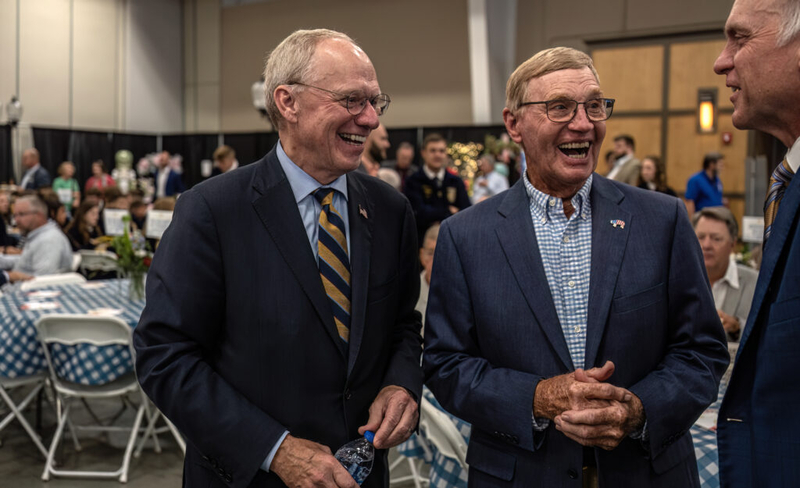
U.S. Rep. John Rose, left, in December proposed the repeal of a measure that would let eight U.S. senators, including Sen. Marsha Blackburn, sue the government. (Photo: John Partipilo/Tennessee Lookout)
Tennessee’s Republican gubernatorial candidates are far from prolific lawmakers, passing little legislation during their tenures in the state legislature and Congress.
State Rep. Monty Fritts’ biggest claim to fame is passage of the so-called “chemtrails” bill that was panned by critics as “nonsense.” The measure passed with ease in 2024 to stop the potential release of climate-controlling chemicals into the atmosphere.
U.S. Sen. Marsha Blackburn of Franklin often touts her efforts in turning back a state income tax while serving in the state Senate in 2001, encouraging Capitol protests that, ultimately, turned into a rock-throwing affair.
#TBT 2001-The Tennessee Tax Revolt kept an income tax out of the state and I am glad to have helped lead the charge! pic.twitter.com/WJc6j63Hnr
— Sen. Marsha Blackburn (@MarshaBlackburn) October 30, 2014
Yet she also co-sponsored a bill while serving in the U.S. House that was designed to help people obtain medication but wound up flooding small communities with highly-addictive opioids, according to multiple reports stemming from an investigation by the Washington Post and “60 Minutes.” At the time, her staff said Congress would try to improve the law if it caused “unintended consequences.”
U.S. Rep. John Rose grabbed attention in December 2025 by proposing the repeal of a provision in national defense funding that allowed eight senators, including Blackburn, to sue the government for half a million dollars over the FBI’s subpoena of their phone data in connection with the investigation into President Donald Trump’s effort to overturn the 2020 election. Senators would have been able to collect for each time the feds looked at their data. The measure was passed as part of the effort to end a federal government shutdown.
Rose said, in part, on the House floor, “… when we sent our funding bill to the Senate last week, we gave Senate leadership a taste of their own medicine and forced them to choose between this policy or reopening the government.”
Breaking down bills
When Fritts sponsored the “chemtrail” bill, he told the Lookout that it dealt only with “geoengineering” purportedly to be done by the federal government and said he wasn’t concerned about a connection to “chemtrail” conspiracy theories that governments and other groups are running a secret program to add “visible plumes” containing toxic chemicals to the atmosphere similar to contrails or vapor trails released by aircraft engine exhaust, which is made up mainly of water in the form of ice crystals.
“Chemtrail” bill set for House circuit described as “nonsense”
Other than that bill from two years ago, Fritts, a two-term legislator, passed House Bill 873 in 2025, a measure that makes it more difficult to bring civil action for negligence against makers of knives, body armor, pepper spray, silencers, gun clips and devices that speed up the discharge of semiautomatic weapons. Fritts supports the state’s permit-less carry law but believes Tennessee should pass what is called true “constitutional carry,” which would remove the state’s “intent to go armed” law and prohibitions on guns in parks and on college campuses.
Fritts’ failed legislation stretched from a measure that would have removed the state sales tax on items bought through the supplemental food program for Women, Infants and Children (WIC) to another that would have prohibited the use of vaccines containing mRNA, a technology used in the COVID-19 vaccine that caused hysteria because of vaccination requirements in some circles.
Aside from his effort to prevent senators from collecting billions from the federal government, Rose sponsored the “Housing Supply Expansion Act of 2025,” which removed the requirement that manufactured houses have a chassis that allows them to be moved after installation. The idea is to cut the cost of young and low-income families to buy homes as rent escalates.
Blackburn sponsored the Kids Online Safety Act, a measure requiring tech companies to put safety features on their platforms to protect children. Another measure she is backing sets up federal guidelines for protections dealing with artificial intelligence.
Recently, Blackburn renewed a bill to prevent foreign nationals from gaining U.S. citizenship by giving birth to children in the United States. She sponsored the bill after the U.S. Supreme Court struck down Trump’s executive order banning birthright citizenship.
Nashville, TN