Congressman Troy Carter calls out Trump admin for ‘excessive political control’ of federal grants
Jul 15, 2026 | 5:10 pm ET
Description
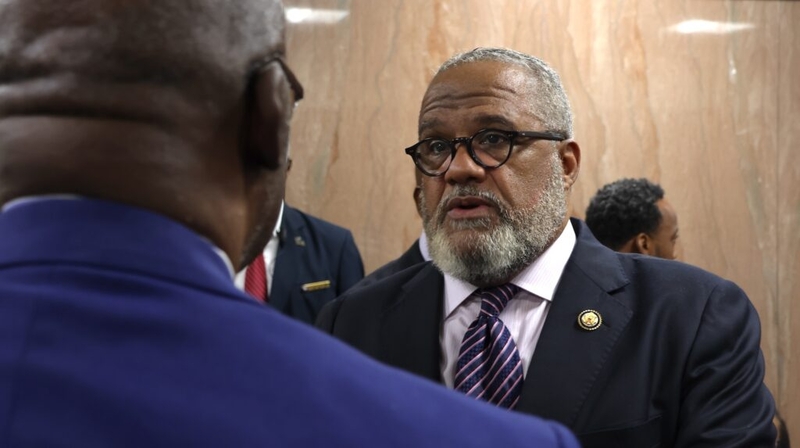
U.S. Rep. Troy Carter, D-Louisiana, speaks with a constituent during a visit to the Louisiana Legislature on May 8, 2026, to oppose a congressional redistricting hearing. (Wes Muller/Louisiana Illuminator)
U.S. Rep. Troy Carter, D-New Orleans, has sent a letter to the Trump administration condemning proposed federal grant rules that would give political appointees the power to decide what scientific research gets funded.
The proposed rules were published by the White House Office of Management and Budget in May, with nearly half a million comments submitted ahead of the July 13 public comment deadline. The proposal specifically refers to the need to stamp out a “woke” agenda and aims to do so by giving senior political appointees the power to fund grants that align with the Trump administration’s goals. Currently, grants have to go through a peer review process, with subject-matter experts greenlighting projects.
The rules apply not only to research, but to any discretionary grant throughout the federal government.
The proposal also would limit international research collaborations and allow political appointees to terminate grants at any point if it is deemed to no longer serve “agency priorities or the national interest,” which could potentially leave researchers and universities in the lurch if multi-year projects are pulled.
“We oppose the proposed Regulation for Federal Financial Assistance rule, which would concentrate political control over federal spending, undermine constitutionally protected rights, disrupt billions of dollars in existing awards, and increase the compliance burden on the organizations and governments that serve the public,” Carter wrote in the letter, which was co-signed by over 100 other Democrats in congress.
The proposed rules have been widely condemned by academic researchers, including dozens at Louisiana universities, who submitted public comments.
“By giving [political] appointees unprecedented authority over federal science funding decisions, scientific research in the United States would be at grave risk of becoming a partisan tool,” Peter Schrock, a sociology professor at Southeastern Louisiana University, wrote. “In a worst-case situation, this would result in support for pseudo-science that happens to be popular with elected politicians at the expense of support for actual science”
Researchers also called out a provision in the proposal that would prevent federal dollars from being used for publication costs, which could limit the dissemination of new research. Publication costs often range in the thousands of dollars, especially for open-source journals, which are more widely accessible to the public.
“Disseminating information to the public … is critical to advance any mitigation practices. For example, I work on wetland loss in river deltas,” wrote LSU professor Carol Wilson. “The information and findings from my research highly benefit the people of Louisiana from protection from storm surges, sea-level rise, salinity intrusion, and preservation of fisheries and natural resources.
“We scientists don’t do science for the sake of science; we do science to make the world a better place to live!,” Wilson added.
The new rules is the latest escalation of the Trump administration’s reimagining of scientific funding, which has included cancelling millions in grants and slashing resources for administrative costs related to research;
Among the thousands of grants the National Science Foundation has cancelled since Trump took office was a nearly $200,000 grant awarded to Julia Earl, a Louisiana Tech biology professor. The agency gave no reason for cancelling its contract other than a change in its priorities, she said.
Tech President Jim Henderson said when the grant was cancelled that he believed the grant was targeted as part of the Trump administration’s efforts to defund diversity, equity and inclusion. Though the project was not DEI-related, it has the word diversity twice in its title: “Effects of Leaf Diversity on Aquatic Insect Colonizer Diversity.”
The loss of federal funding comes as LSU is seeking to dramatically increase its spending on research as part of its goal of becoming a top-50 research university. LSU President Wade Rousse has said the university would seek more private research funding to fill in the gaps of reduced federal funding.
Baton Rouge, LA