Maryland may have to go to court to fight for $20M in annual relief for electric customers
Jul 11, 2026 | 2:12 am ET
Description
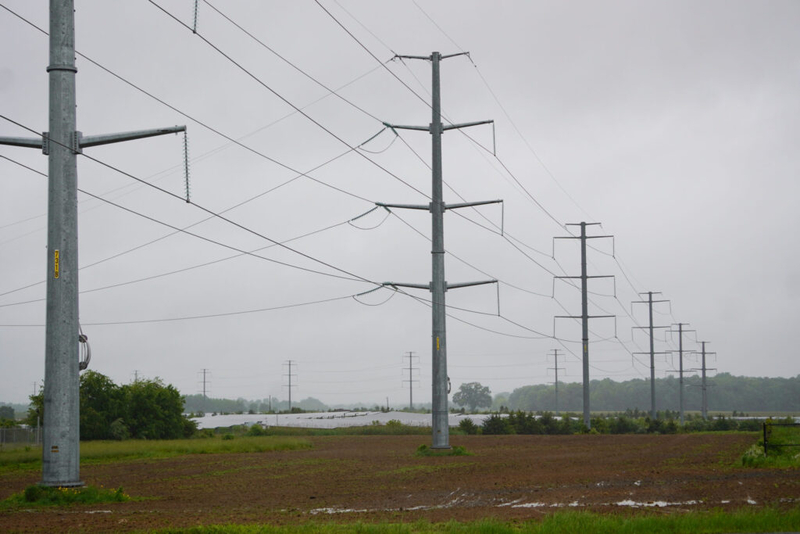
Power lines on Maryland's Eastern Shore. (Photo by Christine Condon/ Maryland Matters)
Maryland lawmakers passed a new rule this year that is projected to save utility ratepayers in the state $20 million a year.
But actually getting those savings for Marylanders will take more legwork — potentially a lot more.
On July 2, a trio of Maryland agencies banded together to ask the Federal Energy Regulatory Commission to make several utilities stop charging consumers a surcharge for participating in the regional electric grid, which is operated by PJM Interconnection.
They point to the new law, that took effect July 1, requiring utility companies to be a part of a regional grid. Though it was technically optional before the law passed, utility participation in the regional grid has become commonplace.
“There’s no reason to pay an incentive bonus for something that’s a requirement in the law … otherwise you’re just taking money out of ratepayers’ pockets for no good reason,” said Kumar Barve, chairman of the Maryland Public Service Commission, which regulates utilities. The PSC was one of the agencies participating in the FERC complaint.

Other states have required utility participation in the grid to end the extra surcharge to customers. But in both Ohio and California, utilities took the fight to court, delaying relief for customers.
After utilities in those states appealed FERC decisions, judges in the 9th U.S. Circuit Court of Appeals and the 6th U.S. Circuit Court agreed that the utilities cannot levy a surcharge unless they participate in a regional grid voluntarily.
It’s unclear whether Maryland utility companies will fight the change, potentially dragging the state agencies through a prolonged court battle. In their FERC complaint, the Maryland agencies asked that state customers get a refund for any surcharges after July 2.
In a letter in early June, the Maryland Office of People’s Counsel asked the utility companies to cooperate and to voluntarily file with FERC to get rid of the surcharge, which the companies receive through transmission rates.
People’s Counsel David Lapp said he hoped the utilities would be moved by the “public perception of continuing to argue for higher profit levels” despite the legal losses in other states, and despite the fact that utility profits have burgeoned amid high electric bills for customers.
“We certainly had hoped that that might prevail upon the companies voluntarily to make the appropriate filing,” Lapp said. “That being said, we’re not completely surprised they didn’t.”
Lapp’s effort got support from House Speaker Joseline Peña-Melnyk (D-Prince George’s and Anne Arundel), who said in a statement in June that she expects the utility companies “to be willing partners with us in the swift adoption of both the spirit and letter of the law” in implementing the Utility RELIEF Act, which included a number of provisions aimed at lowering electricity bills.
Maryland House and Senate leaders reach a deal on comprehensive energy bill
“We will be watching and assessing whether the utilities decide to be cooperative or confrontational on this,” Peña-Melnyk said. “Affordability issues will be a part of our ongoing agenda in the next legislative session, and we will not hesitate to take further action to protect ratepayers.”
In a statement, Baltimore Gas & Electric argued that Maryland legislators were not addressing the real problems by passing the measure and trying to prevent the surcharge.
“While we continue reviewing the Maryland Parties’ filing, it is important to recognize that this proposal does not address the primary driver of rising energy costs: Maryland’s growing imbalance between electricity supply and demand,” wrote BGE spokesperson Lydia Parker. “Simply shifting costs or challenging existing market mechanisms will not increase generation, improve resource adequacy, or reduce the underlying reason for higher customer bills.”
Will Boye, a spokesman for First Energy, which owns Potomac Edison, wrote in a statement that the company is “reviewing the filing and plan[s] to respond in due course.”
If Maryland officials have to fight the utilities at FERC or in the courts, they will consider it a worthwhile pursuit for $20 million in annual savings for ratepayers across the state, said Kelly Speakes-Backman, the director of the Maryland Energy Administration, Gov. Wes Moore’s (D) energy office.
“Whatever resources we spend, it’s not going to come even close to the savings that ratepayers will see. So, we think it’s well worth it,” Speakes-Backman said.
The FERC filing was a group effort for three agencies that don’t frequently join forces. It was led by MEA, with backing from the Office of People’s Counsel — the consumer advocate that represents ratepayers — and the utility regulators at the PSC.
“That shows you just how uncontroversial this position is,” Barve said.
Barve said the commission, which is funded through an assessment on public service company revenues, is hiring two new attorneys to focus on dealings with FERC. They’ll handle plenty of other dealings before the federal agency, too — not just the fight for $20 million in annual savings.
Lapp, whose office is also funded by an assessment on utility revenues, noted that these sorts of cases can be “very resource-intensive,” in terms of staff time and other litigation costs.
“A case like this — depending on how long it lasts — could be in the multiple hundreds of thousands of dollars,” Lapp said.
Barve said he is hoping the utilities will lay down their weapons. In fact, he believes they will, because of public sentiment.
“Here’s the thing: Right now, ratepayers all throughout Maryland are really angry about rates, and so I’d be pretty shocked if the utilities fought this,” Barve said. “I mean, they hear from their ratepayers.”
But it’s unclear how the political blowback in Maryland against investor-owned utilities will change matters. On July 2, Baltimore Gas & Electric, which is an Exelon utility, put forward a proposal to increase residential customers’ rates $8 a month, in spite of losses during this year’s General Assembly session.
CEO Tamla Olivier, said BGE postponed “large bodies of work” on its electrical infrastructure in order to lower costs for consumers. But the rate increase remains necessary, in the company’s view.
The proposal will go before the PSC, which has said that a decision will not be made until January 2027.
Annapolis, MD