Louisiana economy grows faster than U.S. economy
Jul 10, 2026 | 5:24 pm ET
Description
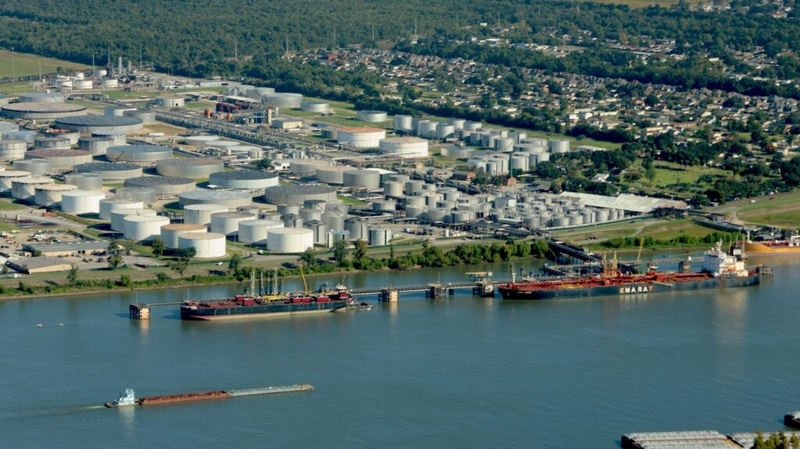
A vital feature of the nation's economy, the Mississippi River is continuously busy with shipping traffic, particularly near oil refineries like these in Norco, Louisiana. (Photo: Wes Muller/LA Illuminator via Southwings)
Louisiana has made slow but positive economic progress this year, expanding production and gaining jobs amid a milder U.S. economy beset by tariffs, high inflation and worsening affordability for residents and small businesses.
New first-quarter data released by the U.S. Bureau of Economic Analysis show Louisiana leading much of the country with 2.9% growth in gross domestic product, which measures the total value of the goods and services produced. The figure puts Louisiana behind only five other states and above the national GDP rate of 2.1%.
Nevertheless, Baton Rouge economist Loren Scott, who provides a forecast each year for the Southwest Louisiana Economic Development Alliance, called those GDP rates “mediocre,” saying the ideal rate is closer to 3.5%.
In a phone interview Tuesday, Scott predicted the mild GDP will continue for the remainder of the year, saying the state’s growth, though not quite as strong as it should be, is due in large part to industrial construction.
Industrial manufacturers are coming to Louisiana for a few main reasons, he said. The state has relatively cheap natural gas, a generally friendly business climate with generous corporate tax breaks, and offers deep-water shipping ports along the Mississippi River and the state’s coast.
Gov. Jeff Landry has successfully leveraged these features to negotiate numerous industrial projects across the state, including Meta’s $27 billion artificial intelligence data center, Amazon’s two data centers worth $12 billion, Hut 8’s $10 billion data center and a $6 billion Hyundai steel mill, among others.
This has boded well for employment. Under Landry, Louisiana has gained roughly 17,000 jobs over the last 12 months, according to data from the U.S. Bureau of Labor Statistics.
Some of the projects have spawned peripheral investments such as $500,000 in grant money Amazon handed out Wednesday to 46 nonprofits, schools and individuals in Caddo and Bossier Parishes — where the company is building its two data centers. Prior to that, the retail giant had already spent more than $6 billion in Louisiana, counting company payroll and infrastructure, since 2010, Amazon spokesperson Joanna Kaleniecka said in an email to the Illuminator.
“Our data center projects are creating jobs with good pay and benefits, generating tax revenue, and supporting local contractors and small businesses,” Kaleniecka said. “We’re committed to building responsibly and investing in the communities where we operate.”

While data centers and industrial projects have stimulated the economy, they could drive up construction and energy costs. Scott said President Donald Trump’s tariffs and the war with Iran have worsened the affordability crisis for residents and other businesses, as inflation raised the prices of goods and services across the economy by 4.6%, according to federal data.
Insurance rates have been a key factor of the affordability crisis in Louisiana. The state’s recent policy efforts to address the rising costs of insurance have had mixed results so far, according to recent rate filings available from the Louisiana Department of Insurance.
Last year, the problem was palpable for florist Herb Oldknow, who owns Herbivore Floral Designs in New Orleans. Following a short-lived uptick in sales during Super Bowl LIX, which the city hosted, his costs climbed while his sales dropped sharply during the second half of 2025.
“I literally thought I was going out of business last year,” Oldknow said. “Every bill has gone up. Insurance has doubled.”
To make ends meet, he reduced the hours of his staff and opted to not pay himself for about 12 weeks, he said.
Kendrick Slan, owner of Omega Insurance Group in Baton Rouge, said insurance rates skyrocketed after five named storms struck the state over a 12 month period from 2020 to 2021. He has seen a few rate decreases this year but no across-the-board premium drops so far that might indicate a trend.
“I see signs of improvement — not consistent signs of improvement,” Slan said. “The thing is we’re always one storm away from none of that mattering.”
Ray Shirey, who does home maintenance and renovations in the Baton Rouge area, said work has been relatively stable this year despite higher costs, adding that he recently changed insurers after his premium went up. He is currently booked with jobs until September, which is a welcome reprieve from a few months ago when his bookings extended only about a week out, he said.
“People live in homes and homes always need work,” Shirey said.
In the restaurant industry, Conrad Churra, owner of two Wakin’ Bakin’ brunch eateries in New Orleans, said he had to raise his menu prices to cover increases in wholesale food costs, payroll and insurance.
“I feel like the whole industry is entering this phase that I like to call ‘airport pricing’ where it’s like $7 for a bottle of water,” Churra said.
Lisa Susano, owner of Monjunis Italian restaurant in Bossier City, said she is seeing inflation across the board but more so with food costs, some of which have nearly doubled.
“I haven’t done anything out of the ordinary,” she said. “Raised menu prices just a little like I do every other year. Just making less money now, but I still do very well.”
Baton Rouge, LA