America and Me: A lesson on power, opportunity and belonging
Jul 03, 2026 | 7:00 am ET
Description
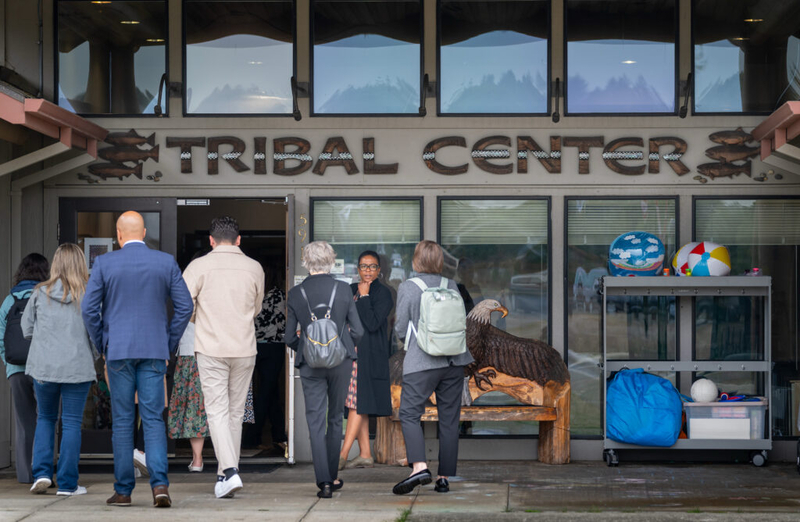
Toya Fick, facing the camera, and members of the Meyer Memorial Trust board and trustees visit with the Coquille Indian Tribe in September 2025. (Photo courtesy of Fred Joe for Meyer Memorial Trust)
I grew up in a segregated town in rural Louisiana. When I was nine years old, I was bused to a white school across the railroad tracks — literally — from the public housing neighborhood where I lived.
On my first day, a woman I didn’t know stood outside the school bus looking for me. When she finally found me, she instructed me to follow her. She led me away from everyone I knew and into a different wing of the school.
I thought I had done something wrong. In fact, I was being placed on a separate educational track that would make me the only Black child in my classes for the rest of my time at that school.
Looking back, I know that experience expanded what was possible for me. But I also know that opportunity should not depend on someone else’s decision about who is worthy of it.
What I learned later was that the district had been forced to integrate the school, but the classrooms in the building remained segregated. While desegregation had been declared, access to opportunity remained uneven. The gap between those two realities is part of a much larger American pattern.
As our nation approaches its 250th birthday, that tension is worth reflecting on.
The United States was founded on a powerful declaration: that all people are created equal and endowed with certain unalienable rights. Yet from the beginning, the country struggled to extend those rights equally. The ideals were revolutionary. The reality was often far less so.
In an early draft of the Declaration of Independence, Thomas Jefferson condemned the transatlantic slave trade as a “cruel war against human nature itself.” Those words were removed before the document was adopted. The Declaration proclaimed liberty while millions remained enslaved.
Declaring freedom and delivering freedom have never been the same thing.
American history is, in many ways, the story of efforts to close that gap. The abolition of slavery, women’s suffrage, the Civil Rights Movement, disability rights, marriage equality and countless other struggles all sought to bring the nation closer to the promises it made at its founding.
Juneteenth offers one particularly powerful example. More than two years after the Emancipation Proclamation declared freedom for enslaved people in Confederate states, many enslaved Texans remained in bondage. Freedom had been declared, but it had not yet been delivered.
That lesson remains relevant today.
Freedom is not merely the removal of barriers. It is the presence of agency. It is the ability to determine the course of one’s own life and future.
At its core, democracy depends on self-determination. And self-determination is the foundation of justice.
That understanding shapes the work we do at Meyer Memorial Trust. We believe justice exists when people and communities have the power to shape their own futures. Our role is not to determine what communities need, but to help create the conditions that allow communities to determine that for themselves.
That principle comes to life in places like Portland’s Lower Albina neighborhood. For generations, Albina was the heart of Portland’s Black community before public policies and development decisions displaced families and dismantled much of what had been built. Today, community leaders are working to restore that legacy and build a future defined by those who call Albina home.
Our recent $15 million commitment to Albina Vision Trust reflects a simple belief: communities should have the power to shape their own future, especially after enduring generations of decisions made about them rather than with them.
Across our work — whether supporting educational opportunity, community resilience, immigrant and refugee communities, Black communities or Tribal Nations — the goal is the same: ensuring that people closest to the challenges, and closest to the possibilities, have the power and resources to shape their own futures.
I often think about that nine-year-old girl being led down an unfamiliar hallway. She didn’t know she was walking into a lesson about power, opportunity and belonging. She only knew that someone else had decided what was possible for her.
Two hundred and fifty years after our founding, the unfinished work of America is not simply removing barriers. It is ensuring that every person and every community has the power to determine its own future. That is the promise at the heart of democracy, and it is a promise still worth striving toward.
Salem, OR