Could nuclear power Alaska’s future?
Jul 01, 2026 | 4:30 pm ET
Description
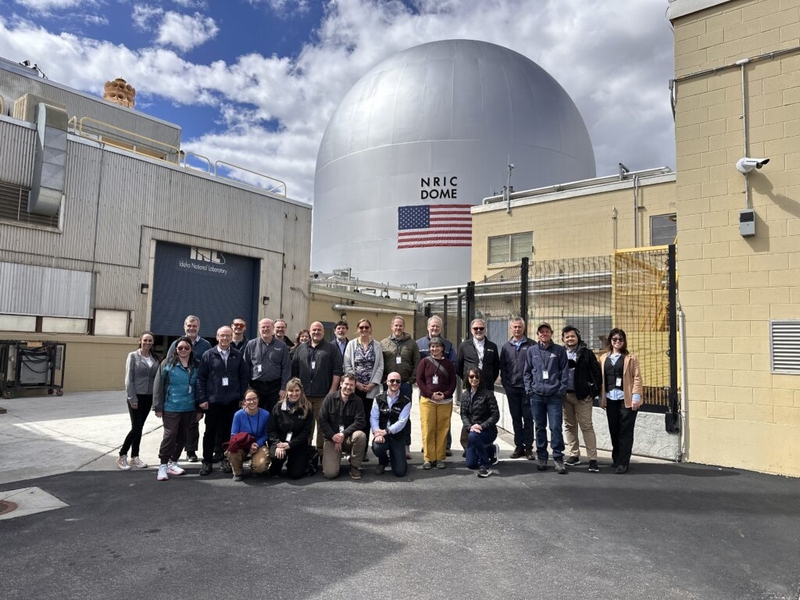
Representatives from Alaska utilities and energy organizations pose outside Idaho National Laboratory's NRIC DOME during a May tour to learn about advanced nuclear reactor technologies and their potential role in Alaska's energy future. (Photo courtesy Gewn Holdmann)
A couple years ago, shortly after Governor Dunleavy began his second term, I was killing time in the Juneau airport waiting for a flight when one of his staff called and said, “You might want to sit down before I tell you this.” The Governor had just thrown out a bold challenge: find a path to 10-cent per kilowatt electricity on the Railbelt. My knee-jerk response was, “That’s impossible.”
But my second thought was different: that’s a moonshot.
A goal like that forces you to throw out the playbook. We are not going to achieve 10-cent electricity by continuing down the path we are already on. It requires thinking beyond conventional assumptions and asking where the biggest opportunities lie given the direction federal policy, technology and energy markets are heading.
I still find myself returning to that question. And after nearly three decades working on Alaska energy issues, I have become increasingly convinced that natural gas is not a path to low-cost electricity – whether that means imported LNG or a North Slope gasline.
Should we be cheering for the Alaska LNG project? Absolutely. As an LNG export project, it has the potential to create jobs, generate state revenue and monetize a resource that has sat largely stranded for decades. But as a low-cost source for domestic power? Not so much.
The reason is simple. When fuel is a significant component of the cost of generating electricity, that cost doesn’t disappear once the plant is built – it continues for as long as the plant operates. Over time, fuel prices tend to rise, even if only with inflation, and history has shown they can also spike unexpectedly in response to global events.
Hydroelectric dams and nuclear plants follow a fundamentally different economic model. They require much larger up-front investments, but once built, fuel costs are low, predictable and far less exposed to global commodity markets. As those capital investments are paid off, the cost of producing electricity tends to trend downward. That is why historically, many of the places with the world’s lowest-cost electricity have achieved it through long-lived investments in hydroelectricity or nuclear power.
That does not mean electricity from these sorts of projects will be inexpensive on day one. Bradley Lake is a good example. When the hydroelectric project came online in the 1980s, it was one of the Railbelt’s most expensive sources of electricity because its construction costs had to be recovered. Today, with those capital costs largely paid off, it is one of the cheapest.
I recently wrote about the Susitna Hydroelectric Project because I think it’s worth taking another look. The state has already invested heavily in the studies required to develop it, and with today’s generous federal incentives – which could offset as much as 50 percent of capital costs if construction begins before 2033 – the project’s economics could look a lot more attractive.
But hydropower isn’t the only infrastructure-based technology Alaska could be looking at. Advanced nuclear qualifies for many of the same incentive programs and offers a few additional advantages. It can also co-generate heat – a major advantage in Alaska’s climate. And unlike hydropower, billions of dollars are currently flowing into the sector from both the federal government and private industry. That investment is accelerating innovation, driving down costs, and creating intense competition – not only among reactor developers, but also among prospective customers hoping to secure future reactor deployments and the energy they will produce.
The race to criticality
Last year, President Trump launched an energy moonshot of his own. Through four executive orders issued in rapid succession, he sought to jump-start a new era of nuclear energy in the United States. The orders established several ambitious targets, including rebuilding the nuclear supply chain and workforce, having ten large reactors under construction by 2030 and quadrupling U.S. nuclear generating capacity by 2050. But the most immediate goal was to have at least three advanced reactors achieve criticality by July 4, 2026.
Achieving criticality might sound alarming. However, in the world of nuclear energy, criticality is a good thing. It means a reactor is operating as intended, with each fission event, on average, causing one more fission event. When this happens, the chain reaction becomes self-sustaining and the reactor is officially “alive” and capable of producing power.
This goal was specifically focused on advanced reactors – a new generation of nuclear technologies designed to be smaller, safer, more standardized and easier to build than today’s conventional plants. Dozens of companies are pursuing these designs and billions of dollars have already been invested. Yet despite all of that activity, no advanced reactor has entered commercial operation in the United States.
That is what makes the President’s deadline so interesting. It cuts through the hype and provides a simple litmus test of industry readiness. Either three advanced reactors will achieve criticality by this week – or they won’t.
Field trip to INL’s National Reactor Innovation Center
I recently invited a group of utility executives and senior engineers from Alaska’s electric power industry to Idaho Falls. The trip was an opportunity to learn about the technology firsthand from leading experts. But I also wanted them to experience something more intangible: the sense of momentum building around advanced nuclear energy. The feeling that it may finally be approaching an inflection point – a transition from a technology of the future to one they can begin actively planning around.
If advanced reactors are going to meet the President’s deadline, Idaho National Laboratory is where that effort will ultimately be put to the test. Many of the technologies that defined the first nuclear age were invented, tested or demonstrated in the Idaho desert. But that was another era. More than half a century has passed since a new reactor achieved criticality there.
Yet even as construction of new nuclear power plants largely stalled in the United States after the early 1990s, INL maintained the expertise, facilities, and institutional knowledge that made it the nation’s premier nuclear research laboratory. After all, nuclear energy never disappeared. Existing reactors still generate roughly 20 percent of America’s electricity and the nuclear Navy remains a cornerstone of our national defense.
But there is a noticeably different energy around the lab these days. Activity has ramped up dramatically and employees proudly wear shirts emblazoned with the number “53” – a reminder that the next reactor to achieve criticality at Idaho National Laboratory will be the 53rd in its history.
Over the course of two long days, we visited some of the laboratory’s most important facilities. One place we were not allowed to enter, however, was DOME – a repurposed containment structure that has been transformed into the nation’s premier test facility for advanced nuclear microreactors.
I had visited the facility before, but access has become much more restricted since Radiant Nuclear moved its Kaleidos reactor there earlier this year. Designed to produce just one megawatt (MW) of electricity, Kaleidos is tiny compared to any existing commercial reactor in the U.S. – literally three orders of magnitude smaller in terms of power output. Its compact design allows it to be transported in shipping containers and deployed in locations that would be impractical for conventional nuclear plants. While still several years away from commercial production, a reactor of this scale could eventually provide an alternative to diesel generation for remote power needs, including in Alaska.
But we also learned about larger reactor designs known as small modular reactors, or SMRs. Unlike microreactors, which are intended to serve relatively small loads, SMRs are designed for more mainstream electricity generation. Rather than building a custom-designed reactor on site, most SMR concepts rely on standardized reactor modules that can be manufactured in factories and then transported to their final destination. Utilities can install a single module or add additional modules over time as electricity demand grows.
Many SMRs incorporate passive safety systems that rely on the laws of physics – rather than pumps or operator actions – to safely shut down and cool the reactor if something goes wrong. Because of these features and because many do not require water for cooling, these reactors have a much smaller footprint than conventional nuclear plants. This means there is a lot more flexibility in where they can be sited, including right next to the loads they are intended to serve.
And those loads are not just electrical. The ability of nuclear energy to provide high-temperature process heat is one reason there is so much interest in these systems. Industrial facilities such as chemical plants, refineries, steel mills and ammonia producers require large amounts of high-temperature heat, and those loads have proven particularly difficult to decarbonize.
We also took a slight detour through the desert to drive by the site where Oklo is beginning construction on its 75 MW Aurora reactor commercial demonstration plant. For now, it is little more than a large hole in the ground. But eventually, the reactor will be installed entirely underground, while the powerhouse will sit above it in an elegant A-frame building designed to look something like a ski chalet. They definitely have the marketing down.
Oklo already has customers lined up if this pilot proves successful. The company is pursuing a business model that many other developers are also adopting. Rather than selling reactors, they envision retaining ownership and selling electricity and heat under long-term contracts. In other words, the power purchaser would not be buying a nuclear reactor – it would be buying energy at a pre-agreed price, significantly reducing the risk for the customer whether it is a utility, military installation or industrial end-user.
Oklo was a familiar name to many of the tour participants, particularly those from Golden Valley Electric Association. It’s the same company that was selected by the U.S. Air Force to supply the 5 MW microreactor planned for Eielson Air Force Base near Fairbanks. What struck me, however, was how much of the company’s attention now appears focused on its larger 75 MW Aurora reactor. Company representatives assured us that the Eielson project remains important, but the Aurora seems to be emerging as Oklo’s standard commercial offering, with future deployments intended to be built in multiples of that basic unit size.
That got me wondering: could there eventually be an opportunity to do both? Build the 5 MW microreactor at Eielson to serve the Air Force mission and then, if the technology proves successful, follow it with a larger 75 MW reactor at the same location supplying power to the GVEA’s grid? A project of that scale would go a long way toward reducing the Interior’s unhealthy reliance on liquid fuels to meet peak demand. It is at least a conversation worth having.
Nuclear at the tipping point
On June 4th, exactly one month ahead of President Trump’s target date, Antares Nuclear’s Mark-0 microreactor achieved criticality at INL. During our visit to the lab, we had walked right past the very nondescript building that houses the reactor. Then, less than two weeks later, Valar Atomics’ Ward 250 followed. I would not be surprised if one or two other vendors make the deadline as well – we will know the final tally within a few days.
In the grand scheme of things, these criticality demonstrations are partly symbolic. None of these reactors will immediately begin producing commercial electricity; achieving criticality is simply one step on the road to full commercialization. But they may also represent a tipping point – the moment when the slope is no longer uphill. After decades of slow progress, advanced nuclear may finally have accumulated enough technical, financial and political momentum that deployment begins to accelerate much faster than many of us expect.
I am writing this article while visiting Richland, Washington – home of the Hanford site and, along with INL, one of the deepest concentrations of nuclear expertise in the country. For years, many assumed this region would host X-energy’s first commercial reactors. The local utility Energy Northwest had partnered with the nuclear vendor to develop four Xe-100 reactors totaling 320 MW, with plans to eventually expand to as many as twelve units. Amazon had also signed on to support the project and purchase power, making Richland seem like the obvious frontrunner.
Instead, X-Energy’s first commercial units will be installed at Dow Chemical’s Seadrift facility in Texas. Unlike a data center, Dow could make use of both the electricity and the high-temperature process heat produced by the reactors, improving the overall economics of the project. The Richland project is still moving forward, but it got bumped to second place.
There is a lesson here for Alaska. States do not lead by waiting for certainty. They lead by skating to where the puck is going – making strategic investments, building partnerships and positioning themselves for the opportunities of tomorrow. By the time a technology is fully proven, the first wave of deployments may already be spoken for. If Alaska waits until advanced nuclear is a sure thing, we may find ourselves at the back of a very long line.
Getting ahead of that curve does not require Alaska to commit to building a reactor. It just requires preparing for the possibility. That effort could take many forms. It might begin with issuing a Request for Information (RFI) to better understand which reactor designs are the best fit for Alaska’s unique needs. It could include evaluating potential Railbelt sites and pursuing a Nuclear Regulatory Commission Early Site Permit to preserve future siting options. Or it might involve exploring with the Air Force whether the Eielson microreactor pilot project could create opportunities for future expansion or shared infrastructure. It should also include bringing together the state, utilities, local governments and other stakeholders to consider when and where nuclear could make sense in light of all our energy options.
None of these actions commits anyone to building a reactor. They simply preserve options, shorten future lead times and position the state to move quickly if – or when – the technology proves itself. Many states are already taking exactly these kinds of preparatory steps.
When Governor Dunleavy challenged us to pursue the moonshot goal of 10-cent electricity on the Railbelt, former Senator Click Bishop responded by covering a whiteboard in his Juneau office with proposed energy projects. Whenever someone came in with a new idea, he added it to the board. Over time, it grew to include virtually every major energy-related opportunity in Alaska, all placed on a more or less level playing field. The goal was not to pick winners and losers. It was to keep as many viable options moving forward and let economics, technology readiness and execution determine which ones ultimately succeed. The vision was an Alaska with abundant, affordable energy capable of supporting new industries, attracting investment and creating opportunities that simply do not exist in a high-cost energy economy.
That is exactly how we should still be thinking today.
Alaska needs leadership and a coordinated effort to keep multiple opportunities moving forward. We cannot afford to pin all of our hopes on a single outcome. If we are serious about building an affordable energy future, we need to think beyond conventional assumptions and invest in the opportunities most likely to shape tomorrow’s energy landscape.
Whether advanced nuclear ultimately becomes part of Alaska’s energy future remains to be seen. But I would hate to see that decision made for us because we failed to prepare while the opportunity was still within reach. Preparing today does not commit Alaska to nuclear energy. It simply preserves our ability to choose tomorrow.
Juneau