Detroit City Council narrowly votes to extend gunshot detection tech, after passionate split debate
Jun 30, 2026 | 3:13 pm ET

Description
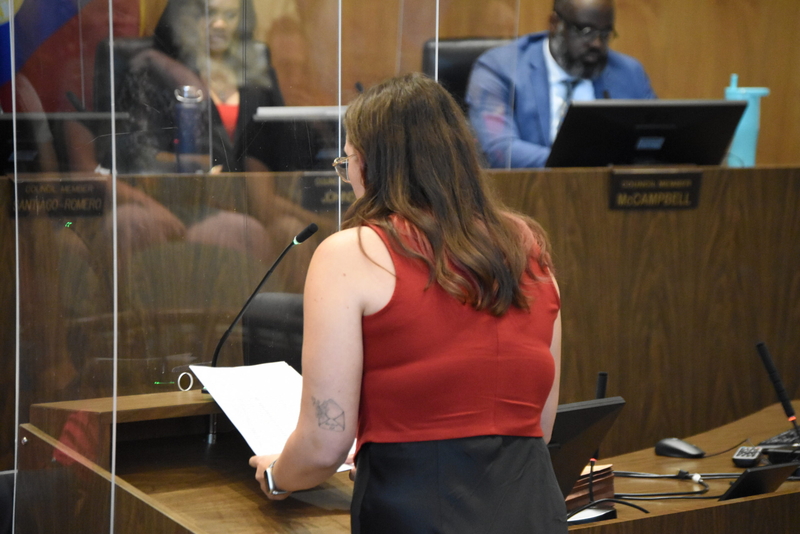
Detroit City Council Member Gabriela Santiago-Romero questions the effectiveness of ShotSpotter, the city's gunshot detection technology program, as the police department sought an extension to the privately-owned tech. June 30, 2026. | Photo by Katherine Dailey/Michigan Advance.
The Detroit City Council voted Tuesday to extend the city’s contract with California-based tech company SoundThinking Inc. for its ShotSpotter gunshot detection technology. The vote was 5-4, with Council President James Tate as well as Councilmembers Gabriela Santiago-Romero, Denzel McCampbell and Mary Waters voting against it.
The extension of the contract will cost the city approximately $2.1 million for nine months, extending the city’s use of the technology through the end of March 2027.
But that cost did not dissuade the majority of the city council, who agreed with the police department’s position that while the technology is not perfect, it is a helpful tool in reducing gun violence in Detroit. Councilmember Scott Benson and City Council President Pro Tem Coleman Young II — both longtime proponents of the technology — expressed their strong support for the program throughout testimony on the proposal.
Backers cite public safety benefits, while critics question effectiveness
“This is not just about law enforcement, this is about human lives,” Benson said. “The mothers who came out today were brave enough to talk about their lives and how this type of technology has helped to save a life.”
Pushing back against some of the criticisms raised against the program, Councilmember Renata Miller questioned how many of those speaking out against the technology actually live in Detroit or have been directly impacted by gun violence in the city.
“We do not have to accept that gunshots is a normalcy in Detroit, especially on the east side of Detroit,” she said. “Please do not act like this is something different than what we already do every day, because the reality is the police department has spoken, they have a job to do, and I am for every single thing they bring to create a deterrent for crime.”
However, the price tag changed the minds of some council members — even one who had been previously supportive of the program.
“I have a challenge with that dollar amount. It’s not about the technology,” said Tate, who has historically been a supporter of ShotSpotter in Detroit. “When asked, would they renegotiate the contract, the answer was no, because we’ve been giving you a deal in the first place, so that leads me now to a situation where I cannot support this particular amendment.”
Tate was not the only council member to break with his own past voting record on the technology — Councilmember Angela Whitfield-Calloway voted against the 2022 expansion of ShotSpotter, but voted in favor of Tuesday’s extension.
The other three votes against the program came from all of the members of the council’s Public Health and Safety Standing Committee, where the resolution has been pending since May 12. All three members of that committee — Santiago-Romero, McCampbell and Waters — raised concerns with the technology when they recommended the full council deny the extension.
“Frankly, I still have not heard enough support from the public, have not seen data that shows that this is working for the cost and that it’s actually protecting our information,” Santiago-Romero, who chairs the committee, said just prior to the committee’s vote.
McCampbell similarly said in committee, “With that price tag of $2 million over nine months, I just feel that it is not in our best interest to extend this contract.”
But stories of the impact of the technology outweighed concerns.
Assistant Chief Franklin Hayes told the story of a ShotSpotter alert on the west side of Detroit that led to a gunshot victim being found alive in an instance where no 911 call was made — a case where he said a life likely would have been lost if not for gunshot detection technology.
“Just an example of the value of this technology as we work in conjunction with CVIs,” he told the council, referring to Community Violence Intervention programs.

In contrast, civil liberties groups, as well as a number of local activist organizations, have been vocally opposed to the technology for years.
“We were hoping for a different outcome, but if this is what the city feels they have to do to protect their residents, that is their decision,” Gabrielle Dresner, a policy strategist for the ACLU of Michigan who focuses on surveillance and policing, told the Michigan Advance just after the vote. She also testified to the council, as well as in past weeks to the Public Health and Safety committee, in opposition to the extension.
The technology garnered public controversy when the city first signed a contract in police precincts 8 and 9 in 2020 and again in late 2022 when both the geographic scope and the time of contract for the technology were expanded.
Privacy concerns over the audio recording capabilities of the sensors and data storage of the information collected have been raised by community groups — as well as by city council members, including McCampbell, in committee debates on the extension. Those concerns have been repeatedly denied by police representatives, who have told the council that the department only receives short audio clips of the few seconds in which the gunshot can be heard.
The Michigan Court of Appeals also ruled in October 2025 that the city violated the Community Input Over Government Surveillance ordinance in 2022 when they failed to post required oversight reports until after the city had already voted to extend the first contract and just two weeks before voting to expand the technology into other parts of the city.
Public comment in the hearing — which lasted around two hours, even with comments shortened by over half — showed strong feelings on both sides of the issue. Some in favor of the technology cited the decline in crime in Detroit as proof that the program is doing what it claims to do. Many of those opposed pointed to the fact that it is an inherently reactive technology, arguing instead that the funds should be directed towards violence intervention groups.
Various members of the Live In Peace Movement, a Community Violence Intervention program in Detroit focused on gun violence prevention for the city’s youth, expressed their support for the ShotSpotter extension. Each member of the group read the same message, including that “we continue to stand firmly in support of the ShotSpotter program, because we believe it can truly be a shot stopper.”
And tearfully, Lakeisha Brooks told the council about how she believes ShotSpotter saved her son’s life by allowing police to respond more quickly.
“If it wasn’t for ShotSpotter, my seven year old son would be dead, so I support it because it’s going to save a lot of children,” she said.

Some residents, like Shea Howell, who introduced herself as a longtime resident of more than 50 years, spoke in opposition to the proposal.
“I have seen what happens in our communities over those decades, and I am completely opposed to ShotSpotter,” she said. “I think people are being bamboozled by information from the companies that are benefiting by pushing high tech solutions that only increase surveillance on our community.”
Statistics first reported by the Michigan Advance on response outcomes of ShotSpotter alerts were also cited in public comment opposition to the extension of the contract.
According to information shared by SoundThinking Inc., the parent company of ShotSpotter, between 2024 and 2025, the Detroit Police Department responded to a total of 24,225 ShotSpotter-triggered gunfire incidents.
In just over 12% of those incidents, shell casings were recovered based on a ShotSpotter alert. Witnesses were located in just over 2% of incidents. And in less than 1% of the cases was aid rendered to a victim by a first responder.
“I’m asking you to put funds into ways to prevent shots from happening in the first place,” Victoria Camille, a member of the city’s civilian police oversight board, speaking in a personal capacity, said in the public comment period. “Yes, there are investments to be made, but they are in people and relationships, not in expensive algorithms.”
On the other hand, her colleague, Board of Police Commissioners Vice Chair Darryl Woods, testified alongside Detroit Police Department officials in favor of the technology.
“Is it perfect? Absolutely not,” Woods said. “But it is the tool that is being used, and let’s finish out this particular portion. Don’t throw the baby out with the bath water, but let’s continue this service as they get even better technology.”
City prepares to seek competing bids
The decision by the full council came down to the wire — the existing contract, which went into effect in October 2022, was set to expire on June 30, the same day as the final vote.
Detroit Police Deputy Chief Mark Bliss said just prior to the committee’s vote that the department was aware of the public feedback in opposition to the technology — public comment periods in meetings of the committee throughout May and June included repeated requests from residents of the city to reject the proposal.
“The one thing that we don’t do is we, as a department, have never run away from criticism. We’ve come before you, we have given you data, we have given you answers to the questions that you pose,” he said on June 22. “This is just an extension on our contract.”
The need for such a short-term extension, Bliss said, reiterating what had been said in prior hearings, is to continue having gunshot detection technology while the city considers a Request for Proposal to consider other options for gunshot detection technology in the city.
That request would also seek to expand the technology into downtown and southwest Detroit. Tuesday’s extension did not expand the technology’s geographic footprint.
Detroit police look at expanding gunshot detection technology into downtown, southwest
Detroit Police Department Chief Todd Bettison explained in a hearing of the city’s Public Health and Safety Standing Committee that when the city began using ShotSpotter, it was the only such technology on the market, while now there are numerous companies that offer it.
McCampbell raised issues during committee hearings with the fact that the Detroit Police Department does not have access to the locations of ShotSpotter sensors in the city, which Michigan Advance first reported in December.
Consistent with their past statements, police officials said that they do not need access to the precise locations of the sensors, and that the triangulation offered by the company is enough to justify the technology’s use.
Bliss told the committee during debate that “it’s no benefit to us to know where they are.”
Waters also sent a memo on May 13 to the council’s legislative policy division requesting further information on “an overview of all wrongful arrests, as well as all lawsuits filed against the City of Detroit, that involve the usage of ShotSpotter by the Detroit Police Department since the launch of the technology in the city.”
As of the June 29 meeting of the Public Health and Safety Committee, there was no response yet ready to those questions.

Lansing, MI