Fifty for 150: Coloradans vote in 1972 to reject the Winter Olympics
Jun 29, 2026 | 6:00 am ET
Description
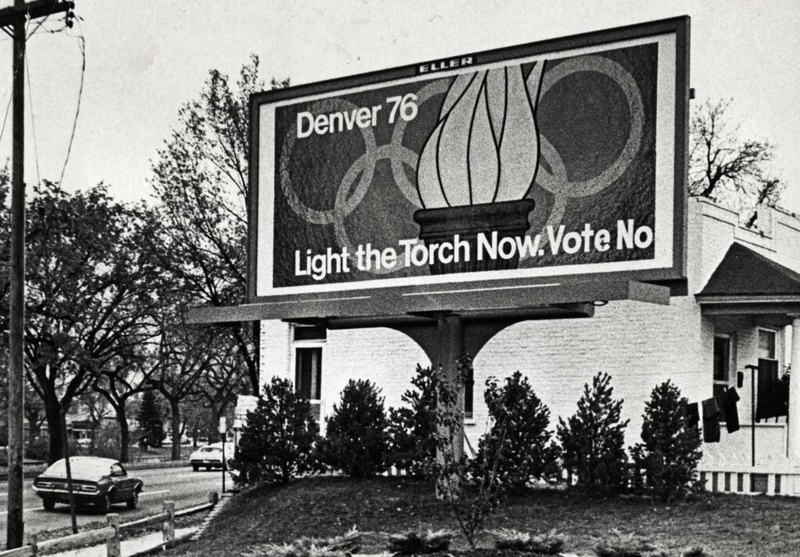
A billboard at Speer Boulevard and 13th Avenue in Denver in October 1972 urged Colorado voters to vote "no" on Amendment 8 and keep the 1976 Winter Olympics in Denver. (Courtesy of Denver Public Library, WH2129-2018-374)
Coloradans faced a ballot full of important questions when they went to the polls on Nov. 7, 1972, beginning with whether to reelect President Richard Nixon and whether to send Republican U.S. Sen. Gordon Allott back to Washington for a fourth six-year term.

This story is part of Colorado at 150. Each Fifty for 150 story focuses on an event that helped define Colorado over 150 years of statehood. Newsline is publishing one Fifty for 150 story every weekday in reverse chronological order until the sesquicentennial, Aug. 1, when the final of 50 stories, about the declaration of statehood, will appear.
Nixon won. Allott lost. But in the view of Denver Mayor William McNichols, who spoke for much of the Centennial State’s political establishment at the time, “the most critical issue on the entire ballot” wasn’t any of the federal or state offices up for election, but a ballot initiative that threatened to cancel Denver’s plans to host the 1976 Winter Olympics.
In spite of the many millions of dollars spent by boosters to sell Coloradans on the idea, in the end, the vote wasn’t particularly close: More than 59% of voters statewide voted to approve Amendment 8, inserting into the state’s constitution a prohibition on “levying taxes and appropriating or loaning funds for the purpose of aiding or furthering the 1976 Winter Olympic Games.”
The vote brought a dramatic end to Colorado’s years-long quest to host the event, which had formally begun in 1964 with Republican Gov. John Love’s appointment of six ski industry promoters and Denver-area business leaders to the Colorado Olympic Commission, which was later replaced by the Denver Organizing Committee.
Love and McNichols led Colorado’s business establishment in championing Colorado’s Olympic bid throughout much of the ensuing decade — in the face of a diffuse set of state and local interests that gradually came together to mount an unprecedented opposition campaign.
Organizers thought they had achieved their goal in May 1970, when the International Olympics Committee, meeting in Amsterdam, selected Denver over three other competing bids. But as author Adam Berg writes in “The Olympics That Never Happened: Denver ’76 and the Politics of Growth,” there were already warning signs on the home front.
“Two days after returning home from his Olympic triumph in Amsterdam … McNichols found a group of tenant rights organizations waiting outside his offices, demanding to know how Denver could spend money to host the games when a ‘housing crisis’ continued to engulf the poor,” Berg writes.
Against a national backdrop of civil rights struggle, Denver politics had recently been roiled by the city’s condemnation and razing of the historic Mexican-American neighborhood of Auraria to clear space for a new higher-education complex. Groups representing Denver’s Black and Chicano communities united to form Citizens Interested in Equitable Olympics, which petitioned the DOC for a seat at the table. Instead, the committee handpicked three Black and three Mexican-American members to join 19 others on its board of directors “without consulting CIEO or other community leaders,” Berg writes, further inflaming opposition from civil rights activists.
Other important sources of skepticism towards the Olympic bid included public concern about the high costs the state would be forced to bear, and its disruptive effects on communities and the environment — especially in foothills towns like Evergreen and Indian Hills, where many alpine events were planned.
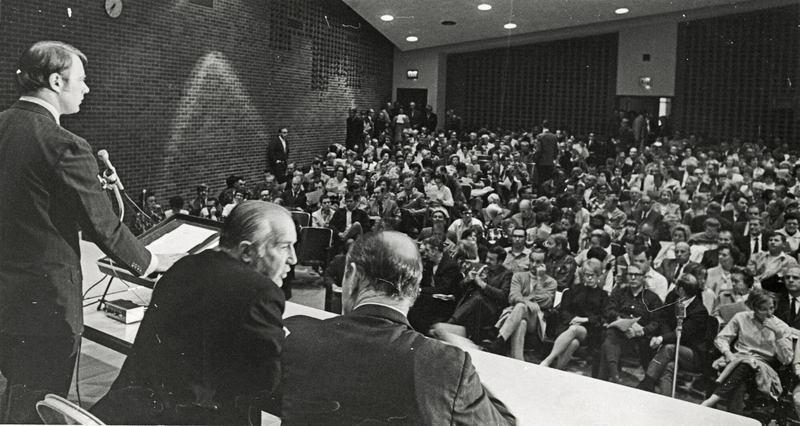
The face of this second category of opposition was a young Democratic state representative named Dick Lamm, who in 1971 led a handful of his fellow lawmakers in a futile attempt to block the games through the state’s appropriations process.
“Lamm and (state Rep. Robert) Jackson were less attuned to matters of affordable housing, de facto segregation, and overall neglect in the city than to pleas for quality of life echoing down from the foothills along the Front Range,” writes Berg.
The scant opposition Lamm and his allies could muster in the Legislature drew furious condemnations from the local newspapers who’d long since become some of the DOC’s biggest cheerleaders. In editorials, the Rocky Mountain News accused opponents of “the rawest kind of political pandering,” while the Denver Post said reneging on the Olympic commitment “would be a disastrous and stupid mistake.”
At the same time, however, a series of stories in the News about the Olympics bid, by investigative reporter Richard O’Reilly, proved pivotal in shifting public opinion. Though they mostly downplayed environmental concerns, O’Reilly’s articles uncovered substantial evidence that the DOC was understating the cost of hosting the games to the public, while wildly overselling Denver’s suitability for the games to international organizers.
The latter story was epitomized by the revelation that a dramatic photo of a mountain on the cover of the committee’s official bid book — Mt. Sniktau near Loveland Pass, the supposed site of Alpine skiing events — had been airbrushed to add snow-covered slopes to what was in fact a typically windblown, arid peak where very little snow accumulated.
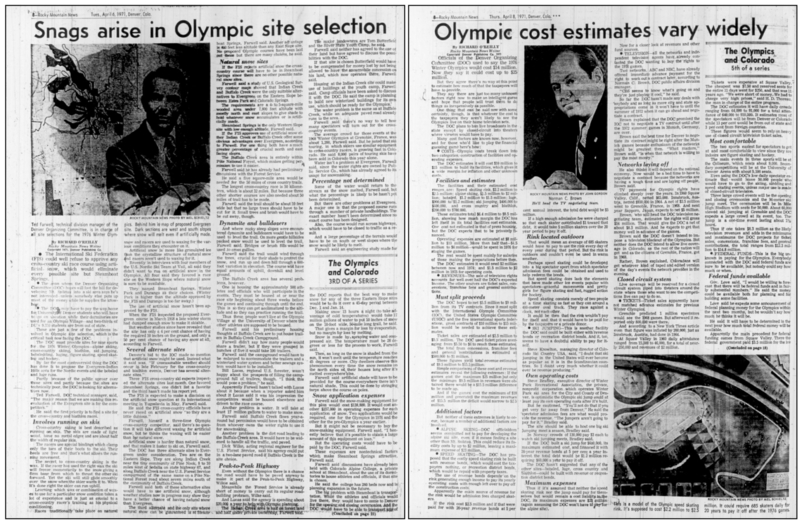
“Denver’s Brown and Black activists, white middle-class environmentalists in the foothills, two fiscally judicious Colorado legislators, and a Rocky Mountain News reporter provided the seeds for an anti-Olympics uprising,” Berg writes.
In late 1971, Lamm and a dozen other anti-Olympics activists formed Citizens for Colorado’s Future, an issue committee that successfully gathered 77,000 petition signatures to place Amendment 8 on the 1972 ballot. Despite a massive PR push by organizers, the opposition campaign channeled the frustrations of civil rights groups, environmentalists and other diverse interests to deal Colorado’s governing political and business elite a stunning defeat. It remains the only time in history a host location has voted to turn the Olympics down.
The 1972 vote was a turning point in Colorado’s political history. Love soon resigned the governorship to become Nixon’s energy czar, and Lamm rode the momentum of the CCF campaign to launch a successful bid for governor in 1974.
The environmentalism and anti-growth sentiment that were the major themes of Lamm’s Olympics opposition would continue to define his cantankerous political identity during his three terms in office — though they would also lead him to take more controversial stances in favor of population control and harsh immigration restrictions.
Two years before his death in 2021, Lamm lent his support to another anti-Olympics campaign, as Denver and Colorado officials prepared a bid for the 2030 Winter Olympics. Though the U.S. Olympic Committee ultimately backed Salt Lake City’s unsuccessful 2030 bid instead, Denver voters nonetheless approved a 2019 ballot measure that prohibits the city from using public funds to host “any future Olympic Games” without getting voter approval first.
Denver, CO