A ‘never-ending cycle’: Data shows flood events have more than doubled in WV since June 2016 flood
Jun 29, 2026 | 5:55 am ET
Description
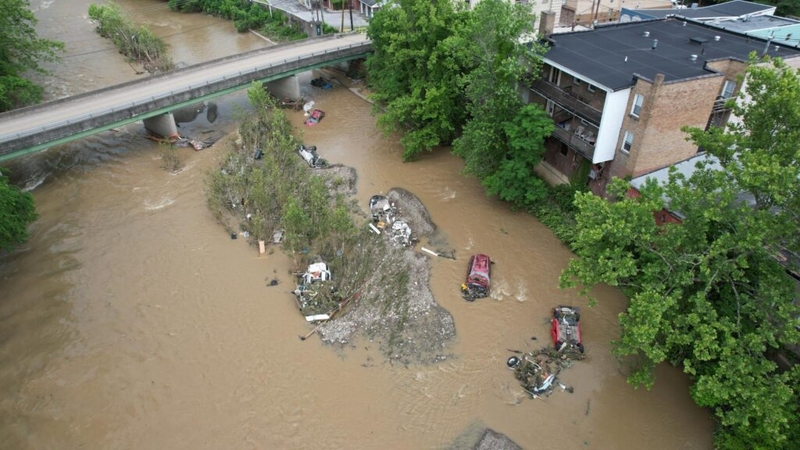
Several heavily damaged vehicles are shown in Wheeling Creek near Junior Avenue in Wheeling, West Virginia, after flooding Saturday, June 14, 2025. (Amy Essington | Essington Creative)
In the decade since the devastating 2016 floods that cost 23 people their lives, West Virginia has seen the number of flooding events in the state more than double compared to the 10 years before, according to the National Oceanic and Atmospheric Administration’s storm database.
Since July 1, 2016, there have been 1,059 floods and 905 flash floods recorded in the state, resulting in 21 total deaths, per the database. From July 2006 to before the June 2016 floods, the state recorded 324 flooding events and 441 flash floods with six related deaths.
The increase reflects what researchers and emergency responders describe on the ground: more frequent disruptions, faster-moving water in mountain watersheds and recovery timelines that are often extended due to more storms.
Roy Polmanteer moved to West Virginia just two weeks after the 2016 floods. Today, he serves as the disaster relief coordinator for the West Virginia Convention of Southern Baptists, a branch of one of the largest disaster relief organizations in the nation.
Polmanteer came to the state with more than 30 years of experience as a first responder — as a police officer, firefighter and paramedic — under his belt. Since he began leading West Virginia recovery efforts for the Southern Baptists, he’s put those experiences to use overseeing volunteer teams that respond to disasters of all sizes across the state and beyond.
“The way we define disaster, it’s something that happens to somebody that they cannot alleviate themselves,” Polmanteer said. “Whether it be one house or whether it be the entire Eastern Seaboard after Superstorm Sandy, we’ll be there if we’re needed.”
During larger events, response involves debris removal, temporary roof stabilization, chainsaw work, mass feeding operations and stripping the interior of homes down to the studs so rebuilding can begin. But Polmanteer said the response phase is only the start of a recovery process that can stretch months and, for many flood survivors, years.
“There are people — they never really recover in many ways,” Polmanteer said. “Physically they may be fine, but that emotional response, that trauma response — it takes a toll.”
That prolonged recovery — emotionally and financially — is often exacerbated by repeated flooding events. According to Nicolas Zegre, the director of the Mountain Hydrology Laboratory at West Virginia University, the state and its residents are bound to see even more damage from floods in coming years as the number of events is expected to increase and outdated infrastructure puts more communities at risk.
Zegre researches what factors leave certain communities more vulnerable to floods. He describes his research as community-driven, and trusts individuals who have lived through flooding events to be the experts in their own experiences, which he uses to inform his work alongside concrete storm and weather data.
“When we go around the state and when we talk with homeowners and business owners about their experiences around heavy rainfall, it is a pretty consistent story: It seems like it’s raining harder, more frequently,” Zegre said. “Our models that we use to understand how the system is changing are corroborated by those experiences. Citizens in West Virginia are experiencing heavier rainfall more frequently and that means, often, more flooding.”
Many of the state’s roads, bridges and culverts were designed for what Zegre described as a “previous century’s climate,” not the heavier rainfall now occurring in a warming atmosphere.
The state’s mountainous geography also intensifies the risk. Much of West Virginia’s roadways were built to serve coal haulers. They run through narrow valleys and along rivers and streams, where rainfall can quickly cause dangerous flash flooding with little to no warning to affected residents, Zegre said.
And the more it floods, the more floodplains grow, leaving wider swaths of a region more vulnerable to future events.
Following the 2016 floods, a federal disaster declaration was approved for the 12 counties hardest hit by the storms. According to the NOAA database, those 12 counties have seen a nearly 300% increase in the number of floods over the last ten years compared to between 2006 and 2016. Flash flood occurrences also more than doubled in those counties between those two time frames.
When flooding reaches the threshold for federal assistance, the Federal Emergency Management Agency coordinates disaster response after a presidential declaration. According to an emailed statement from a FEMA representative, the initial focus for responders is on life safety — food, water, medical care and debris removal — before shifting into longer-term recovery, like housing assistance, infrastructure repair and rebuilding homes and other structures.
That transition is often where recovery becomes most prolonged, particularly in rural areas of West Virginia where access is limited and areas to rebuild outside of flood-prone zones are scarce, according to FEMA. And when repeated flooding events occur, the damage compounds; infrastructure can weaken more and previous projects that were not yet completed incur more damage.
Polmanteer said he sees the impact of those repeated events in the field. His teams have returned to the same communities multiple times, sometimes finding homes that were previously gutted still unrepaired before another flood arrives.
Zegre said that’s not an unusual story.
“There are people, they’re trying to recover, and then two years later it happens again,” Zegre said. “Maybe it’s not as bad, but they’re working on their house, and then that sets them back, and it’s just this kind of never-ending cycle that they’re caught in.”
Zegre said many residents report heightened anxiety during storms, financial pressure from repeated rebuilding and growing uncertainty about whether staying in place is sustainable.
“These are really hard questions and they’re only getting harder,” Zegre said.
Some research shows that it can take up to 10 years for a survivor to move on from a natural disaster, like flooding. Zegre said there is other emerging research showing that the trauma from flooding can be passed down through generations, “like cells and DNA.”
But, he continued, “poor societal memory” can leave people unprepared.
“People think, ‘it’s not going to happen to me,’ and because the factors that make certain areas more vulnerable to flooding are largely invisible in our day-to-day lives, it’s easy to forget it could happen until it does,” Zegre said. “Unless you’re impacted directly by a flood, it’s really hard to have it forefront in your mind to be prepared and to respond in an adequate way.”
That, Zegre said, is why education is so vital to flood preparedness.
He said that education should begin long before an emergency takes place, teaching children and adults not only why West Virginia is vulnerable to flooding, but also how to respond when heavy rain arrives. That includes understanding the difference between flood watches and warnings and identifying evacuation routes, among other things.
It also means becoming more aware of how the environment works. Zegre said helping residents understand how rivers behave, how land use affects runoff and how a warming climate is producing heavier rainfall can make communities more prepared to respond.
“Education really spans planning and preparation, having things in order, but also responding, and then setting yourself up in a way where recovery is more efficient,” Zegre said. “By focusing on education, we have an opportunity to share stories and share experiences and identify what is working, but also what is not working. We can identify risks and, even if we can’t immediately remediate them, we can know people are aware of them.”
Polmanteer said he hopes preparation could mean fewer families will experience the kinds of losses his volunteers see after every major flood — destroyed homes and family keepsakes, and also the losses of life. But he knows disasters will continue to happen.
As the number of floods continues to rise across West Virginia, he said, his teams will keep responding. He had one message for anyone who is impacted in the future, no matter the severity of the event.
“Don’t be afraid to ask for help,” Polmanteer said. “There are people who are here to help, and no one should have to recover alone. Let us help.”
Charleston, WV