Pa. school nurses push for more staffing support, funding
Jun 16, 2026 | 4:21 pm ET
Description
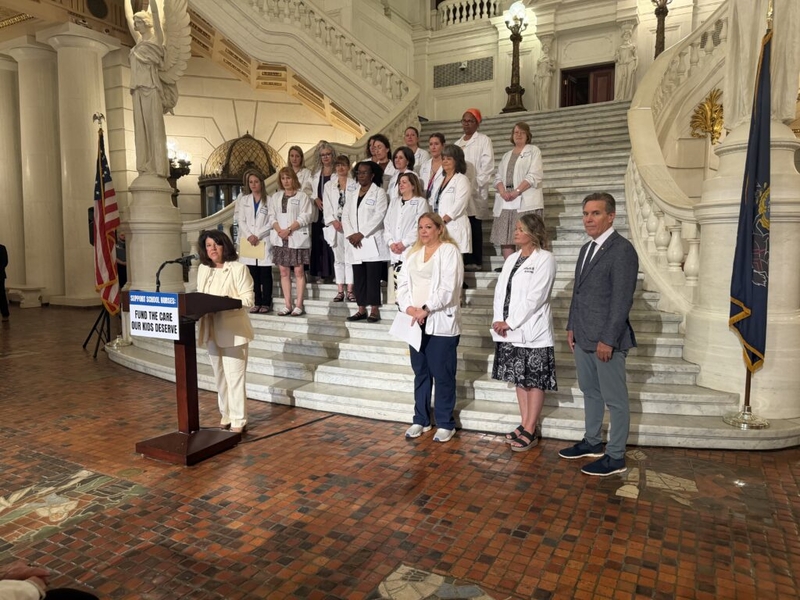
Rep. Lisa Borowski (D-Delaware) pushes to increase school nurse staffing on June 16, 2026. (Photo by Whitney Downard/Pennsylvania Capital-Star)
Natalie Javitt is a Pennsylvania Legislative Correspondents’ Association intern.
Middle school nurse Kacie Blum said she had nearly 12,000 visits to her office this past academic year, seeing 60 to 75 students a day.
Blum’s local urgent care sees around 35 patients a day with multiple providers on staff, she said.
Listen to Natalie and Emily’s audio recap:
Providing care for students with diabetes, cystic fibrosis and cerebral palsy, along with working on individualized health plans and clinics, are a few things Blum is tasked with each day. But she said it’s only possible for her to deliver consistent and reliable care if she has the time and capacity to do it.
“There’s little room for a bathroom break, a lunch break or the planning periods I’m supposed to have for the administrative side of my day,” said Blum, who received the 2025-2026 School Nurse Excellence Award for Pennsylvania’s South Central Region.
Blum, who works at York Suburban Middle School in York County, was one of 20 school nurses who traveled to the Capitol Tuesday to demand an update to Pennsylvania’s 75-year-old public school code governing nurse-to-student ratios and state funding for medical needs.
A House bill proposed by Rep. Lisa Borowski (D-Delaware) would increase reimbursement rates and the required number of nurses per student in schools.
Currently, the code prescribes one school nurse per 1,500 students. That ratio would be cut in half to one nurse for every 750 students under Borowski’s House Bill 2285, bringing it in line with CDC recommendations.
Pennsylvania reimburses public schools for health service costs with a flat funding structure. The bill also seeks to increase this reimbursement rate by 30% per the average number of students to offset rising medical and service costs.
And it proposes limiting reimbursement to the school’s cost for providing care.
Borowski proposed the bill after meeting Leigh Ann Coary, a school nurse in the Tredyffrin/Easttown School District, that raised her concerns about nurses being stretched too thin. On an average day, Coary said, she sometimes sees more than 100 students, making it challenging to meet their individual needs and multitask.
“If I’m dealing with a medically fragile student, I cannot also be in another hallway responding to an allergic reaction,” Coary said. “If I’m on the phone with a parent about a student in crisis, I cannot simultaneously be running to an emergency. When we are shortstaffed the question becomes, ‘Who is left waiting?’”
Coary said school nursing laws should be updated to better reflect the unpredictability and variety of health crises students experience today.
The bill modernizes reimbursement instead of relying on an outdated funding system, but policies won’t matter if staffing shortages aren’t addressed, she said.
Coary continued that nurses need to be recruited and retained by school districts so they don’t have to cover as many students.
The nursing shortage is a national issue felt in the state, with a survey finding a 19% vacancy rate for registered nurses in Pennsylvania hospitals.
Borowski said she expects the shortage to factor into lawmakers’ deliberations over the bill. But she said the staffing ratio ensures children have access to care even amid the shortage, and increasing funding would improve care by actually covering costs.
“I don’t know how one person can accommodate the needs of so many students in one day,” Borowski said.
Blum said increasing reimbursement rates is more cost effective than paying litigation costs should something go wrong if there aren’t enough nurses to help in an emergency.
She said Pennsylvania’s school code is archaic and written for a different era, as the last time the reimbursement structure for school health funding was updated was in 1991.
“The work I do inside the walls of my school trickles out into my students’ homes and the streets of their neighborhoods,” said Whitney Roach, a nurse from Philadelphia County. “School nurses are uniquely qualified and trusted to improve the health and well being, not just of schools, but of entire communities.”
The House Education Committee passed the bill with a party line vote in March.
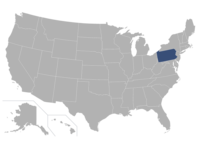
Harrisburg, PA