Committee finds inconsistency and lack of scrutiny for Pa.’s legal aid revenue source
Jun 11, 2026 | 5:52 pm ET
Description
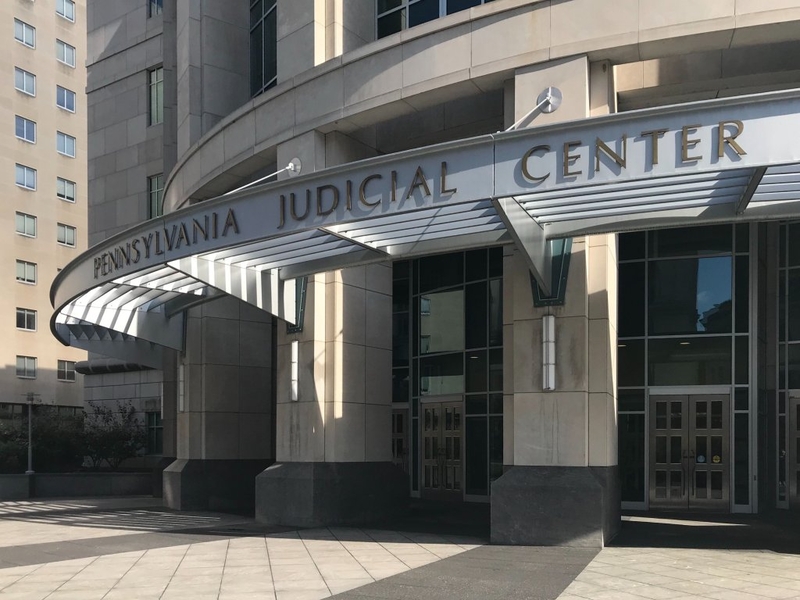
The Pennsylvania Judicial Center in Harrisburg. (Pennsylvania Capital-Star file photo)
Two dozen years ago, the commonwealth established the Access to Justice account, setting a surcharge on certain court filings to pay for civil legal aid for low-income Pennsylvanians. As of 2026, that amount is $6, and traffic offenses have a $4 fee.
These collected dollars work their way through intermediary agencies to the Pennsylvania Legal Aid Network, creating a “stable, predictable funding stream” that supplies more than $14 million currently.
But a recent examination — spurred by House Bill 331, which Gov. Josh Shapiro signed into law in February — revealed an incomplete picture for revenues collected by county row offices.
The report, presented to the Legislative Budget and Finance Committee on Wednesday, analyzed the current scope of fees, instances when the surcharge wasn’t assessed and alternative funding sources.
Staff for the legislative committee found that county row offices — such as the clerk of courts, register of wills, and others — are the single biggest source of money for Access to Justice funding, but relied heavily on an “antiquated” mailing process to remit payments.
While individual transactions are scrutinized, no one entity is assigned to take a broader view, comparing month-to-month or year-to-year remittances to identify variances.
“In the same way that you and I look at our checking account every month and make sure that everything went in and out as we expected,” said Stevi Sprenkle, the legislative committee’s deputy executive director. “There’s just pretty basic analysis that could be done to increase accountability and oversight over the program.”
More report details
County row offices made up 58-69% of Access to Justice revenue across the four fiscal years reviewed between 2021 and 2025. Total funding during that time fell from $17.6 million to $14.3 million, even as other legal aid funding sources grew.
Primarily, funds shrunk because the number of cases fell — decreasing from over 18,000 cases in the 2022-2023 fiscal year to less than 10,000 cases two years later. Historically, mortgage filings documented by the Recorders of Deeds are one of the biggest sources of funds, but those have declined as interest rates climb and court rulings allowed filers to bypass the county row office and file with a private company instead.
“We estimate that this totaled over $15 million in lost revenue for Access to Justice during our review period,” said Sprenkle.
Adding a $2 fee to guilty pleas and convictions associated with traffic citations, on the other hand, could have generated an estimated $7.5 million in revenue.
But the process for sending collections is “outdated,” according to the report. Payments are usually mailed — sometimes with a hand-written check. These funds are supposed to be sent to the Department of Revenue (DOR) monthly.
But Sprenkle shared that DOR didn’t have a county-by-county record, and had to build a custom report for analysts to review. That data showed a nearly 32% decrease in filings between 2021 and 2025.
In addition to underpayments and overpayments, there were times when county officials didn’t sign accompanying certifications or reported fractional payments like “$12,272.77068.” Some counties that were subject to extra scrutiny didn’t record the temporary reduction of a computer fee that was in effect in 2022 and 2023.
“There’s a lot of confusion, and maybe not enough guidance on how (counties) are supposed to be submitting this information,” Sprenkle said. “Even we found the form was somewhat confusing in terms of how it lumped multiple fees together.”
Next steps
The use of handwritten information seemed “particularly antiquated,” Sprenkle shared, since Pennsylvania uses an online portal for tax collections known as the Pennsylvania Tax Hub to submit inheritance taxes and realty transfer taxes.
The report recommended that DOR begin to collect all Access to Justice remittances through that online portal, a change, Sprenkle said, that “could happen today” without legislative action. The number of filings for monthly remittances should then be submitted by the county row office to the Administrative Office of Pennsylvania’s Courts.
Another recommendation tasks the administrative office with performing a regular analysis of the fund “to more promptly identify shortfalls in fee collections and corresponding revenue,” sending cases that need more investigation to the Department of the Auditor General.
Sprenkle emphasized that “we do not expect them to do full-blown audits,” saying reviews should instead be “looking for any variances (or) if anything sticks out to them.”
A few recommendations are directed at the General Assembly, asking them to weigh the cost of a statewide civil case management system — which has been long considered but hasn’t yet come to fruition — against the risks of a decentralized system.
Lastly, “the General Assembly may wish to review current practices” when it comes to mortgage assignments, and whether court-related fees should be realigned to reflect current practices.
Though overall legal aid funding has increased, lawmakers still emphasized the need to keep revenues stable.
“As we look at remedies, the $7.5 million that you mentioned from traffic (citations), that sounds like a good remedy, but it looks like we may need a much bigger remedy to make up for the old fee structure and challenges with actual collection,” said Sen. Art Haywood (D-Montgomery).
Harrisburg, PA