Des Moines sues fire truck companies, alleging ‘parasitic’ pricing, anti-trust violations
Jun 10, 2026 | 4:51 pm ET
Description
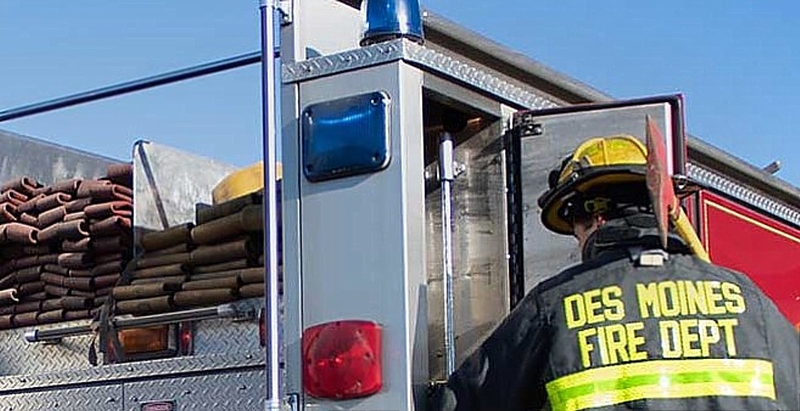
(Photo courtesy of the Des Moines Fire Department)
The City of Des Moines is suing more than two dozen companies that sell life-saving apparatus such as fire trucks, alleging they have engaged in illegal and “parasitic” pricing schemes to “reap extraordinary profits” from taxpayers.
The lawsuit, filed in U.S. District Court for the Southern District of Iowa, names as defendants REV Group, 14 of its alleged affiliates and 11 other companies that produce firefighting trucks, parts and equipment.
The lawsuit challenges what it calls the defendants’ multi-year, anti-competitive scheme to consolidate and “roll up” markets for critical lifesaving apparatus — fire trucks and the chassis on which they are built — and to impose exclusionary restraints in the market for replacement parts.
The lawsuit claims the defendants have methodically acquired small and large fire-apparatus competitors, as well as key companies in the fire-apparatus supply chain, and have restricted fire departments’ ability to replace parts, all with the intent of lessening competition and moving toward the monopolization of those markets.
Through their “illegal schemes,” the lawsuit alleges, the defendants have “reaped extraordinary profits on the backs of fire departments, taxpayers, cities, and counties.” The City of Des Moines specifically claims it has “suffered substantial overcharges and lost equipment value” as the defendants shut down plants, substantially increased their prices and severely extended delivery timelines.
The public has suffered harm alongside the city, as the higher prices and costs defendants have forced on fire departments have drained localities’ health and safety budgets ... The taxpayers those firefighters swear an oath to protect do not deserve this.
As an example, the city alleges that in July 2024, it agreed to purchase firefighting equipment from one of the defendants for $1.5 million — a price the city claims includes “hundreds of thousands of dollars in anticompetitive overcharges.” The order specifies a delivery date between 42 to 45 months, or nearly four years, the city claims, although the equipment’s useful life is no more than 10 to 20 years.
“The public has suffered harm alongside the city, as the higher prices and costs defendants have forced on fire departments have drained localities’ health and safety budgets,” the city claims.
According to the lawsuit, private equity has played a pivotal role in the alleged reduction of competition. About 10 years ago, the lawsuit alleges, the private equity firm American Industrial Partners in Manhattan observed that fire truck markets in the United States were relatively deconcentrated — filled by small manufacturers, some owned and operated by the same family for generations, that competed against each other.
The lawsuit claims American Industrial Partners saw an opportunity to profit by eliminating competition through the consolidation of the smaller manufacturers into an industry giant with the power to extract high prices. The company then “sought to exploit the fact that fire trucks are critical lifesaving apparatuses” that every locality needs to provide firefighting services to citizens. AIP imposed ever increasing supra-competitive prices on cities and counties, thereby “raking in extraordinary payouts for AIP and its executives,” the lawsuit asserts.
Lawsuit: Companies ‘celebrate’ backlogged orders
In 2015, AIP allegedly rebranded part of its operation as REV Group and accelerated its consolidation strategy. With nearly a dozen once-independent companies rolled up under a single corporation, the REV Group then began to leverage its dominance to extract profits from fire departments and the taxpayers who fund them while also shutting down plants and laying off hundreds of skilled workers, the lawsuit claims.
As a result, the lawsuit alleges, backlogged orders for undelivered fire apparatus “skyrocketed to a record $4.2 billion” by fiscal year 2024, and REV Group increased its prices by 50% to 100% or more. The lawsuit claims that while backlogs have resulted in fire departments waiting months for parts that once were available within 24 hours, the defendants have “celebrated” their inability to keep up with orders. In 2018, the lawsuit asserts, REV Group’s then-CEO Tim Sullivan told investors, “We like backlog, we love backlog.”
The lawsuit likens the defendants’ conduct to a “protection racket,” claiming some of the companies will allow cities to jump ahead of other customers waiting for product simply by agreeing to pay significantly higher prices.
“The markets for fire apparatuses, chassis, and … replacement parts are no longer competitive,” the lawsuit asserts. “They are markets dominated by powerful behemoths. These manufacturers bought their way to dominance, and they are now in full extraction mode, deliberately suppressing output, withholding supply, delaying deliveries, restricting competitive options, and charging supra-competitive prices without consequence … When the availability of a well-maintained fire truck can be the difference between life and death, the local fire department will continue to buy fire trucks — even after a private equity firm jacks up the price.”
The lawsuit alleges the “massive price increases,” despite the defendants’ “best efforts at subterfuge,” cannot be explained by inflation or by COVID 19-related supply chain issues.
“Our nation’s federal and state antitrust laws have long outlawed the kinds of acquisitive schemes defendants have parasitically plotted and carried out on the backs of localities and taxpayers across America,” the lawsuit states. “Our fire departments do not deserve this. Our firefighters do not deserve this. The taxpayers those firefighters swear an oath to protect do not deserve this. The extraction of excessive private rents from the public must stop, and it must stop now.”
The lawsuit seeks not only unspecified financial damages to recover money lost to the allegedly illegal anti-competitive actions of the defendants, but also an injunction that would prohibit any such conduct in the future.
“Absent court intervention, cities and counties including the City of Des Moines will continue to pay extractive prices — draining localities’ health and safety budgets — and suffer reduced choice, worsened terms, delivery delays, and other harms, which they must endure as they meet their obligations to protect the public safety far into the future,” the lawsuit alleges.
In addition to REV Group, the lawsuit names as defendants alleged affiliates that include E-ONE Inc., Kovatch Mobile Equipment, KME Global, KME Holdings, KME RE Holdings, Ferrara Fire Apparatus Inc., FFA Holdco Inc., FFA Acquisition Co., Ferrara Fire Apparatus Holding Co., Spartan Fire, Smeal SFA, Smeal LTC, Smeal Holding, and Detroit Truck Manufacturing.
Also named as defendants are AIP, American Industrial Partners Capital Fund IV, American Industrial Partners Capital Fund IV, AIP/CHC Holdings, AIP CF IV, and AIP/CHC Investors, Oshkosh Corp., Pierce Manufacturing, Maxi-Métal Inc., Boise Mobile Equipment and BME Fire Trucks.
The defendants have yet to file a response to the lawsuit and did not respond to a request for comment.

Des Moines, IA