Street medicine team treats Southern Nevada’s unhoused where they are
Jun 10, 2026 | 7:55 am ET
Description
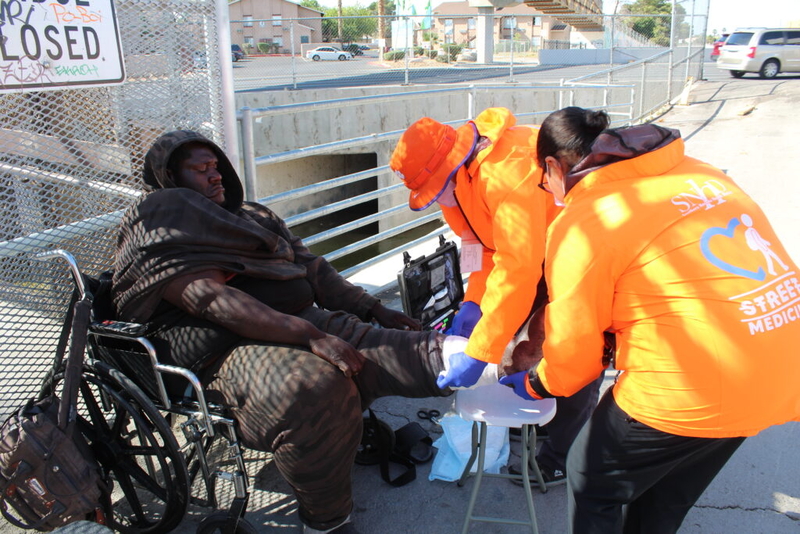
Long Tran and Yareli Romualdo Daniel, members of the Southern Nevada Health District's street medicine team, provide medical care to Brian Manning. (Photos: Michael Lyle)
The Flamingo Arroyo Trail becomes an impromptu medical clinic where Brian Manning, who is experiencing homelessness and staying near the area, finally gets checked out about his recurring leg pain.
Manning, who has experienced homelessness on and off for nearly two decades, has cellulitis, a fairly common bacteria infection on the skin. Though treatable, it can be a challenge to keep clean and stave off infection while living on the streets.
The Southern Nevada Health District’s newly formed street medicine team, which offers primary medical care for those experiencing homelessness, has been treating Manning for the last several months.
Manning is one of the 130 unduplicated clients the street medicine team has been able to offer primary care since it began in November. The team not only offers routine medical care but provides follow-up appointments throughout encampments, parking lots, parks or wherever unhoused clients are residing, while also refilling and delivering prescriptions for those living on the streets.
When they locate Manning for his scheduled follow-up appointment, he is wheeling himself down the street on Desert Inn Road. Manning can walk, but he often relies on a wheelchair when walking on his left leg gets too painful.
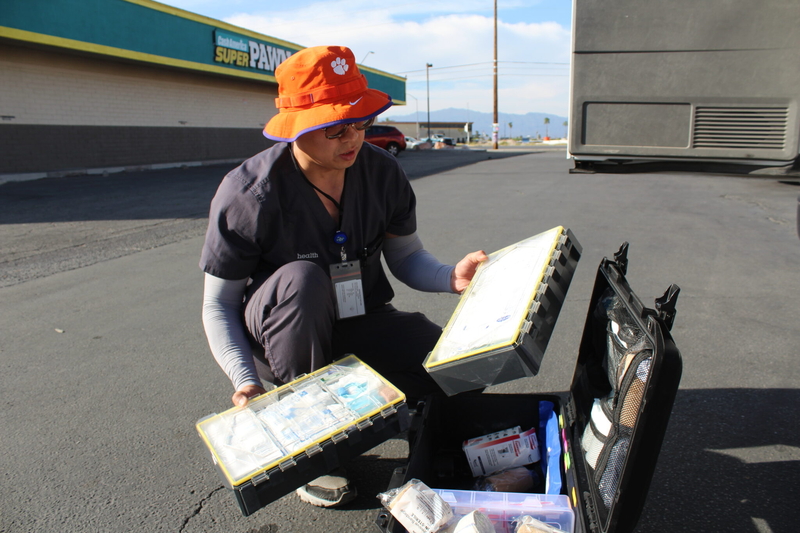
The four-person team – an advanced practice registered nurse, a registered nurse, and two community health workers – pulls to the side of the road, unloads bags of medical supplies, and sets up a few yards on the trail slightly away from the hustle and bustle of the street.
Long Tran, the advanced practice registered nurse with the team, begins to examine Manning’s legs, cutting away old bandages to see the status of his leg.
“Have you been applying the antibiotic ointment,” Tran asks Manning as he carefully peels back layers of dressing.
“It’s been irritating and I don’t know if I should go to the hospital or not,” Manning responds.
Manning confesses he worried it could be infected again. The leg is swollen at the moment and he has been having headaches.
To his relief, the leg isn’t infected. The team gives him antibiotic ointment, though they may have to soon switch to oral antibiotics if there isn’t improvement next visit.
“It looks like it’s healing,” Tran tells him.
Manning’s sky-high blood pressure on the other hand – a common issue among the unhoused – has the team concerned. They tell him that is probably the cause for his headaches.
“Do you want to do blood work today or set it up for the next visit,” Trans asks, telling Manning the blood test can check his liver and kidneys to ensure there aren’t other issues.
“Let’s do it next week,” Manning replies.
The team leaves Manning with a bag of gauze and antiseptic cleaners, items he can use to keep the wounds clean until their next meet up. Manning acknowledges he could never purchase this amount of wound care supplies independently.
“If he doesn’t get better or improve I would recommend going to the ER,” Tran said, in an interview after treating Manning. “They don’t like going to the hospital so we try to treat it out here first through oral medication and extra wound care supplies. If we keep seeing it and it doesn’t improve we will try to convince them to go to the hospital. Our goal is to prevent that. We treat them out here so they are still independent.”
They pack up their car, and move on to try to find their next client for the morning, who is staying in a nearby encampment.
The need for primary care
The 2024 annual “point-in-time” count, the most recent snapshot of a single night when unhoused people are counted, identified more than 7,900 unhoused people in Southern Nevada, a 13-year-high.
Homeless service providers have continued to call for the need for more housing, including permanent supportive housing to provide wrap-around services for those exiting homelessness.
During conversations with outreach workers and community partners last year, it became apparent to health district officials that there was a “need for more medical services on the street for our unsheltered population,” said Shannon Pickering, the community health nurse manager with the health district.
“Our services are especially needed for those clients who don’t access current shelters and services with the hope of being able to provide what they need,” that day, Pickering said.
The street medicine team officially launched November 2025, and provides direct primary care and health services, including wound care and management of chronic medical conditions, to unhoused people on the streets.
“As the teams go through and work with the unsheltered and encampments and on the street, if there is a medical need and the client would like primary care services, then our team will work with them,” Pickering said.
The team has also collaborated with nonprofits like HELP of Southern Nevada and the Salvation Army to connect with clients.
Since launching in November, they have been able to treat a variety of health ailments for chronic hypertension, complex wounds and respiratory illness.
“A lot of clients suffer with asthma here in the valley, and so our team has done a lot of follow up related to respiratory and asthma treatment for clients that were out of care and no longer had access to their inhalers,” Pickering said.
People can receive a variety of health services like blood work, treatment for wounds, and prescriptions while getting vitals checked.
“Or if they were prescribed medication for hypertension,” Pickering offered as an example, “and now we’re just following up to make sure that they’re doing okay on that medication so that their blood pressure is under better control.”
The majority of clients they’ve treated since the team began, around 78%, rely on Medicaid.
If they’re not covered by Medicaid or insurance, or don’t qualify, the team still provides primary care services, Pickering said.
Many of the people they speak with have known what ails them, but being on the street has made it hard for them to maintain their health.
Patients have told the street team they don’t feel comfortable going to doctors offices. Sometimes it’s difficult to even get to medical facilities.
“How many people who are living in an encampment are willing to go to a doctor’s appointment, try to navigate that and then come back and find their dogs gone, all their IDs are gone, their camp is gone or it’s been robbed,” Lou Lacey, director of the homeless response team with HELP of Southern Nevada, said in April when at a health district forum. “A lot of folks refuse medical services.”
Many preventable issues can take a toll on unhoused people leading them to finally seek medical attention at the emergency room.
Manning was one of those who had to be rushed to the hospital when a previous infection in his leg got so bad, it brought him to tears. Someone called an ambulance, which took him to Sunrise Hospital.
He was there for two weeks before being discharged and returning to the streets.
Southern Nevada’s pharmacy desert also makes it difficult for people to maintain prescriptions to keep healthy.
Manning said walking the mile to a nearby pharmacy has its challenges, especially on the days his leg hurts and he relies on his wheelchair.
Nevada Current requested data from the Nevada Health Authority on how often unhoused people access emergency rooms in the hospitals throughout the state.
Hospital emergency department and inpatient billing data showed roughly 14,241 people identified as homeless sought medical treatment at an emergency room in 2024, a 27% increase over the previous year’s 10,951.
Available data for 2025 only covered the first nine months of the year but shows during that time 11,633 people experiencing homelessness turned to ERs.
Data includes patients identified as unhoused, residing at a homeless shelter, or who have no known address. The largest portion was those residing at homeless shelters.
The authority noted that unhoused people accessing emergency rooms make up roughly 1% of total visits.
The largest portion, roughly 18%, of ER visits in the last three years were for behavioral and mental health. Other top reasons include: 14% injury or poisoning; 8% “Musculoskeletal System” diseases; 6% respiratory issues; and 5% skin related issues/ diseases.
“While many factors influence emergency department utilization among people experiencing homelessness, providing access to primary care in community settings may help reduce reliance on emergency departments for conditions that can be managed through routine or earlier intervention,” said Lourdes Yapjoco, the Director of Primary and Preventive Care with the the health district.
The ER data, she added, may help guide efforts related to chronic disease management, point-of-care testing, wound care, medication access, care navigation and follow-up support after hospital discharge.
Yapjoco said it was notable that the largest portion of visits were for mental and behavioral health.
“This underscores the importance of ensuring individuals have access to appropriate behavioral health services and highlights the value of strong coordination between healthcare providers, outreach teams and community-based behavioral health partners,” she said.
There are brick-and-mortar clinics near the homeless corridor in the City of Las Vegas that help unhoused folks, but not everyone is willing, or able, or get to those places.
“We found that we can identify medical issues and clients having a high need, but then their success rate of being able to access a traditional brick and mortar clinic is a big barrier at times … those are the clients that we are wanting to serve,” Pickering said.
‘They weren’t judgmental’
When the team sets out to meet Tiffany Ridgeway, an unhoused woman who they’ve been seeing for a few months, they go to her last known location.
The transient nature of homelessness makes it tricky to meet clients for scheduled medical appointments. It can take the team several tries to reconnect with patients.
They find Ridgeway lying down and wrapped in a blanket near the spot she has normally resided. She is one of the 54 clients the team was able to provide first-time appointments or follow-up care in April.
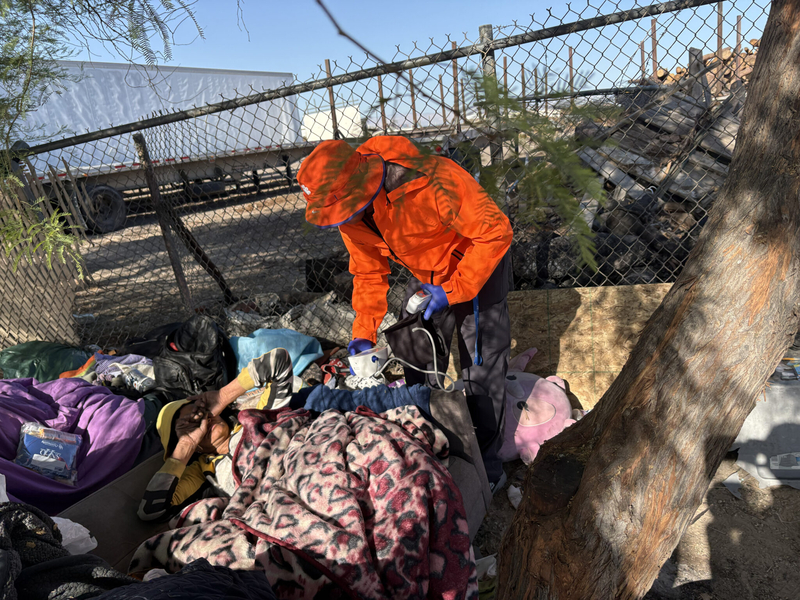
Ridgeway is the first client the team is treating for Hepatitis C. The treatment is very costly and meticulous. Because it’s expensive, the team has to pick up the prescription and drop it off for Ridgeway.
“The medication needs to be delivered to an address,” Tran said. “If they’re living on the street, you know that that is a barrier for people being able to get the treatment.”
But the team is able to provide her with the most current dose of medication. They checked her blood pressure and asked her questions about changes to her health status.
“It’s been really rough,” Ridgeway said, about staying on the streets, adding that without the team offering treatment, “I would probably die a slow, painful death.”
“They came out, they weren’t judgmental and treated me like I was a human being,” she said. “There are a lot of people who don’t get health care and never know what is wrong with them.”
Ridgeway is lying down because she had a broken leg, which she said occurred during an encampment abatement.
“I almost got bulldozed,” she said.
Like many others living on the streets, she also is being treated for high blood pressure.
While she has been consistent with hepatitis medication, she hasn’t been as diligent with her high blood pressure medication. She has previously lost medication, as well as other valuables, during previous encampment clearings.
“I’m going to do everything I can to make sure the medicine doesn’t get taken,” she said.
Ridgeway, who has worked as a mechanic, says she has been living off-and-on the streets for more than two years. Earlier this year, a business in the area provided her with a trailer to offer her a place to sleep.
The trailer, which wasn’t operational, was towed away, leaving her to return to sleeping on the streets, she said.
“They made it illegal to be homeless,” Ridgeway said.
It’s not just her chronic ailments that have taken a toll. Ridgeway was hospitalized twice in the last year because of dehydration.
She was diagnosed with a bladder infection that spread to her kidneys. Just a few days later she was released from the hospital, but then fainted and returned to the hospital.
Finding a client isn’t always simple.
Before successfully doing a fellow-up appointment with Manning in late April, the team had tried twice to conduct a visit.
During some unseasonable triple-digit heat in March, the street medicine team pulled into a 7/11 close to where Manning usually resides during the day.
He wasn’t there. Across the street next to an apartment complex is a wash, where other unhoused individuals usually camp. The team parks its van and walks around trying to see if they can locate Manning.
After an unsuccessful search, they decide to move on to their next client who is a few miles away. As the team drives down Desert Inn Road, they spot Manning sitting under the shade at a McDonald’s.
The team rescheduled a time to go back the following week and left Manning with a bag of wound care supplies.
“Do you know how hard it is to come by all of this and how much money this is,” worth, a grateful Manning said when the team handed him a bag full of wound cleaning supplies.

The team was unsuccessful in meeting with Manning on a scheduled follow-up appointment a few weeks later.
It’s not until the third attempt to meet with Manning in April when the team is able to successfully do a follow-up exam on his leg after they locate him at the Flamingo Arroyo Trail. About an hour after the team wraps up their visit, they drive by the trail, where police have shown up to clear out the area.
The importance of being early
Extreme heat and overdose are the largest contributing causes of death among people experiencing homelessness. Health conditions also play a contributing factor.
Data from the Clark County coroner’s office shows about 600 unhoused people who died in 2024 and 2025, and that’s an undercount; the data only includes cases in which the coroner has been able to inform the family.
The Current did an analysis and found 76 deaths listed specific health-related issues as the primary immediate cause of death — without going through individual autopsy reports it’s hard to determine how other factors like heat, addiction/overdose, etc contributed.
Of the 326 deaths in 2024, there were 36 that specially named health-related issues as the immediate cause of death. In 2025, 40 deaths of 269 were due to health-related causes.
While drugs and heat could have contributed to those deaths, hypertension, cardiovascular disease, heart attack, and septic shock were among the most commonly listed primary causes. One of the instances of death was attributed to septic shock but listed the secondary cause as cellulitis – similar to what Manning is being treated for.
“The mortality data underscores that homelessness is associated with complex health needs that extend beyond any single diagnosis or condition,” Yapjoco said. “Many individuals experience multiple health challenges simultaneously, making early intervention, access to care and ongoing support especially important.”
The street team also distributes naloxone, which can reverse the effects of an opioid overdose, to unhoused people who ask for it during their check ups.
As Southern Nevada enters the summer, the team for the first time will be on the ground to offer on-the-spot care that could prevent heat deaths.
The team will have a chance to check on clients, examine them for heat-related illness, and connect them to additional resources that “may help reduce heat-related health risks,” Yapjoco said.
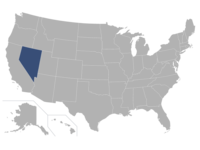
Las Vegas, NV