As end of session looms, NC Republican leaders push back expected budget date
Jun 09, 2026 | 7:26 pm ET
Description
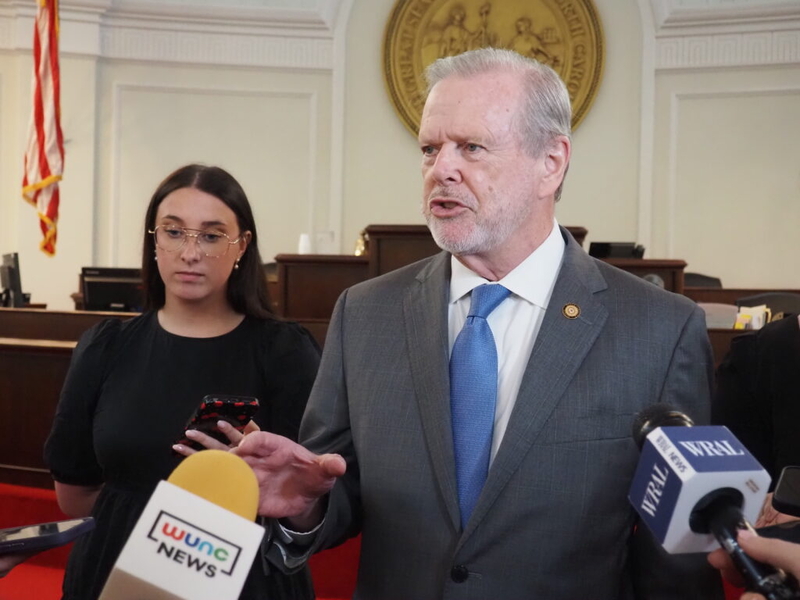
State Senate President Pro Tem Phil Berger (R-Rockingham) speaks to members of the media in the Senate chamber on May 6, 2026. (Photo: Brandon Kingdollar/NC Newsline)
Not long ago, Republican state lawmakers were eyeing the middle of June for the rollout of North Carolina’s long-delayed budget. Tuesday, they said that may not be possible.
Senate President Pro Tem Phil Berger (R-Rockingham), who initially projected a budget bill would be finalized the week of June 15, said he is now “not as optimistic about that as I was.” But he maintained that Republicans can deliver a budget by the end of June.
House Speaker Destin Hall (R-Caldwell) said he believes next week may still be a possibility, but “it’s tough to answer that question.” He added that he hopes to have a lengthy budget discussion with Berger on Wednesday.
“The chairs are very close to finishing up their work, and so usually what we would do is wait until they get done and resolve what they can,” he said. “From what I hear, they’ve made a lot of progress, and so I anticipate Sen. Berger and I will probably meet sometime tomorrow. And if we don’t, we’ll probably talk this weekend or later in the week by phone.”
North Carolina has not passed a comprehensive budget since October 2023. The state was the only one in the nation to end 2025 without one, in large part due to disagreements between House and Senate Republicans over the state’s tax policy.
Will NC lawmakers make their deadline for a budget deal? Stein is unconvinced, but hopeful.
House and Senate leadership announced an end to their stalemate over key tenets of the budget agreement in a May 12 joint press conference, debuting the “framework” of a plan that would raise teacher, law enforcement and state employee salaries, and stretch out planned tax cuts to give the state budget more breathing room, while also putting constitutional amendments on the ballot to codify lower income tax rates.
But nearly a month later, lawmakers have yet to release any bill text, nor have they answered lingering questions about whether it will include additional aid for western North Carolina recovery efforts or expanded Medicaid funding, both of which were priorities Democratic Gov. Josh Stein set out in his budget request.
One factor in the delay: House lawmakers waited five weeks to vote on a property tax reappraisal moratorium passed by the Senate and sponsored by Berger, even though property tax relief is a key component of the budget deal between the House and Senate.
Local officials have raised concerns about making room in their budgets to cover basic services if they cannot raise property taxes to meet local needs. Those concerns are becoming more pressing as June 30, the deadline for most local budgets, approaches.
The House passed the bill on second reading Tuesday afternoon, but the bill won’t get official approval until Wednesday.
“As I said when we introduced the bill, as I said when we passed it over, the time is problematic,” Berger said. “You’ve already got local governments that are in the process of adopting their budgets. It creates some potential problems for them, or at least certainly some logistical issues.”
Hall said the time was needed to address members’ questions and concerns on the bill.
“You have various members who, their district may be impacted with it, so some of them were talking to their county commissioners or their city councils, and we wanted to give them time to have that feedback,” Hall said.
Time is also ticking down on the rest of the General Assembly’s work. Lawmakers have little time to move forward with bills they hope to pass this year, Berger and Hall said. And with the general election looming in November, there’s little appetite among most rank-and-file lawmakers to spend more time in Raleigh.
“We told our members that if they have something they want to get through committee on the Senate side, they need to get it done by the end of next week,” Berger said. “That is all a part of hopefully getting things wrapped up within a reasonable amount of time.”
Hall did not disclose a deadline for his members, but said he believes “we’re drawing near the end on the committee process,” meaning they need to “try to get their bills through” as soon as possible. “I anticipate once we get a budget passed and finished, that’ll largely be the business, at least for this short session.”
NC Newsline reporter Christine Zhu contributed to this story.
Raleigh, NC