State will pay extra for county jail space amid crackdown on alleged parole violations
Jun 09, 2026 | 4:02 pm ET
Description
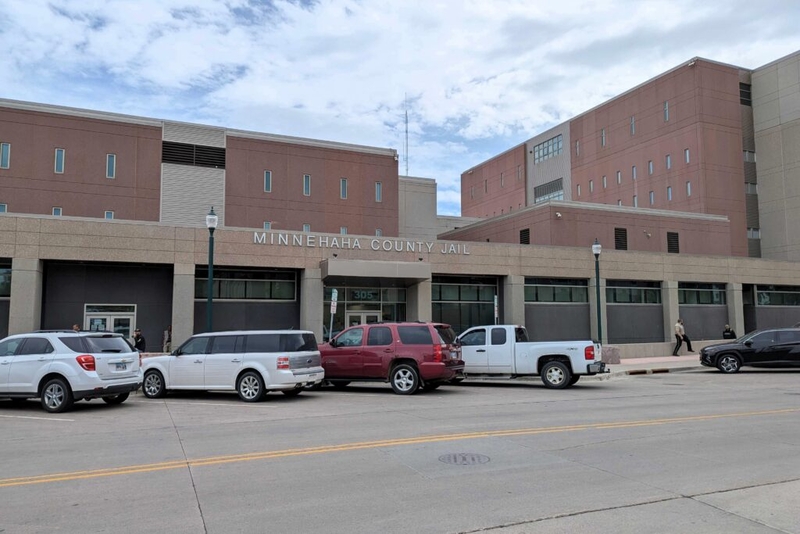
The Minnehaha County Jail in Sioux Falls on May 15, 2025. The state of South Dakota has a new, higher-rate contract with the county to house people accused of parole violations. (Photo by John Hult/South Dakota Searchlight)
SIOUX FALLS — The South Dakota Department of Corrections will pay the state’s most populous county a premium to house people accused of violating parole, under the terms of a short-term contract approved Tuesday.
The price bump for room and board at the Minnehaha County Jail is one ripple effect from a state-level crackdown on parolee behavior. It’s pushed more parolees into local jails and spurred the sheriff to open and staff the facility’s dormant fourth floor to make room.
In late April, Gov. Larry Rhoden signaled the state’s intention to jail parolees more quickly for things like failed drug tests and new drunken driving charges, and to hire five more parole agents. Rhoden’s announcement came days after a parolee allegedly shot and injured a Sioux Falls police officer. A year earlier, another man on parole is alleged to have fired on and injured an officer in the city.
Parole successes touted even as criticism prompts changes from governor
The state pays counties to hold parolees while parole officers consider sending them back to prison for violations, which could include behavioral or employment issues, failure to maintain contact with their parole officer or a conviction on a new criminal charge.
The state parole board must sign off after a parole officer decides that a parolee needs to go back to prison, and there can be a waiting period before the person is then transferred to prison custody.
The state’s prison population and the number of parolees held at both the Minnehaha and Pennington county jails have swollen since Rhoden’s announcement.
The number of parolees held in county jails for parole violations alone, with no new charges, grew by dozens in both Pennington and Minnehaha counties within days of the policy shift. The state’s prison population, meanwhile, grew by nearly 200 in May, corrections spokesman Michael Winder said. The number of people on parole dropped by 181 in that same time frame, as parolees returned to active inmate status.
There are currently 65 parolees across the state being held at county jails on parole holds, Winder said Tuesday.
Commission approves contract
The state’s room-and-board rate for local jails is $95 per day, per inmate, less than the price paid by neighboring counties or federal agencies. That figure is set by law.
Under the terms of the new contract, the state will pay Minnehaha County $125 per day, per inmate for the first 20 parolees held on suspected violations, $95 for parolees 20 to 60, and $200 for every inmate past 60.
The high figure affixed to the third tier is a deterrent, Sheriff’s Office Chief Deputy Jeff Gromer told county commissioners.
“Quite honestly, our jail’s already pretty full, and we don’t want to hold more than 60 of them,” said Gromer.
The commission approved the contract on a unanimous vote. It will stay in effect through July 24. At that point, Gromer said, the state expects to have opened its new women’s prison in Rapid City, and “they’re confident they won’t need as many beds out in the community.”
Winder, the corrections spokesman, said earlier this week that the opening date has not been set, but is expected to come this summer.
Back at the commission meeting, Gromer said he expects the issue of per-day payments to county jails to become a topic of conversation for the next state legislative session.
Factoring in food and staffing, it costs more than $95 per day to house an inmate, Gromer said.
Minnehaha County Commissioner Gerald Beninga said he hopes the “unfunded mandate” issue can be resolved. It’s been a problem for all 16 years he’s served as a commissioner, he said.
Commissioner Joe Kippley, however, said he’d take “the glass half full perspective” on the contract.
“The state obviously was able to come to a short-term solution here with us,” Kippley said. “That’s kind of a baby step.”
Price of accountability
Pennington County Sheriff Brian Mueller and his counterpart in Minnehaha County, Mike Milstead, have spent the better part of two years pushing the state to take a harder line on parolees. Most of the people on parole in both jails are there awaiting trial on new criminal charges, rather than for suspected parole violations.
Former prison inmates on state supervision have been getting “too many bites at the apple,” Mueller said, and have been “committing new crimes in our communities.”
But Rhoden’s announcement and the Department of Corrections policy shift “immediately backed up our county jails across the state,” Mueller said.
South Dakota governor pledges parole reform days after Sioux Falls officer is shot
Rhoden’s announcement also promised speedier processing of parole violations — something that members of the state Board of Pardons and Paroles said last month could increase their workload — but speedier processing alone doesn’t always ease Mueller’s immediate burden.
While parole violations are processed, the person on parole remains in county jail. The state also needs to have space in its facilities, which also lengthens the waiting period in jails like Mueller’s.
Winder said he did not have an “updated number” on state prison facility waiting lists, saying “the number of pending parole intakes fluctuates daily.”
Mueller brought up his space concerns with state officials last month. The state responded by moving to place more “parole hold” inmates in Sioux Falls through the now-approved Minnehaha County contract, and to lean more heavily on Hughes County, where the state has a contract for the use of up to 72 jail beds.
Mueller said he looks forward to a legislative conversation on cost sharing, but also hopes the conversation broadens beyond per-day compensation. Ideally, Mueller said, the state would use its own facilities to house allegedly noncompliant parolees awaiting their fate.
“We’re going to create more public safety accountability,” which Mueller called “a good thing,” but “jail bed space and prison bed space has to continue to be part of that conversation.”

Pierre, SD