Utah school trust lands officials eye selling 50,000 acres in Book Cliffs for nearly $30 million
Jun 09, 2026 | 2:53 pm ET

Description
A moves in near Green River, Utah, with Book Cliffs mesa in the background. (Redtea/Getty Images)
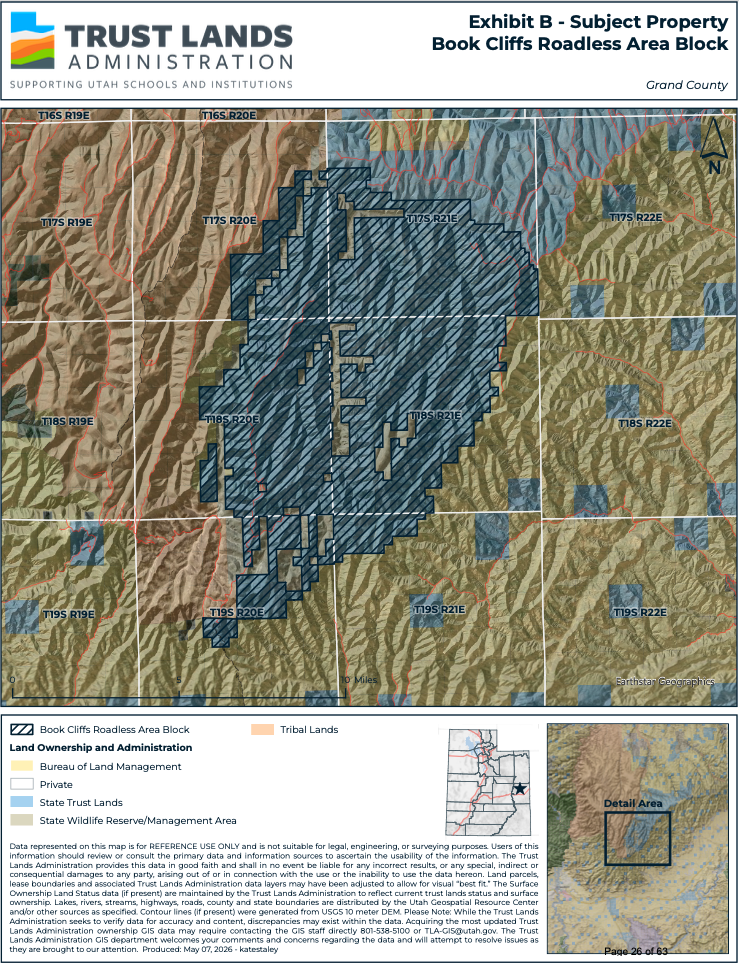
Utah Trust Lands Administration officials are poised to sell about 50,000 acres of the Book Cliffs area in Grand County — a major swath of a popular hunting and fishing area — to another state agency, the Utah Division of Wildlife Resources, for a nearly $30 million price tag.
State leaders have long eyed the proposed sale in order to preserve public access to Book Cliffs land that is currently part of the Utah Trust Lands Administration’s investment portfolio, which is required to manage, develop or sell land in order to maximize benefits for the administration’s beneficiaries, largely public schools.
Utah lawmakers in 2024 passed a law and appropriated money in 2025 to help pave the way for state wildlife officials to negotiate directly with the Trust Lands Administration for the purchase of lands that have a “unique” public interest for hunting, fishing or other recreational uses.
However, as the sale appears to be near approval — supported by the administration’s director and the trust land system’s independent advocacy office as a “unique” deal to benefit both beneficiaries and other public interests — some public school advocates are expressing concern about the sale and where the money that would fund the transaction came from.
The Trust Lands Administration board is expected to vote on whether to approve the sale during its next meeting scheduled on June 18.
Public education advocates express concern
To buy the Book Cliffs land, the Division of Wildlife Resources would use part of $50 million the Utah Legislature set aside last year. That money came out of a fund called the Public Education Economic Stabilization Account, which acts as a “rainy day” fund for public education in times of economic downturn.
Under Utah law, the Legislature is required to put 15% of ongoing income tax revenue growth each year into the fund — unless the annual deposit would push the account over its cap for the year. In 2025 and 2026 the fund had about $440 million in it (while its cap was about $521 million), so lawmakers opted not to put more money in the fund those years.
Last month, Advocates for School Trust Lands, a national nonprofit with a mission of “ensuring states fulfill their fiduciary duties as trustees” of school trust lands, sent a letter to the Utah Trust Lands Administration’s board questioning the legality of the proposed sale of Book Cliffs land.
One of the questions raised by the nonprofit included whether the Legislature could “constitutionally” give that $50 million to the Division of Wildlife Resources for the purchase, “given the Utah constitutional requirements on income tax revenue and current statutory restrictions on the use of that restricted account.”
Under the Utah Constitution, income tax revenue is reserved largely for spending on public education, except in some cases including services for children or people with disabilities.
“Before the Board of Trustees proceeds, we ask that you get the legal advice you need from the Attorney General, as to legally researched responses to the above questions,” the Advocates for School Trust Lands letter said. “Just because someone claims an action is in the best interest of the beneficiary, does not make it so. Please let’s find a solution that allows you as trustees to not violate the constitution and maintain your integrity.”
Margaret Bird, founder and board president of Advocates for School Trust Lands — who also spent decades advocating for school trust lands and led the effort to create Utah’s School and Institutional Trust Lands Administration in the ’90s — also spoke at the Trust Lands Administration’s board meeting May 21.
Bird said she was “gravely concerned” about the proposed sale.
“You have a very difficult issue in front of you right now, and it reeks of special favors for special entities,” she said. “You are selling basically 15% of your assets in one deal, and it is not a public auction where you know you’ve got the full market value that the law requires. … This deal, it is basically the state selling land to the state, and that is not acceptable, under any form of fiduciary duty.”
Bird added there’s a “double problem here, and that is you’re buying school lands with school money to give to hunters,” she said. “I do not fault the hunters. … I think the hunters would say, ‘Do not buy land for me out of my children’s fund.’”
Julie Cluff, president of the Utah PTA, also spoke during the board meeting, “not in regards to the sale of the Book Cliffs property … but just the overall concern that we have for the processes that happened.”
Utah schools will get a record $134 million in 2026 trust lands money, a 20% bump
“Utah PTA is deeply concerned that the funds intended to stabilize and support education are now being used in a way that ultimately reduces long-term educational benefits to Utah’s students,” Cluff said. “Taking money from the Utah Education Stabilization Fund to purchase trust lands means education is losing support from both ends, first through the use of education-related reserve funds, and second through the loss of valuable trust land assets themselves.”
Cluff said that while legal procedures have been followed, “Utah PTA remains concerned of the long-term consequences that these decisions have for future generations of Utah’s children.”
“Trust lands were established to support the ongoing support of public education, and decisions regarding these lands should always prioritize the lasting benefits of students, both now and in the future,” she said.
Trust Lands officials support ‘unique’ sale, argue it’s in beneficiaries’ best interest
Trust Lands Administration Executive Director Michelle McConkie presented the details of the proposed sale to the board May 21, describing it as having “rare, real win-win potential.”
She pointed to a 1993 Utah Supreme Court case that she said “even recognized back then that there are some really unique pieces of land in the Trust Land’s portfolio, and that selling this land and getting it into other state-protected ownership — as long as the Trust Lands (system) is being compensated and the beneficiaries are not being injured — may sometimes be the most prudent and the best way forward.”
“This is a very rare opportunity to be able to sell five pieces of underperforming financial aid assets for a tremendous amount of money for the trust,” she said. “And that’s why we are so excited about it and bringing it to the board.”
McConkie also pointed to analysis she conducted, which showed the sale would generate “greater returns for the public school trusts,” she said, and that the status quo results in “losses of more than a million dollars for each year of delay.”
“Quite honestly, the easier thing to do, in some ways, is to do nothing. That is not in the best long-term interest of the beneficiaries,” she said. “They are losing money every day that we do not do something more with this land.”
A lost ‘golden goose’ or ‘reasonable’ deal? How a landfill tested Utah’s school trust lands system
Liz Mumford, director of the Land Trust Protection and Advocacy Office (which represents the trust land system’s beneficiaries), told the board that her team has been watching the Book Cliffs issue for years, and she said it’s been “evolving” as lawmakers paved the way forward with HB262.
Mumford noted it’s the first transaction of its kind under HB262 — which she said trust lands officials supported “because of its ability to create a pathway for the state to act as a buyer of certain trust lands, because there are instances where those trust lands would be in public benefit, and there was not previously an appropriate way to secure the fair market value for beneficiaries.”
Mumford said the advocacy office “now concurs with the recommendation” to sell the land to the Division of Wildlife Resources for about $30 million.
“We feel that this transaction is a mutually beneficial approach,” she said. “It takes a … low-revenue surface asset and creates a major cash infusion that will go into the Permanent Fund and impact distributions to public schools.”
The Permanent State School Fund is an endowment fund for public schools. Last year, it topped $3.8 billion.
Mumford also said the sale would ensure the Book Cliffs land “remain under state stewardship for the public,” while at the same time allowing the Trust Lands Administration to keep the mineral rights on the property. That will allow trust lands officials to take in proceeds from any future mineral development, which could “potentially generate hundreds of millions of dollars,” according to Trust Lands Administration documents detailing the proposed sale.
Mumford acknowledged “this is a complex issue,” but she said the advocacy committee and office “really looked at this from the beneficiary perspective and how it fits into the broader picture.”
On “fiduciary prudence,” Mumford said that because the land currently generates less than $125,000 a year for the Trust Lands Administration in permits and fees, “we feel like it has much more significant potential” to invest proceeds from the sale.
“The transformation into a cash asset that goes into the Permanent Fund for investment … is really powerful,” she said. “When you choose that sell-and-invest strategy, it creates a diversified market opportunity that far outperforms the potential appreciation on the land with its rugged topography.”
Mumford also said the advocacy office monitored the appraisal process, which used a “three-appraisal formula” to establish the sale price.
Under HB262, the Division of Wildlife Resources has to pay at least fair market value, which must be determined by at least one third-party appraisal. However, under administrative rules the Trust Lands Administration board required up to three appraisals to determine fair market value — and three appraisals were done to determine the Book Cliff’s price of nearly $30 million. That value was the average of the two closest appraisal amounts, according to Trust Lands Administration meeting materials.
“We’ve evaluated those independent third-party appraisals to ensure that they factored in the highest and best use,” Mumford said.
Mumford also said the advocacy office “carefully evaluated” McConkie’s analysis to ensure it was “comprehensive and accurate and it included that critical comparison of sale versus lease for consideration.”
She acknowledged that “anytime there is a project of this scale and impact” questions will surface, including whether the sale would “diminish the future portfolio for public schools.”
“Selling a large block is concerning, but we have noted the intentional way that TLA has evaluated this in context with the full portfolio and the total financial return for public schools,” she said.
To concerns about the use of funds from the Public Education Economic Stabilization Account, Mumford said the advocacy office is “keenly aware of challenges” facing public school funding, and “we remain in consultation with education leaders and stakeholders to advocate for account guardrails” on that fund.

“It faces broader challenges, and we want to parallel our advocacy efforts with education leaders as they work to resolve those with legislators,” Mumford said, while also adding the advocacy office recommends that in the future, lawmakers set aside funds from the general fund for future Trust Land Administration purposes, not the education stabilization account
“We recognize, also, this sale is the first one you’re doing, right?” Mumford said. “Anytime you’re doing a new rule, a new law, it’s a learning process. And we believe that it’s critical because it does set a precedent for future sales. And we invite continued attention and evaluation so we can use any procedural improvements and leverage those insights in any future large land block sales in the future.”
After evaluating all these factors, Mumford said “we agree with this sale and believe it’s in the best interest of the public school’s trust.”
Hunters support sale for conservation
Leaders of several groups representing hunters and fishers spoke in favor of the deal during the board meeting, including Troy Justensen, president of Sportsmen for Fish and Wildlife, one of the state’s largest hunting organizations.
Justensen stressed the importance of the Book Cliffs to “both hunters and anglers, but also just outdoor enthusiasts (who) get out there and enjoy nature.”
In his more than 30 years of conservation in Utah, Justensen said “no other single piece of property is held with more esteem and mystique as the roadless part of the Book Cliffs.”
“It is absolutely critical and vital to continue to maintain the opportunity for the general public to access this,” he said.
Guy Webster, a hunting outfitter who lives in Green River due to the town’s proximity to the Book Cliffs, said he’d be “very concerned” if the land was sold to “somebody besides the Division of Wildlife Resources.”
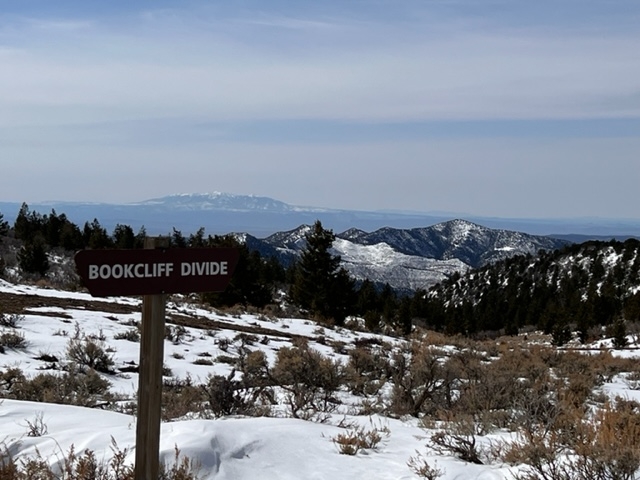
“It is a very special place. It is a unique place. It is the only place in Utah that you can truly have a backcountry pack-in,” he said, urging the Trust Lands Administration to only sell it to state wildlife officials so they can preserve it for future generations.
The Grand County Commission also wrote a letter of “strong support” to the Trust Lands Administration board, saying the sale would help “keep habitat intact, protect wildlife migrationcorridors, and preserve remote, non-motorized hunting and fishing opportunities with low-impact public access — all while allowing the Trust to realize immediate financial benefit.”
Utah Division of Wildlife Resources spokesperson Faith Jolley issued a statement to Utah News Dispatch on Monday, noting that the $50 million appropriated by the Utah Legislature to the division was “specifically for the purchase of large trust land parcels to secure hunting, fishing and public access on these properties into the future.”
“This property provides important habitat for deer, elk, bison, and many other wildlife species, and it is crucial to ensure this area remains available for wildlife,” Jolley said. “If purchased, this property would be managed as a wildlife management area, and would provide additional hunting and fishing opportunities on this property for the public into the future.”
Salt Lake City, UT