Critics warn of years in prison for young adults under carjacking bill before Congress
Jun 09, 2026 | 5:00 am ET
Description
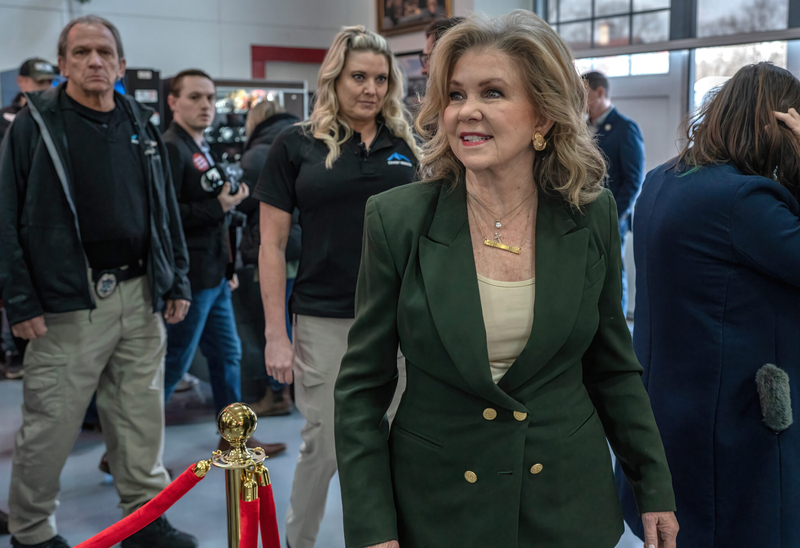
U.S. Sen. Marsha Blackburn, pictured in a December 2025 file photo. Blackburn, a Tennessee Republican, sponsored a bill aiming to make it easier for prosecutors to win convictions in carjacking cases. ((Photo by John Partipilo/Tennessee Lookout)
By Elena Tittel/Medill News Service
WASHINGTON – A North Carolina jury convicted a man for carjacking a truck from a McDonald’s parking lot by holding something “cold and hard” on the driver’s neck. A federal appeals court overturned the conviction in 2016, citing insufficient evidence.
“The evidence was insufficient to support a rational finding beyond a reasonable doubt that (Kenneth) Bailey possessed the specific intent, conditional or otherwise, to kill or seriously harm his victim when he took control of the vehicle,” a panel of the U.S. Court of Appeals for the 4th Circuit wrote in its ruling.
Cases like that inspired some in Congress to propose a federal law that would make it easier for prosecutors to convict people of carjackings. That could result in harsher sentences, even the death penalty.
People younger than 25 make up most of the carjackers, causing advocates and Democratic legislators to argue that a lower threshold for proving carjackings could result in many young adults, especially Black men, spending decades in prison.
“These tough on crime, really extreme sentencing schema don’t really work, and they only end up incarcerating more youth and perpetuating racial disparities," said Malik Pickett, a senior attorney at the Juvenile Law Center, a nonprofit public interest law firm and national advocacy organization.
The bill, dubbed the Federal Carjacking Enforcement Act, was introduced on May 1, 2025, by Sen. Marsha Blackburn, R-Tenn. The Senate Judiciary Committee on April 30 advanced the measure with an 18-4 vote. But the measure has not yet faced a floor vote. An identical House version introduced by Rep. Barry Moore, R-Ala., in November has not had any action yet.
According to data reported by the Council on Criminal Justice, across nine U.S.cities, carjackings rose during the COVID-19 pandemic and peaked in 2023. Since 2024, carjackings have declined.
In Washington, D.C., which has a higher-than-average carjacking rate, there have been 1,751 carjacking offenses between January 2023 and the end of May 2026, 1,273 of which involved a firearm, according to the Metropolitan Police Department.
Proving intent
The federal carjacking statute first came into effect in October 1992. On Sep. 13, 1994, the statute was amended to include “Whoever, with intent to cause death or serious bodily harm takes a motor vehicle” and added the possibility of the death penalty in cases when someone was killed.
However, some lawmakers said the need to prove intent made it difficult for prosecutors to convict carjackers.
“We need to make it easier for federal prosecutors to combat and prevent carjackings,” Blackburn said in a statement following an April hearing. “My Federal Carjacking Enforcement Act would make our streets safer for Tennesseans and all Americans by fixing a broken statute that has hindered federal prosecutors from holding carjacking offenders accountable.”
The bill would change the required standard of proof so that prosecutors would instead need to show a defendant acted “knowingly,” rather than needing to prove the defendant acted “with intent” to cause harm.
In some previous cases, prosecutors failed to prove intent, making prosecution difficult. For instance, in the North Carolina case, Kenneth Lee Bailey Jr. stole someone’s truck in a McDonald’s parking lot. In Bailey’s testimony, he claimed he approached the witness’s car and asked for a ride, promising payment. However, when the witness refused, Bailey forced his way into the car and placed something “cold and hard” on the driver’s neck. The prosecutor failed to prove that it was a weapon.
Intent requires prosecutors to prove that the defendant wanted to inflict harm, whereas knowingly only requires the prosecutor to prove the defendant was aware that their actions would result in harm, even if that was not their goal.
“Federal prosecutors shouldn’t have to read minds to put dangerous criminals behind bars,” Moore said in a press release.
Penalties for carjackings too harsh, some argue
People convicted of serious carjacking crimes can face between 15 to 25 years in prison, depending on if serious bodily injury results. If death results, the defendant could face life in prison or the death penalty, the statue states.
Sen. Cory Booker, D-N.J., said during the April hearing that easier convictions and stricter sentences for carjackings might do more harm than good.
“Federal prison does not put young people on a better path,” Booker said. “Carjackings are a serious crime … but I think here this bill is doing some things that have been proven to be misguided, that undermine a sense of fairness and decency.”
Youth criminal justice advocates argued against the change in the federal carjacking legislation to make it stricter.
Carjackings “are traditionally local offenses that should be left in the hands of communities,” said Liz Komar, senior policy counsel at The Sentencing Project, an advocacy group. “They don't need more aggressive federal penalties.”
Young people convicted
Research from The Sentencing Project shows carjacking convictions disproportionately involve young adults. From 2020 to 2024, nearly half of carjacking convictions involved individuals 24 or younger.
Data from the Council on Criminal Justice also shows that Black men are disproportionately convicted of carjackings. Between 2018 and 2022 across 10 U.S. cities, the Black offending rate was higher than the white offending rate for carjacking, robbery and motor vehicle theft.
Komar said that young people committing these crimes might not realize what they are doing is a serious crime.
“I think we've seen on social media, particularly in some cities, for carjacking to be related to young people engaging in risk-seeking behavior who don't understand that what they're doing is a crime,” Komar said. “They're certainly not entering into it with the intent to seriously harm someone and then spend decades in prison, and nonetheless, that's what may result.”
Democrats and youth advocates argued against the new legislation, citing research that showed that for those convicted under the age of 25, their brains are still developing. Research cited by The Sentencing Project has shown that young people are most at-risk for committing crimes in their late teenage years to their mid-twenties, raising questions as to whether lengthy prison sentences are appropriate for young defendants
However, this hasn’t stopped federal prosecutors from prosecuting youths and imposing long sentences:
- In January 2020, 19-year-old Elijah Roberts from St. Louis was sentenced to 11 years and two months in federal prison for his involvement in a February 2018 armed carjacking, which would have made Roberts 17 at the time.
- In May 2025, 20-year-old Bryant Hoskins and 19-year-old Samuel Fancher, Jr. of Indianapolis were sentenced to 17 years in federal prison each after pleading guilty to two counts of armed carjacking that took place in May 2024.
- In April 2026, 21-year-old Jaquell Blackwell – a member of the “5zzly” crew, a Bronx-based gang – was sentenced to 63 months in prison for committing three armed carjackings. Another member, 21-year-old Abodul Azika, was sentenced to 87 months in December 2025 for his participation in an armed carjacking with Blackwell and two other armed carjackings. The carjackings took place between June 2022 and June 2023, which would have made the men around 18 at the time.
Difficult to be released
Once incarcerated, it can be difficult to be released. Deandre Govan in February 2024 was sentenced to nine years in federal prison at the age of 21 for a string of armed carjackings he committed three years prior. His motion for compassionate release was denied on March 11, 2026.
In his motion, he argued that these offenses were committed prior to the age of 25, “placing him squarely within the class of youthful offenders now recognized by the Sentencing Commission and courts as possessing heightened capacity for rehabilitation.”
The U.S. Sentencing Commission, an independent federal agency, was created to respond to widespread disparity in federal sentencing.
Govan also argued that the effects of the COVID-19 pandemic made his sentence more severe than the U.S. District Court for the Southern District of Indiana originally intended and that he had “endured prolonged lockdowns, suspension of rehabilitative programming and heightened exposure to illness all while suffering from multiple mental health condition[s] which he was diagnosed [with] as a child,” according to court filings.
Still, the court ruled that such circumstances do not constitute extraordinary and compelling reasons for release.
Medill News Service articles are reported and written by graduate student journalists in the Washington program of the Medill School at Northwestern University.
All States Newsroom content is free to republish. Read our republishing policy for more information.