Nebraska DHHS reviewing federal rule on Medicaid work requirements, declines call to ‘press pause’
Jun 05, 2026 | 6:15 am ET
Description
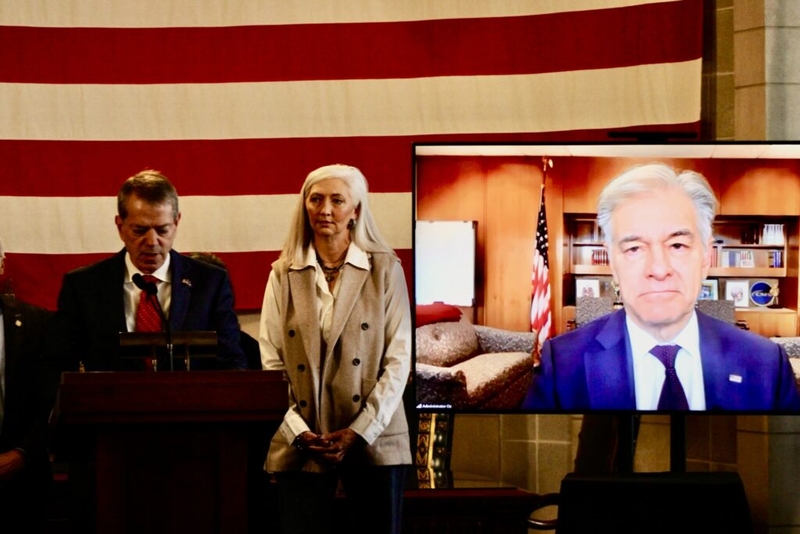
Nebraska Gov. Jim Pillen in December announced that Nebraska would be the first state in the country to start implementing new federal work requirements for Medicaid health insurance recipients. The launch is Friday, May 1. Pillen appeared with a virtual Dr. Mehmet Oz, administrator of the federal Centers for Medicare and Medicaid Services. (Juan Salinas II/Nebraska Examiner)
LINCOLN — Nebraska became the first state to implement new federally mandated work requirements for Medicaid recipients in May, and the federal government this week released a first look at what all states would need to follow by Jan. 1.
The U.S. Centers for Medicare and Medicaid Services released its interim final rule on the work requirements Monday for public review. Local nonprofit Nebraska Appleseed blasted the proposal as more onerous than Nebraska’s requirements, implemented eight months early, and which the advocacy organization argues could lead to more hurdles down the line.
Broadly, the federal requirements mandate that certain adults receiving Medicaid who are between the ages of 19 and 64 will need to work, volunteer or attend school for at least 80 hours per month, earn at least $580 a month or qualify for an exemption.
Among those who are exempt are people who are pregnant, have a disability, are a parent or caretaker of a young child, or veterans with a total disability rating.
Collin Spilinek, a spokesperson for the Nebraska Department of Health and Human Services, said the agency is reviewing the new guidance “to determine what changes, if any, will be necessary to make.”
States face tight timeline as feds unveil new Medicaid work requirement rules
The state agency has said roughly 25,000 of the 72,000 adult Nebraskans enrolled through Medicaid expansion will eventually be subject to the updated work requirements to keep or get Medicaid coverage at their renewal period.
The federal proposal includes a new hurdle on top of Nebraska’s requirements, Appleseed argues, that “directly targets” people with disabilities, mental conditions or medical needs, such as cancer or HIV, by requiring Medicaid recipients who have serious medical needs or disabilities to “prove” a condition makes them unable to work to qualify for an exemption.
“This federal rule adds major and punitive new restrictions that will directly hurt Nebraskans, especially those with serious medical needs and disabilities,” said Sarah Maresh, Appleseed’s health care access program director, in a statement.
Maresh said Nebraskans were already “confused, scared and at risk of unnecessarily and inappropriately losing” health care because Gov. Jim Pillen decided to act early.
Collin Spilinek, a spokesperson for Nebraska’s DHHS, said the agency has been able to “successfully manage” the new workload of implementing the requirements with “no issues.”
“Staff members have the foundational expertise to absorb the new requirements without expanding headcount and have received targeted training specific to the work requirements, including new policy content, system workflows and verification standards,” Spilinek said this week.
Maresh and Appleseed urged DHHS to “press pause” and join the rest of the nation in implementing requirements by January 2027. Spilinek said there are “no plans” to do so.
“People’s lives are on the line,” Maresh said.
In April, days before Nebraska moved ahead with the work requirements, Drew Gonshorowski, director of the state’s Division of Medicaid and Long-Term Care, told KETV the changes are meant to promote workforce and curb Medicaid misuse.
“Our commitment here is to ensure that our members receive coverage long term,” Gonshorowsk told KETV at the time. “And we will work with our providers to ensure sustainability of our systems.”
Lincoln, NE