Rhode Island’s housing policy needs fundamental changes to produce real returns on investment
Jun 05, 2026 | 5:15 am ET
Description
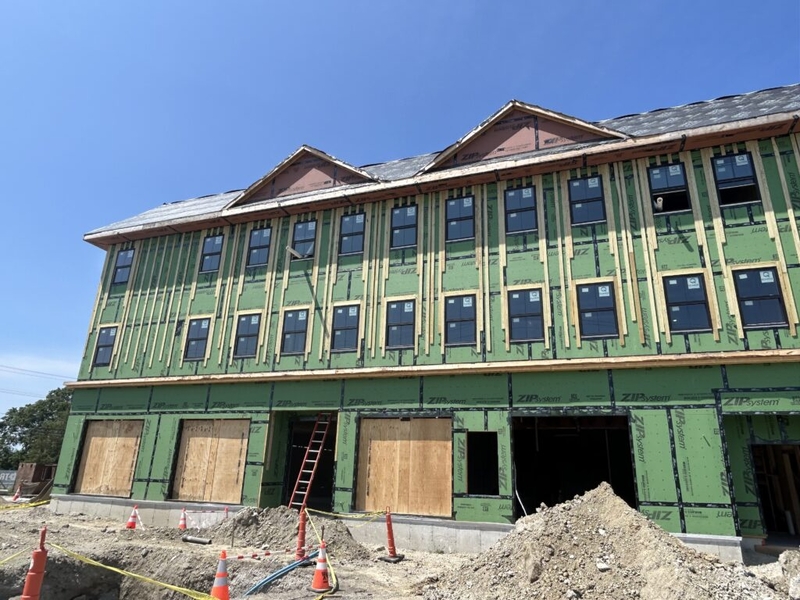
Rosebrook Commons, a 144-unit mixed use mixed income apartment development with 23,000 square feet of small business ground floor commercial retail and community space on West Main Road in Middletown, is shown under construction in July 2025. (Photo by Janine L. Weisman/Rhode Island Current)
In response to Rhode Island’s daunting housing affordability challenges, state policymakers have advanced key policy initiatives. They enacted numerous land use reforms, resulting in a substantial uptick in building permits. They transformed the state’s fragmented governance model with a more centralized strategy under a newly established Executive Office of Housing. And they’ve made enormous capital investments over the last several years and dedicated new streams of revenue to housing, addressing decades of historical underinvestment by the state.
While progress has been made, it hasn’t been felt by the vast majority of Rhode Islanders.
Unfortunately, most of the generous taxpayer investments for housing have been funneled into high-cost programs that prioritize secondary goals — like green building mandates and renovating historic buildings — and that focus heavily on units for the lowest income households. By design, these programs produce relatively few affordable units and little or no units for middle-income households. Consequently, these investments have helped relatively few Rhode Islanders and have made no meaningful impact on the state’s overall housing challenges.
The remarkably low return on investment is evident from the most recent funding round of affordable housing projects. This April, $52.2 million from the 2024 housing bond and other state and federal one-time sources financed 200 newly constructed units, of which 184 are affordable to households earning less than 80% of area median income ($91,200 for a family of four), with no units for middle-income households. The units had an average total development cost of $512,377, with the state subsidizing 51% of the cost at $283,782. The average cost of these units is roughly 50% higher than the average cost of construction in the private market, based on a recent survey of new multifamily properties for sale in Rhode Island.
While progress has been made, it hasn’t been felt by the vast majority of Rhode Islanders.
If we continue on this course, the 2024 housing bond ($120 million) and the proposed 2026 housing bond ($120 million), if approved, are projected to yield just 642 net new affordable rental units. Including these housing bonds, the cumulative investment of $522 million since 2021 is expected to produce 2,207 affordable units, which addresses only 9.6% of the state’s total affordable housing deficit of 23,222 units. To fully bridge the housing shortage at current subsidy levels would require nearly $6 billion — the equivalent of 50 consecutive $120 million bond measures.
The state cannot continue to fund a model that produces so little at such a high cost. To truly address the state’s housing needs and ensure a real return for taxpayers, several changes should be considered.
First, the General Assembly should require that at least half of future bond issues be allocated to develop middle-income housing units, which can increase overall supply more efficiently and help lower housing prices statewide.
Second, the state should overhaul its housing policies to maximize the production of housing units by imposing strict limits on development costs and deemphasizing supplemental policy objectives.
Third, the General Assembly should streamline roles and responsibilities between the Executive Office of Housing and Rhode Island Housing to generate savings and consolidate the overly complicated, multiplicity of housing production programs.
Finally, policymakers should explore alternatives to create housing affordability, including rental assistance, public development programs, and subsidies to market rate developers.
Rhode Island has a historic opportunity to address our housing affordability challenges, but we cannot afford to stubbornly double down on a high-cost, high-subsidy model that is clearly not working; we must instead pivot to a strategy built on maximizing the state’s housing dollars in order to effectively meet the housing needs of all Rhode Islanders.
Providence, RI