Alsobrooks, public health advocates warn of HHS ‘leadership vacuum’ under RFK Jr.
Jun 03, 2026 | 3:08 pm ET
Description
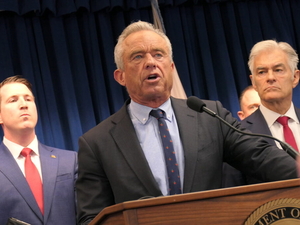
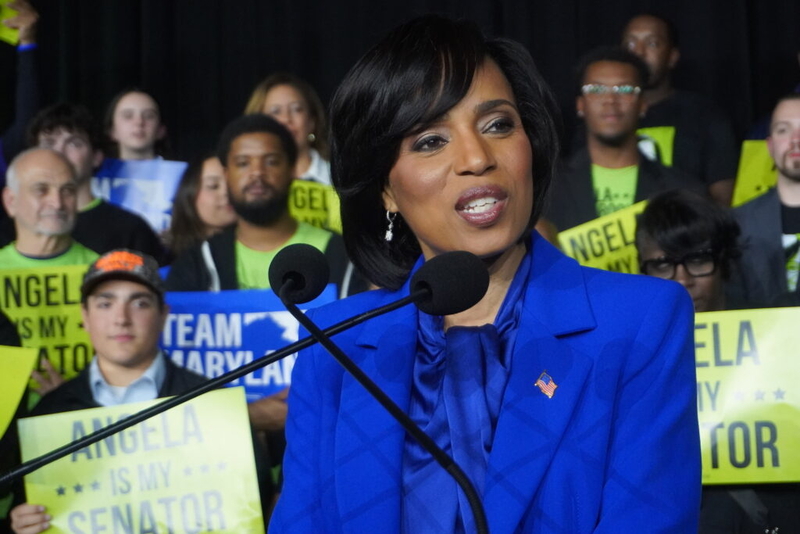
U.S. Angela Alsobrooks has been a leading voice in calling for U.S. Health and Human Services Secretary Robert F. Kennedy Jr.'s removal or departure for over a year. (Photo by William J. Ford/Maryland Matters)
U.S. Sen. Angela Alsobrooks (D-Md.) has called for the removal of U.S. Health and Human Services Secretary Robert F. Kennedy Jr. from his position for over a year, but hammered that message once again this week as a number of highly dangerous infectious diseases emerge across the world.
Alsobrooks said that leadership at the federal Department of Health and Human Services is needed now more than ever, especially during this “critical time” when deadly outbreaks of hantavirus and Ebola pose international public health threats.
“It is an unmitigated disaster that could have, and should, have been avoided,” Alsobrooks said Tuesday during a virtual conference with Protect Our Care, a nonprofit organization supporting progressive health care policies.
She joined several health care advocates warning about a “dangerous leadership vacuum” at the various agencies operating under the HHS, including the Federal Food and Drug Administration and the Centers for Disease Control and Prevention that have officials leading in an “acting” role, rather than serving in a permanent capacity.
“We are at a critical time,” she said. “I think this is going to impact our country for decades and it really did not have to be this way.”
There are 11 acting directors overseeing operations at the CDC, while five top staff positions remain vacant. At the FDA, there eight acting officials, including the acting commissioner Kyle Diamantas, and vacancies for the principal deputy commissioner and the associate commissioner for minority health.
“How shameful it is, at a time when the worse measles outbreak in decades is still raging, and as Ebola and hantavirus threaten the globe, there is no one in control in these critical positions,” Alsobrooks said. “He (Kennedy) is filling these seats with people who are loyal to the administration, but not necessarily loyal to the American people.”
Her comments come as federal officials continue to monitor Americans who were passengers on a cruise ship where a hantavirus outbreak was detected in May. Meanwhile, a severe outbreak of Ebola emerged in the Democratic Republic of the Congo, emphasizing the need for coordinated public health efforts among national leaders to help contain the disease.
HHS bucked the characterization that its agencies were unable to attract qualified individuals to lead in top positions, saying that there “is no shortage of highly qualified candidates eager to serve at HHS.”
“The progress HHS has achieved over the past year has been historic, and the Trump Administration continues to attract highly qualified and accomplished candidates ready to advance President Trump’s mission to Make America Healthy Again, including at the CDC, FDA, and OASH (Office of the Assistant Secretary for Health),” said Emily G. Hilliard, press secretary with the department, in a written statement Wednesday to Maryland Matters.
But Alsobrooks and other speakers with Protect Our Care said that under Kennedy, various agencies within HHS underwent mass layoffs that will affect the nation’s ability to respond to current and future public health concerns. The Trump administration has also reduced funding for research and prevention of diseases like Ebola and recently ousted top officials with the National Institute of Allergy and Infectious Diseases.
In a written statement, Protect Our Care said that the leadership vacuums “comes on top of a series of deeply short-sighted decisions the Trump administration made that left them ill-prepared to deal with the latest global health threat and keep Americans safe.”
Maryland ranked high among states for public health preparedness, but could be doing more
Demetre C. Daskalakis, the former director of the National Center for Immunization and Respiratory Diseases within the CDC, said that the disruption in leadership at United States agencies could threaten future public health mitigation efforts.
“Preparedness depends on people, you can have plans on paper,” Daskalakis said. “But without experienced epidemiologists, laboratorians … communicators, data teams, field staff, it collapses when it’s most needed.”
Alsobrooks said it’s been “heartbreaking” to see the “decimation” of these agencies, some of which are located in Maryland.
“Maryland stands for the very principle of excellence in public health, in research, in science, in medicine,” she said. “What we’ve seen over the last year is the slow deterioration of an excellence of standard that I think will set back our country, and by extension, harm people all across the world.”
Annapolis, MD